
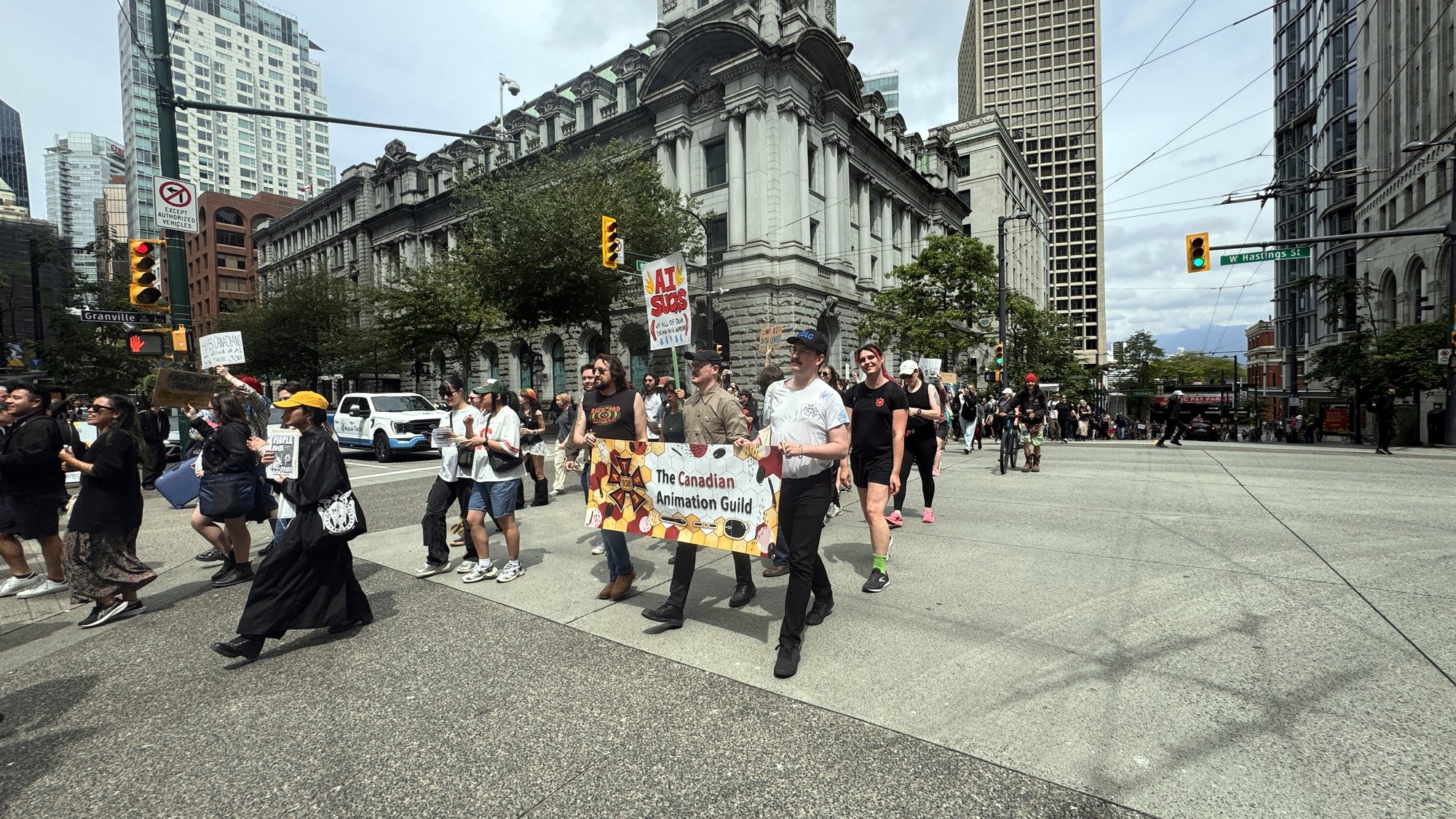
Lead photograph, from the archive: Vancouver’s AI and data-centre protest, May 23, 2026. Photograph: Kris Krüg. View the May march photographs.
You can book the Nest. You still have to deal with the people whose house it is.
On November 2, students protested Global Summit AI Vancouver at UBC’s AMS Nest. Their Instagram announcement and r/UBC callout called for pots, pans, instruments and art supplies: a noise rally from eleven to one, followed by art and discussion. The argument was specific: why should their student union building provide a stage for companies whose power and conduct they want challenged?
David Allison encountered the protest on his way to speak to a UBC class. He admired the students for standing up publicly for their values. A participant replied that they were protesting the international tech conference in their own student building. Another reply clarified the concern about AI and the technologies built around it, including weapons.
From the Nest, November 2: Watch David Allison’s protest reel on Instagram. Video: David Allison.
A crowd does not need to shut down a conference to expose a problem with the way an industry enters a community.
I’m stoked about these technologies. I’m fucking concerned too.
I run BC + AI. I build with AI, teach with it, make things with it, and bring people together around it. I also moderated a panel for this summit’s organizers at their spring event. That relationship matters here. I want the work inside these rooms to succeed. I want the people outside them to have a meaningful say in what success means.
Canada’s AI rollout is at risk of losing its social licence: the public trust and acceptance that let this work take root. People need a say in the terms: what gets built, what gets used, who pays, and how a bad decision gets reversed. A rollout that outruns those conversations can burn trust faster than any workshop can rebuild it.
The building is part of the argument
The summit’s advertised speakers include people from Nvidia, Meta, Anthropic, Microsoft, Google and Cisco, alongside researchers, Canadian companies and other practitioners.
The coalition behind the protest includes NoAI UBC Committee, Climate Justice UBC, the UBC Social Justice Centre, Palestine Solidarity Action and UBC Greens. Their announcement names Cisco and Nvidia and challenges surveillance, military uses and harm to people and the environment. Palestine solidarity is central to their statement. These students are asking what the companies building AI are doing with their power, including whose lives their technologies put at risk.
The place matters. A student union building carries a social meaning that a conference booking cannot purchase. Students use it, organize in it, and understand it as theirs. Booking a room does not settle what its community is willing to host.


Read the summit program and protest call
The summit lists November 2 and 3; the protest call linked here is for November 2. Read the agenda, speaker roster and protest coalition’s announcement.
A paid booking can coexist with a failed relationship.
I’d want to hear the organizers’ account of their outreach too. The public dispute cannot tell us every conversation that happened beforehand. It can tell us that some of the people who use this building felt strongly enough to organize against the event. A venue contract does not resolve that relationship.
I understand why ticket-holders want to get on with the program. They paid to learn. Researchers and small companies have reasons to want these conversations. A noise rally can make somebody’s day harder, including somebody with very little control over the decisions being challenged.
I still think showing up matters. Peaceful protest is one of the ways people with less institutional access force a question onto the agenda. I know the noise is inconvenient. I also want to know what made people bring the pots.
Three days before the Nest protest, Naomi Klein and Catherine Warren were in conversation at Futureproof. Klein described young people hustling online while doubting they’d ever find a secure job. She connected that pressure to AI companies treating their creative work as material to mine. Later, she argued against consumer purity tests. A person can use AI and still want deep changes in the industry behind it.
In May, Ian Bogost wrote in The Atlantic about students booing AI at American commencements. He connected the reactions to university incentives and uncertainty about graduates’ futures, while resisting a tidy explanation of what every boo meant. The Nest students have made specific demands. Those deserve the same care.
I’ve been following this argument all year
In May, I walked with Vancouver’s first big anti-AI march. I photographed signs about water, jobs, creative work and the right to think for yourself. What stayed with me was how young the crowd was. People being promised an AI future were already arguing over the terms.

Some of the chants were blunt enough to make an AI conference organizer flinch. I work with these tools every day and found a lot of the concerns familiar. Artists were asking about consent and compensation. Young people were asking what happens to the work through which they expected to build a life. Residents were asking who had decided that their neighbourhood should help power this industry.


By August I had written Both Hands on the Power Cord. The phrase matters because following AI’s power cord takes you out of the software demo and into electricity, water, land, ownership and public decisions. A useful chatbot can sit at the far end of a very contentious arrangement.
Then came ALL IN in Montreal. I went as media, moved between the conference and the street, and wrote about both. There was serious research and useful work inside. Outside, people were making arguments the program could not contain.

On October 26, GeekWire’s Todd Bishop reported climate protesters interrupting Seattle AI Week’s opening panel. Jobs, energy and the costs borne by communities were central to their case. A week before the Nest rally, another West Coast AI gathering was confronting questions about who gets to set the terms.
In my BC + AI essay after Montreal, I argued for places where people could learn, experiment, disagree and influence a decision while it could still change.
The Nest brings that question home. How often are we inviting people to shape the future, and how often are we inviting them to sit through its announcement?
The concern reaches well beyond the rally
These concerns reach far beyond the students in one atrium. The polling makes that clear, while also showing where Canadians disagree.
The Angus Reid Institute’s May survey of 1,803 Canadian adults found 68 per cent wanted heavy regulation of AI and technology companies even if it slowed development. Seventy per cent favoured caution in government adoption because of unintended consequences. Seventy-four per cent doubted any government could keep pace with the technology.
That is a difficult mandate: protect us from something we doubt you can control.
A separate Léger survey of 1,505 Canadians in July found 81 per cent concerned that AI data centres could raise household electricity bills and 79 per cent concerned about environmental impacts. Yet 46 per cent called their development a good thing, against 37 per cent calling it a bad thing. Support for development in respondents’ own province was almost evenly divided, 44 to 42.
Concern can coexist with support
| Léger, Canada, July 2026 | Respondents |
|---|---|
| Concerned about household electricity bills | 81% |
| Concerned about environmental impacts | 79% |
| View AI data-centre development positively | 46% |
These surveys measure different questions in different months. They cannot tell us who supports this rally or establish a consensus across political groups. They do make it hard to dismiss concern as a fringe position.
The mixed answer is the part worth hearing. People can see a benefit and still demand limits. Using a tool does not settle what infrastructure to subsidize, which institutions should deploy it, or how much authority its owner should have.
My enthusiasm does not require me to sign a blank cheque. Neither does anybody else’s.
We already tried explaining the tools harder
In July, on the BC + AI blog, I wrote The AI Trust Gap Is Not an Education Problem. It drew on the SFU Dialogue on Technology survey, which found awareness and use rising in British Columbia while concern rose too. Seventy-nine per cent were more concerned than excited about AI. More than three quarters distrusted technology companies to develop it with the public’s wellbeing in mind.
Those are B.C. findings. The comparison with 2024 does not prove that learning caused concern. It does make the easy sales story harder to sustain: show people more AI, and they will naturally trust the people selling it.
I teach this stuff. Learning can help somebody discover a capability they love. It can also help them recognize a deployment they want stopped. Both are useful outcomes of an education.
If a workshop only counts as successful when somebody adopts the product, we have quietly made the vendor’s objective the student’s objective.
A teacher should be able to say this tool does not belong in this classroom. A worker should be able to challenge a system used to judge their work. An artist should be able to ask what happened to their source material without being told that the future has already voted.
People need enough understanding and enough authority to make those judgments count.
Ottawa has named trust. Now it has to earn it
ALL IN is a conference. AI for All is Canada’s federal strategy. Keeping the names straight matters, because a summit organizer and a government carry different responsibilities.
The strategy acknowledges job security, privacy, sustainability, sovereignty and trust. It puts protection and public participation alongside adoption and Canadian industrial capacity. There are reasons to want that ambition to work. Dependence on foreign infrastructure and platforms leaves Canadian researchers, businesses and public institutions with choices they may not control.
But the strategy also ties the benefits of AI to wider adoption. That makes it tempting to treat public trust as something to produce so the rollout can proceed.
Trust has to remain a judgment people can withhold. Otherwise the invitation to participate comes with the answer already filled in.

Listen · CBC Radio · 7:48
The federal strategy, from here in B.C.
Ottawa has made more specific commitments too. On September 3 it announced Responsible Data Centre Development Principles: local benefits, protection from shifted electricity costs, reduced water and environmental impacts, transparency and strategic value for Canada. OpenAI, Anthropic, Meta, Microsoft, Google and other companies are among the listed signatories.
Good. Those are subjects people have been raising in the street. Now a host community needs to see how a particular project meets them, who checks, who answers a complaint, and what happens when a commitment is missed. A national announcement cannot answer every local question in advance.
Sovereignty has to reach the people living with it
There is a version of sovereign AI where the servers move to Canada and almost nothing else about power changes. Canadians supply resources and public support while renting access to systems whose terms are set elsewhere.
I want a more demanding version. Who owns the infrastructure? Who governs the data? Can a public institution change suppliers without losing the work it built? Who gets the durable benefit, and who carries the bill when the projections miss?
Watch · From the interview archive
Who benefits from compute?
When we talk about OpenAI, Anthropic, Meta, Nvidia or Palantir, name the product, contract or deployment we’re arguing about. Follow the money and the authority. A useful product can come from a company whose other decisions deserve a fight. Enthusiasm for one capability is a lousy substitute for examining the deal.
The same care applies to Canadian companies. A Canadian address does not establish a fair arrangement. A maple leaf does not tell a worker whether they can contest a decision or tell a host community how much power a facility will draw.
And Canada’s sovereignty cannot stand in for the rights and decisions of Indigenous Nations. In the Montreal follow-up I wrote about Jeff Ward, Animikii and the work presented with Sandy Bay Ojibway First Nation. That example starts with authority over the community’s own information. Indigenous leadership has its own terms and rights; it cannot be folded into a general public-engagement exercise and declared satisfied.
The principle I want to carry from that work is respect for who has the authority to decide. A student protest, a municipal hearing and a Nation’s governance are different situations. Treat each seriously on its own terms.
Give people something they can change
We have some experience with the difficulty of making participation matter. Our AI Ethical Futures Lab worked through Ottawa’s transparency questions with about twenty people in Vancouver. Peter Van Garderen facilitated, Tanya Slingsby hosted at Parker Street Studios, and Sara Taherzadeh brought the findings together. The public record preserves the process and its doubts.
One of those doubts was whether the consultation would change anything. People were wary of giving their time to a process that made them feel heard and left the decisions untouched. The follow-up asks ISED to say which recommendations it accepts, defers or rejects, and why.

That is a practical place to start. Show the connection between what people said and what happened next.
For an event, engage the people who use the building before the program is locked. Let them choose their own representatives. Make participation possible without an expensive ticket. Pay people for substantial preparation and facilitation. Give the conversation room to change a session, an invitation, a sponsorship arrangement or the way the event uses the space. Publish what changed, including where agreement was impossible.
For a data centre, put the local terms where residents can inspect them: resource demands, infrastructure costs, promised jobs, public support and who is responsible for each commitment. Make the costs of monitoring and correction part of the project. A community should not have to fund its own investigation to learn what it has been asked to host.
For a school, workplace or public service, give the people affected a role in deciding where AI belongs. Establish records, human review and a workable route to challenge consequential decisions. Where an alternative is needed, fund it. An appeal that nobody has time or authority to answer is another decorative promise.
For public investment, fund the capacity to question and govern alongside the capacity to adopt. Teachers, worker organizations, libraries, artists and community groups need people and time to do this work. They cannot all survive as volunteer advisers to a well-funded rollout.
None of this guarantees agreement. Serious engagement can produce a refusal. Any process that cannot survive that possibility has very little to offer the person being consulted.
The standard applies to my rooms too
I organize events. I know the schedule, the venue bill and the speaker who has somewhere else to be. I know how quickly the person asking the difficult question can become, in an organizer’s head, the thing standing between this room and a successful evening.
That is exactly the instinct I want to catch in myself.
If I say our community welcomes skepticism, the evidence has to include what we change after hearing it. A microphone is useful. So are a clear sponsorship disclosure, a recorded disagreement and a decision somebody can point to later. The word community earns its keep through that work.
I want people building extraordinary things to have places to show them. I want researchers and small companies to meet collaborators. I want Canada to develop more of its own capability. And I want the person worried about their job, their water, their art or their kids to have enough power in the process that listening to them carries consequences.
The students in the Nest have forced that conversation back into the room. I am glad they showed up.
Canada can keep describing its AI future at conferences. Earning a social licence means being willing to let the people who live here change what gets built.
If the only future on offer is one we are allowed to applaud, expect more pots and pans.
From the archive
- You Can’t Drink Data · Vancouver march and photographs · May 23
- The AI Trust Gap Is Not an Education Problem · July 20
- Both Hands on the Power Cord · CBC and Power Struggle · August 3
- Champions, Saplings, and Chalk on the Sidewalk · ALL IN Montréal · September 16
- What BC Can Bring to Canada’s AI Future · September 20