
Notes from my first anti-AI protest, and why both sides of this fight keep missing the same thing.
I went to my first anti-AI protest today.
Say it again slowly, because the irony isn’t lost on me: I’m the AI guy. I run BC + AI. I vibe code something before my coffee’s cold most mornings. And this afternoon I was on Granville Street in a crowd of a thousand people chanting “Fuck AI” at the top of their lungs, and I was not there undercover.
I was there because they’re right about a lot of it. And because I think the people screaming “shut it all down” and the people promising “this changes everything, trust us” are making the exact same mistake. They’ve both decided the future is something that happens to us instead of something we build. I don’t believe that. I’ve never believed that. So I laced up and went downtown to march. I say a prayer about this most mornings, which is either funny or the whole point.
Here’s what I saw.
A thousand people made a thousand arguments, and most of them fit on a piece of cardboard. Here are the ones that stopped me.


Harbour Centre, 1:30 PM
The call was for 1:30 at Harbour Centre. I figured a couple hundred people. Anti-AI is still a niche thing to be mad about in public, right?
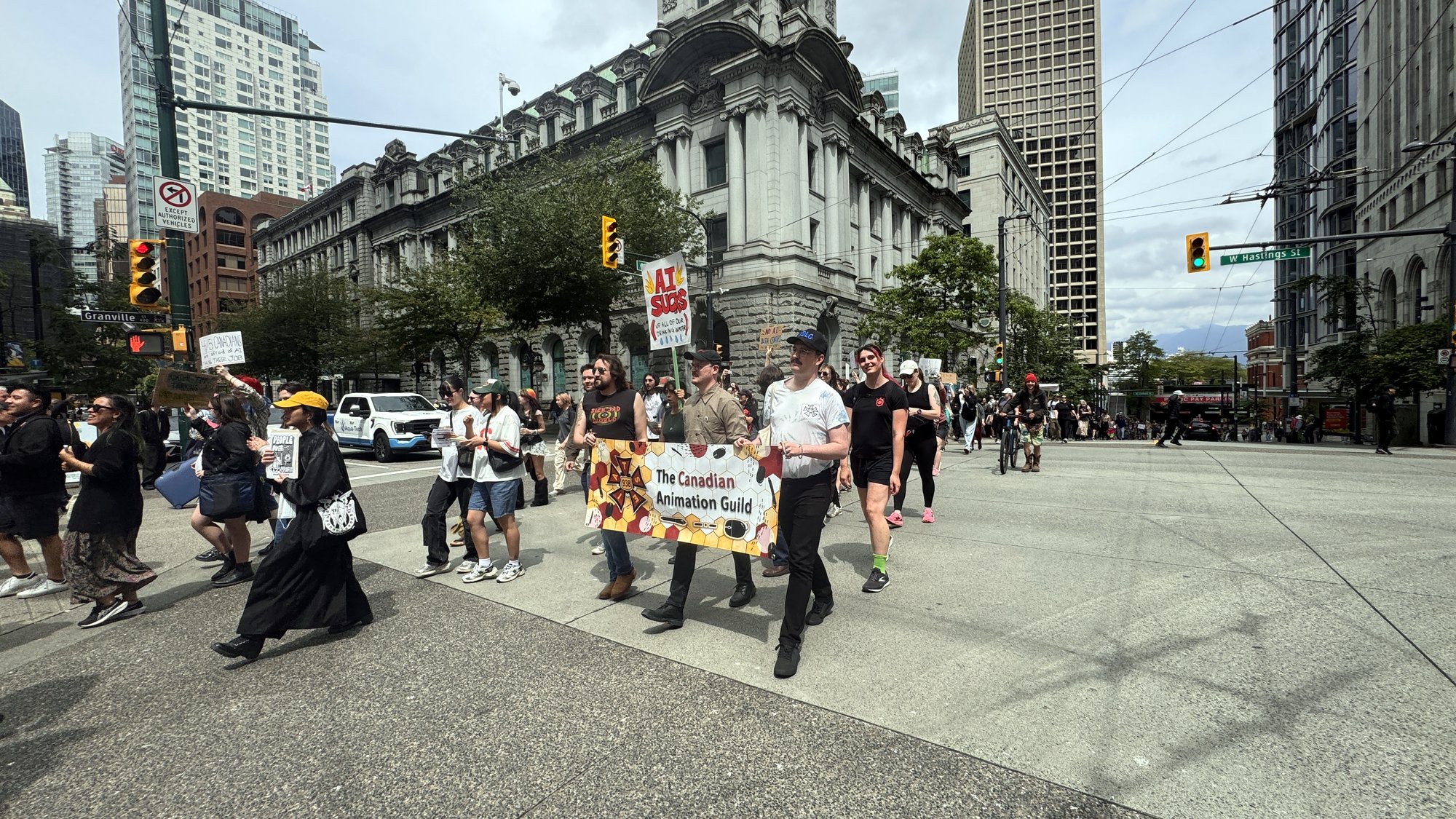
Wrong. By the time I got there it was 500, easy. Once the crowd spread out and I could actually see it, it was closer to a thousand. And the signs. I tried to photograph every one and gave up around a hundred. Somebody had turned a literal book about servers into a placard. Organizers were calling for the sign-holders to move to the front so the cameras would catch the message clean.

But the thing that stopped me wasn’t the size. It was the age.
I’ve been to a lot of marches. Women’s marches, anti-war marches, and God love them, those crowds are silver-haired. They’re my generation and my parents’ generation. This one was inverted. Most of this crowd was under 30. Half of them looked under 20. There were two girls near me who couldn’t have been older than 14.

I want you to sit with that, because it’s the most important fact of the day and almost nobody is reporting it that way. The generation that’s supposed to be the most “native” to this technology, the one the boosters keep telling me will ride AI into some frictionless future? That generation just filled the streets of Vancouver to scream at it.
That’s not noise. That’s a signal. And if you work in AI and it doesn’t rattle you, you’re not paying attention.
“AI Art Is Not Art”
The march moved fast and loud down Granville, taking up two full city blocks before long. The chants found their rhythm:

“Fuck AI.”
“Use your brain.”
“AI art is not art.”
People on the sidewalk joined in. At one point a guy on the curb got a whole “Fuck AI” call-and-response going and the street picked it up like a wave. I’ve helped start a lot of chants in my life. I know that feeling, and the energy was real.
Here’s the thing I kept turning over as I half-jogged to keep up with a crowd thirty years younger than me: every one of those chants is a legitimate argument wearing a slogan.
“AI art is not art” is a fight about consent and credit. It’s about models trained on the life’s work of artists who were never asked and never paid. I’ve made that argument myself, in rooms full of people who didn’t want to hear it. The only reason I learned to prompt at all is because Midjourney kept labeling Chinatown as “dystopia,” and if you want real representation you have to go train your own damn model on your own damn images.

“Use your brain” is a fight about cognition. It’s about a generation watching their own thinking get outsourced to a chatbot one homework assignment at a time.
These aren’t dumb kids being scared of the future. These are smart kids doing the math on their future and not liking the answer. More on that in a minute.
“We’re Gonna Take This Whole Fucking Bridge”
By the time we hit the Granville Bridge approach I could see flashing lights up ahead. Police had Drake and Granville blocked. They knew we were coming. What struck me was how few of them there were. Way fewer than I’ve seen at bridge takeovers half this size. I don’t think anyone in a uniform expected a thousand people to show up mad about data centres on a Saturday.

This is the part where I confess to a little elder sheepdogging.
I’ve done enough of these to know that a polite Canadian crowd will instinctively stay in its lane. Literally, one lane. And a march that stays in one lane never takes a bridge. So I worked the edges, helped widen the footprint, helped people understand it was okay to take the road. Cars honked. Some of it was rage and some of it was solidarity and honestly at a certain volume you can’t tell the difference and it doesn’t matter. It all feeds the crowd.
There was a Tesla. I’ll just say it’s remarkably easy to stop a Tesla by standing in front of it, and leave it there. A cop chased me out of the middle of the road, then parked himself in the next lane over and blocked traffic better than I ever could. We didn’t fully take the bridge. But for a few minutes, we owned the road.
And somewhere in there, the chant changed.
It stopped being only about art and brains and started being about infrastructure:
“No data centres.”
“Data centres, shut them down.”
And then one I hadn’t heard before.
You can’t drink data.
I stopped walking for a second when I heard that one.

Because here’s what almost nobody in that crowd knew: I’ve been quoting that exact math for a year. AI’s water consumption is projected to hit 1.7 trillion gallons by 2027. Meanwhile, 36 Indigenous nations in this country still don’t have clean drinking water. I’ve put those two numbers side by side in newsletters, in a letter to the federal AI Task Force, in talks where people stared at their shoes.
A 17-year-old just turned my footnote into a chant on a bridge. The kids are ahead of the policy.
They’re ahead of most of the industry, too.
Why They’re Right
Let me be clear about what these folks are mad at, because it’s specific and it’s fresh.
A week ago Ottawa announced roughly a billion dollars for three new data centres. Two of them right here in Vancouver. Nobody asked the city. Nobody asked the watershed. Nobody asked the 14-year-olds whose creative work is being scraped to train the thing, or the 22-year-olds whose entry-level jobs the thing is being built to do.
That last part is what keeps me up at night, and it’s the thread that connects to the age of that crowd. The junior pipeline is collapsing. The entry-level rungs, the research assistant, the junior designer, the first-year analyst, the kid who used to learn the craft by doing the grunt work: AI is eating all of them. So when a 19-year-old paints USE YOUR BRAIN on a pizza box and walks into traffic over it, that is not Luddism. That is a generation that has correctly identified that a billion public dollars is flowing toward the machines instead of toward them.
Our own theory of change at BC + AI starts from exactly this premise: AI has non-consensually disrupted careers, communities, and families across this province, and federal resources keep bypassing the grassroots builders to fund the incumbents. The protesters and I are reading from the same diagnosis. I just refuse to stop at the diagnosis.
Why “Shut It Down” Isn’t Enough
And here’s where I part ways with the loudest voice in the march. Gently, because I was in the march, and because I’d rather argue with people I’m standing next to than people I’ve written off.
“Fuck AI, shut it all down” is a feeling. It is a true, earned, righteous feeling. It is not a plan.
You cannot un-invent this. The models are open-weighted and seeding onto laptops in a hundred countries. A march doesn’t repeal a technology any more than smashing a loom repealed the textile industry. What refusal does do, and this is the painful part, is hand the whole thing to exactly the people the protesters trust least. If everybody with ethics walks away in disgust, the only people left building AI are the ones who were never going to ask the watershed in the first place.
But before anyone in a hoodie at a Vancouver AI meetup nods too hard: the boosters have the identical problem from the opposite direction. “More compute, more scale, trust us, it’ll trickle down” is also not a plan. It’s a pitch deck. Federal strategy picks the champions, funds the biggest players, and prays innovation drips down to the rest of us. It doesn’t. Six hundred and forty-five British Columbians answered the federal AI consultation, second only to Ontario, and got zero recognition in the final reports. I have the receipts.
Refusal and boosterism are the same move wearing different costumes.
Both of them decide the future is inevitable and hand the steering wheel to somebody else.
I don’t do that. I’ve never done that. The way I’ve said it to my own community a hundred times: AI is trained on stolen work without consent, and I’m more creative than I’ve ever been because of these tools. Both things are true. We walk forward holding both. We’re chasing the opportunities and we’re skeptical of the party line and we’re holding government and corporations to account, all at the same time, with both hands full. That’s not fence-sitting. Fence-sitting is comfortable. This is the opposite of comfortable. It’s just honest.
What I’d Build Instead
So if I’m not going to shut it down and I’m not going to cheerlead the billion-dollar megacentre, what’s the actual third thing? Because “we need some fucking vision around this” is the most true sentence I know, and vision without specifics is just vibes.
Here’s mine. This is the West Coast play, and most of it already exists.
Build it on clean power, or don’t build it. BC Hydro runs on a 98% renewable grid. If Canada is serious about “clean AI” instead of greenwashed AI, BC is the only credibly clean place in the country to put compute. The protesters chanting “you can’t drink data” and I want the same thing here: AI infrastructure whose water and power costs are a hard constraint, not a footnote. Notably, the BC government is already throttling speculative data-centre expansion with new electricity limits. The province is closer to the marchers than Ottawa is.
Govern it Indigenous-first, not Indigenous-as-afterthought. Carol Anne Hilton, CEO of the Indigenomics Institute, sits on our board with actual decision-making authority. Not as an advisor we consult when we remember to. We run on OCAP principles: Ownership, Control, Access, Possession of Indigenous data. The vision I keep coming back to is clean green compute, produced here, Indigenous-zoned. A pathway to reconciliation instead of one more extraction. You can’t drink data, and you also can’t keep building the future on stolen land and stolen water and call it progress.
Make consent the default, technically. My friend Philippe Pasquier at SFU’s Metacreation Lab trained an AI model on twenty years of my own street photography. Two thousand portraits, all mine, nothing stolen. We published the method, peer-reviewed, honorable mention at Ars Electronica. That’s not a thought experiment about ethical AI. It’s a working proof that artists can train on their own work and keep ownership. Philippe’s pitch to his students is the whole movement in four words: Stop being a user. Become a creator. That’s the answer to “AI art is not art.” Not less AI, but AI that artists actually own.
Distribute the compute instead of hyperscaling it. This is the direct answer to the data-centre fight. Sev Geraskin and April at the Economy of Wisdom Foundation are working with PolarGrid on distributed, real-time AI compute. A network that cuts cloud costs by something like 75% by spreading inference across many small nodes instead of one enormous thirsty building. You do not necessarily need a billion-dollar megacentre drinking the watershed. That’s a choice, made by people who profit from scale, not a law of physics.
Keep the value local. Build for 20 years, not for the exit. We’re a nonprofit. 250+ paying founding members, thousands of event-goers, training programs with 75–100% completion rates when the industry standard is 5–15%. We are not optimizing for a VC exit or maximum extraction. We’re building for two decades of community resilience and keeping the talent and the money here instead of draining it to Sand Hill Road.
And underneath all of it, the thing I actually believe: I don’t build systems that optimize humans. I craft spaces where humans can be gloriously inefficient, creative, and alive. AI is a mirror and an amplifier. You’re the original intelligence. DJs used to be called selectors. Generation is cheap now, taste is not, and your judgment is the whole game. That’s not a consolation prize for the kids on the bridge. That’s their leverage, if we build the thing right.
I Didn’t Show Up Empty-Handed
I made signs too. Mine were for the messy middle, the both-hands-full position that refuses to pick a lazy side, and I made them with AI, because we are the training data and pretending otherwise is its own kind of lie. Here’s the set:


On to City Hall
The march didn’t end where I thought it would. I figured Art Gallery, or a real bridge occupation. Instead somebody asked the crowd how they felt about taking it all the way to City Hall, and a thousand people said yeah, and off we went. “Shut it down.” “Data centres, shut them down.” “Resistance is justified.” Toward the seat of municipal government, which is honestly the right instinct. This is a civic decision. It should be made in public, by the public, near a watershed.

I parked illegally and stayed longer than I meant to. Worth it.
Here’s where I land. I want these folks to stay at the table, and protest is part of the table, maybe the most honest part. I marched with them today and I’ll march with them again, because the critique is real and a billion dollars landed on this city without anyone’s consent and somebody has to stand in the road about it.
And then on Monday I’m going to go build the alternative. Because a chant is not a data-centre policy, and a billion dollars is not a vision, and “shut it all down” and “trust the process” are both just ways of admitting you’ve given up on steering.
The digital future belongs to the people weird enough to imagine it differently. There were a thousand of them on Granville today.
They don’t know it yet, but they’re not the opposition. They’re the recruiting pool.
You can’t drink data. So let’s build the kind that doesn’t make us choose.
I’ll see you out there.

This is a first-person dispatch, reconstructed from audio I recorded on the march and my own photos. Crowd numbers are estimates and the chants are transcribed by ear. If you were there and I got a detail wrong, reach out and I’ll fix it. Errors are mine.