
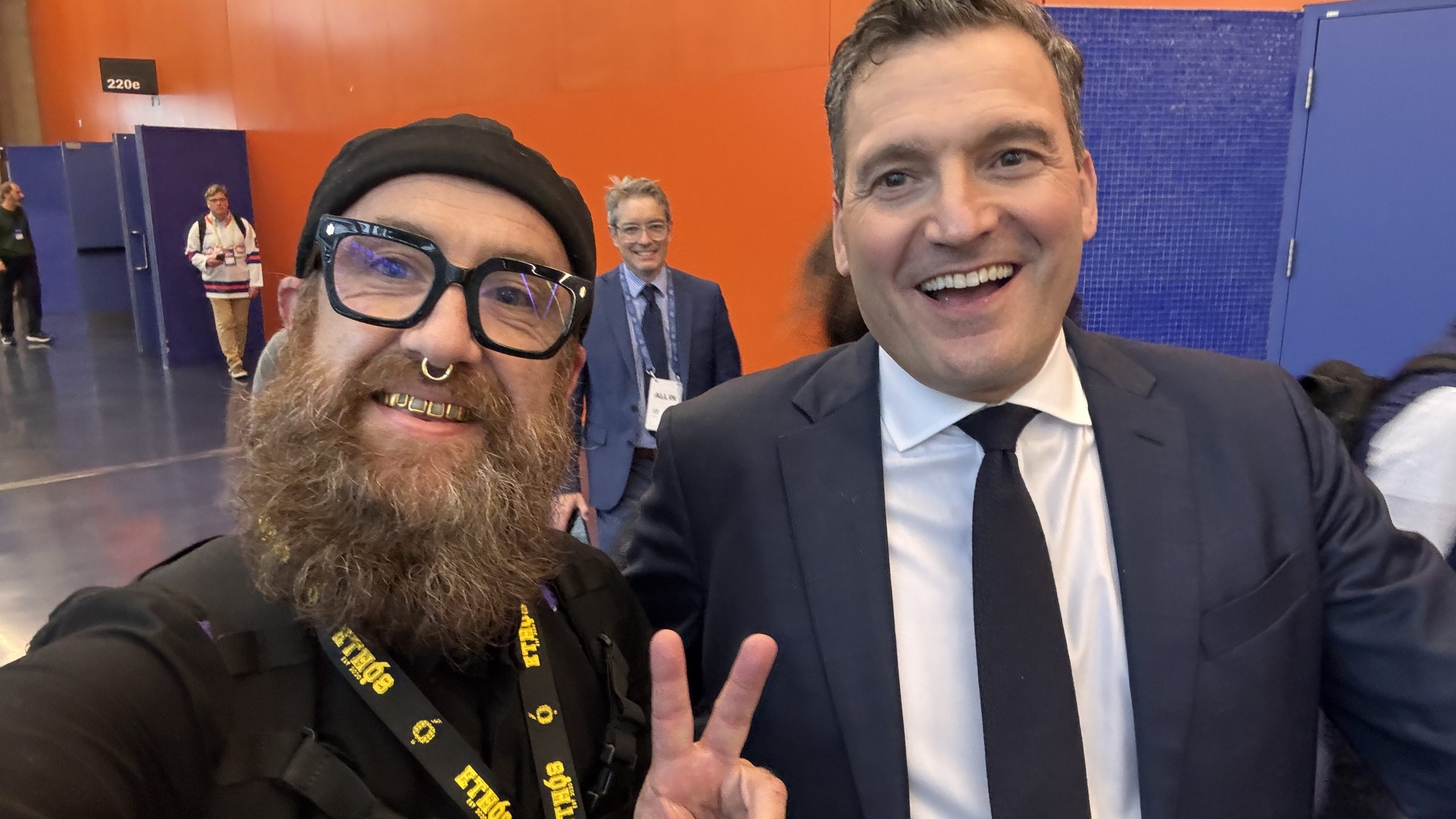
The heavy ones are always the worst.
ALL IN Montréal, day two: a bomb-squad backpack, five minutes with Justine Gauthier, two minutes with Evan Solomon, and the moment a BC + AI sapling showed up carrying paperwork.
The backpack disappeared while Edoardo De Martin, co-founder and CEO of Vancouver-based Industrio, was explaining how to prevent emergencies.
This felt on brand.
I had set it down beside a concrete pillar so I could photograph Edoardo pitching Signal, Industrio’s common operating platform for the City of Vancouver’s Emergency Operations Team. One incident. Six agencies. Sixteen data sources. One shared view before everything goes sideways.
Inside the bag were two laptops, a recorder, camera gear, cables, business cards, half the administrative nervous system of my life, and enough battery bricks to make a reasonable person ask questions.
I stepped away for a couple of minutes.
The bag was gone.
Security had taken it. Nobody wanted to touch it. The venue had called the bomb squad.
Good thing I am so squeaky clean.
I found myself backstage with cops, apologizing in several directions at once while Alexis, one of the people running security, explained what an abandoned, extremely heavy backpack looks like in a building full of cabinet ministers, international delegations and several billion dollars of AI ambition.
It looks bad.
It looks especially bad when you have spent the previous twenty-four hours orbiting the federal AI minister, photographing a protest outside, and slipping through side doors on a media credential.
Alexis already knew my face. He had checked that credential the day before while I was hanging around Evan Solomon. Now he had my bag, two bomb cops, and a fresh chapter in the ongoing story of Kris Krüg accidentally becoming part of the event he was trying to document.
I apologized. He walked away. Then he came back laughing.
That was how I got to know Alexis.
What was in the bag
My reputation is that I’m a bit of a badass. The truth is I’m a pretty straight-laced rule follower. Nonetheless, things find me. This time it was five cops, including two bomb cops, standing over a backpack with two laptops in it.
Meanwhile, somewhere beneath the carousel, Alexis is sweating over my abandoned backpack. “The heavy ones are the worst ones,” he told me. Mine had two laptops in it.


The photograph happened. It is still the least interesting way to order the day.
The real story is what I had been carrying into the building all day, and what British Columbia has been trying to carry into the national AI conversation for the last year.
Not a logo. Not a delegation photo. Not a press release about the importance of collaboration.
Work.
A member-powered nonprofit community of 300-plus people. A monthly AI Ethical Futures Lab. A formal response to the federal consultation on AI transparency. A facilitation process other communities can download and run for themselves. A festival in Vancouver where researchers, artists, builders, policymakers and professional troublemakers can occupy the same room before the decisions harden.
In the first dispatch from this trip, I got into the wrong boarding line while interrogating the machinery of sovereign AI. Humbling. By the last afternoon in Montréal, I was finally standing at some of the right doors.
The bag held the kit. The day was about finding out who would open the door.
Plantains and middle powers
The night before, Martin Lopatka from EPAM Systems and I had been sitting under chandeliers eating deviled eggs, mixed nuts and, eventually, plantains.
This is the ideal environment for discussing national technological sovereignty. Fluorescent conference rooms produce position papers. Plantains produce the truth.
Martin and I went around the middle-power AI question for hours. Canada and Europe want an alternative to simply renting intelligence from American hyperscalers forever. The slogans are easy. The machinery is not.
On-premise models require hardware. Open weights do not magically create operations teams. A Canadian mailing address does not make a supply chain sovereign. Cohere’s move with Aleph Alpha creates a serious Canadian-European player, but it also concentrates more of the game inside a very large corporate machine.
Martin works inside one of those machines. He also wants EPAM to invest in Vancouver-based applied research with UBC, possibly UVic, and open-source projects that produce value beyond a sponsorship cheque and a logo wall.
Martin has developed a healthy allergy to invitations that begin with collaboration and end with somebody asking the big company to pay for the shrimp platter.
“I also know when I’m being sold to,” I told him.
Fair.
BC does not need another panel where everyone agrees ecosystems are important. We need things people can build together, inspect together and keep using when the event photographer goes home.
At one point I told him to use our nonprofit as an applied research lab.
No incompatibility. Bring the institutional capacity. We will bring the people, the public process, the oddballs and the laptop full of half-working shit.
The next day, Martin would be the person who helped me catch Evan Solomon in a hallway.
Of course he was.
The useful doors are usually opened by somebody you were eating plantains with the night before.
The bright light at the LawZero booth
By Thursday morning the Palais had developed weather. Warm fronts of lanyards moved through the aisles. Sudden pressure systems formed around ministers. The LawZero booth had its own atmosphere.
I found Neil standing near the edge of it.
LawZero was still glowing from the Canada-Germany funding announcement I wrote about in the previous dispatch, worth up to $300 million. The day before, Justine Gauthier had stood on the big stage with Yoshua Bengio, Evan Solomon and German Digital Minister Karsten Wildberger while cameras inhaled the whole scene.
Now the booth was five people deep and buzzing like somebody had plugged it directly into Ottawa.
I was explaining to Neil why I thought LawZero was a bright light when the other person I had been looking for walked straight at me.
I had texted him five minutes earlier because I saw he had left the booth and figured we would miss each other. Then there he was. Conference physics.
Loki convenes our Mind, AI & Consciousness group back in Vancouver. We spend a fair amount of time arguing about philosophical zombies, synthetic minds and whether behaviour can ever prove inner experience. At LawZero we talked about a more immediate safety problem: powerful systems pursuing goals in ways the people around them cannot reliably predict or control.
The booth contained exactly the kind of institution BC does not yet have at national scale: serious researchers, federal relationships, large compute ambitions, and enough gravity to pull ministers into the room.

It also contained my friend Justine, five bodies away, about to leave for lunch.
“I’m gonna go grab Justine. I’ll be back.”
This sentence is essentially my operating model.
Five minutes before lunch
I caught Justine in the five-minute crack before lunch, which is where half of journalism lives.
She was running on short nights and the afterglow of a giant announcement whose choreography had changed at the last minute. Somebody was already coming to steal her for lunch.
I asked for the five minutes.
She gave them to me.
I told her why I wanted her specifically. She has ties to British Columbia. We have known each other for years. She had just helped land a Canada-Germany AI-safety funding announcement worth up to $300 million. And I was trying to do the kind of journalism that does not accept the velvet rope as an editorial boundary.
The previous day I had been inside the press pen with Solomon and Bengio. Then I went outside and stood with the people protesting the conference. Same recorder. Same notebook. Same pair of shoes, now with chalk dust on them.
That insider-outsider movement was the spine of day one. By day two, I wanted to know whether anything could actually cross the line besides me.
Justine and I talked first about the damage at the Mila and LawZero offices. The anger outside was real. So was the fact that people working on AI safety had their windows smashed by people furious about AI.
There is a brutal missed connection in there.
People are demanding accountability, transparency and a say in what happens. Inside the damaged building are people trying to design systems that do not pursue dangerous goals. Yet there are almost no spaces where those groups can encounter each other as human beings before everybody has been assigned a side.
The absence of that space is not neutral. It feeds the us-versus-them machine. It turns journalism into amplified press releases on one side and spectacle on the other. It rewards whoever can produce the cleanest enemy.
Then the conversation dropped through the stage floor and hit the machinery.
“Talent and compute is the two things,” Justine said. The money was not for another governance PDF floating above the technology. LawZero was going back to the drawing board, designing AI from the start to be safe by design, not goal-seeking, not trying to imitate humans.
The first move would be a smaller Scientist AI model that could sit alongside existing systems and predict possible harms.
“No, no, it’s it’s it’s like an actual model. It’s an actual code,” she said.
There are deep technical and social questions still hanging off that idea. Who defines harm? Which systems submit to the guardrail? What happens when a probability becomes a decision? How do people outside the lab get a meaningful role?
Five minutes was not enough.
It was enough to move the story.
Yesterday, Justine was a friend at the podium inside the giant announcement. Today she was a person late for lunch, explaining what the money was supposed to make possible while I tried to hold the institutional promise and the broken windows in the same frame.
Five minutes. One actual answer. Better than another hour of stage fog.
A consultation kit in a conference bag
While all this was happening, the federal government had a question sitting open on the internet: what do Canadians need in order to trust AI and feel safe using it?
A consultation can be a democratic instrument. It can also be a web form nobody finds until three hours before it closes.
We decided not to wait.
For two months, our AI Ethical Futures Lab in Vancouver worked through the federal AI transparency consultation as a community. Laptops out. Facilitator in the room. Prompts on the wall. People arguing over the meaning of trust, disclosure, responsibility and repair.
Then we documented the process, prepared a formal response, submitted it through the federal channel, sent it to our MP Taleeb Noormohamed, and published what twenty people told Ottawa.
We also turned the process into a kit.
Here is what the government asked. Here is how we worked through it. Here is what our community said. Here is a structure your own community can use if you want to respond too.
We didn’t wait for funding. We just started meeting.
That line matters more to me than any number printed on a giant cheque behind a minister.
Not because the cheque does not matter. Compute costs money. Researchers deserve salaries. Canada needs institutions with serious technical capacity.
But the champions-and-saplings question from yesterday was never really about choosing one and starving the other. It was about whether the country knows how to connect them.
A national safety institute without community participation becomes another distant authority. A grassroots circle without routes into policy can produce insight that never leaves the room.
The useful work is bolting the two together before either side decides it can do without the other.
Ottawa, meet the West Coast
After lunch I sat down with Invest Ottawa and performed one of the stranger rituals in Canadian federalism: explaining that the West Coast exists.

That is a strange sentence when you have hundreds of members, monthly programs, a Responsible AI Professional course, an AI Builders Fellowship, regional groups and a three-day festival in a planetarium.
But this is the reality of ecosystem work in a country the size of Canada. A thing can be very real in Vancouver and invisible in Ottawa at the same time.
I walked them through the association, Futureproof, the consultation response and the downloadable process. We talked about Ottawa’s AI-safety network, sovereign infrastructure, possible public events, and the idea that a BC safety group and an Ottawa safety group might eventually show up together on a national or international stage.
No memorandum of understanding was injured in the making of this conversation.
It was just the useful first move: now we know each other. Now there is a path where there was not one before.
Nothing had been announced. Good. We had names, a next conversation and somewhere to send the work.
Edoardo stopped beside our table before the meeting was over. I had already emailed him thirty photographs from the stage.
“Did that crash your camera?” he asked.
No. But I did have a funny story about what happened while I was making them.
We sat down afterward and I told him the whole thing. He had spent his pitch explaining how Signal turns emergency response from reactive to proactive. I had spent the same pitch creating a fresh situation for the operations team.
“All you needed was an egg timer,” he said.
The home team at Mila
By mid-afternoon the BC gathering at Mila had become a small human switchboard.
Michelle from the World Trade Centre Vancouver. Jackie Griffiths from Invest Vancouver. Rhonda Barnett, newly announced as CEO of Digital. Builders, economic-development people, founders, visitors. Rob hosting. The room had that temporary conference-community feeling where everybody has ten minutes, three business cards and one useful introduction to make before somebody catches a flight.
Minister Rick Glumac was there even though he was feeling rough. Cam was with him, moving people into each other’s orbit. An assistant deputy minister was mentioned as someone we should follow up with.
This is what I want the BC + AI ecosystem to look like when it travels.

Not a velvet-rope club. Not one organization claiming to speak for everybody while the interesting people wait outside. A messy network of public servants, artists, researchers, companies, community builders and regional connectors who can recognize each other’s work and make the next introduction.
The good stuff kept happening between the boxes on the organization chart.
Someone from Victoria knows an Indigenous technology founder. Someone from Vancouver knows the federal consultation. Someone from the province knows the ADM. Someone from EPAM knows where Solomon will be in twelve minutes. Someone from MUTEK comes to find me in a park.
You do not need to own the network for it to work.
You need to feed it.
A gate is more useful when it swings both ways.
Open weights and human states
The afternoon refused to stay one size.
At the Mozilla event, an audience question put the open-weights safety conflict on the table. One side sees public model weights as necessary for inspection, research and independence from a handful of companies. The other sees frontier weights as dangerous material that can be stripped of guardrails and repurposed.
Public weights let researchers inspect and adapt a model. They also let anyone capable enough strip off the guardrails.
Open systems can distribute power. They can also distribute capability. Closed systems can contain some risks. They can also consolidate control inside companies that ask the public to trust what it cannot inspect.
There is no slogan that gets us out of doing the governance.
Then I interviewed Israel Goytom, founder of Synheart, who is building what he calls a Human State Interface. The system draws on signals from devices and context to infer changing states such as stress, fatigue, cognitive load and capacity.
“You can’t have a single state for a day or for a week or even for an hour, right?” he said. “So that’s what we do. We make sure the systems or modern technologies adapt to the human state.”
My brain lit up and threw a warning at the same time.
A computer that can notice a human is overloaded might help it stop demanding more. The same inference machinery in the wrong institution could become a new layer of surveillance wearing a wellness badge.
So I asked where the trouble starts.
A system that claims to understand the human state had better include humans in the argument about what happens next.
Two minutes with Uncle Evan
Then the hallway opened.
Not metaphorically. An actual hallway. Martin on one side of the human current, Evan Solomon coming off the Mozilla event, me arriving from the BC room with my credential, my recorder, my retrieved backpack and absolutely no intention of pretending this was normal.
Martin had helped line up the moment. Evan Solomon had just come off the Mozilla event. I had been upstairs with Rick Glumac and the BC crew. Everything compressed into the kind of two-minute encounter that looks inevitable in a photograph and absolutely was not.
I had been getting good interviews, I told him. Vancouver came up. The open-source announcement. LawZero. A quick photo before the current carried everybody onward.
Boom.
I got my two minutes of hallway time with Uncle Evan at ALL IN Montréal, thanks to Martin Lopatka.
This was our third hang. Around me, Evan drops the politician frame and turns back into the media-and-culture guy, which gives me some hope that the next hallway opens into actual work with his staff.
The next day, The Wire Report said a protester had made it onto the ALL IN stage during Evan’s appearance, prompting him to re-emphasize safe AI advancement.

The selfie will travel farther than anything I said that afternoon. Fine. Let it carry something useful.
The achievement is that when I met the next people, I had something more substantial to say than “look who knows me.”
I could tell them BC had responded to the federal transparency consultation. That we had built a repeatable public process. That our MP had forwarded the work. That four of the thirty-three submissions in the previous federal AI task-force process had identified Vancouver as a hub, cluster or possible centre, and nobody had pulled those threads into a case.
So I am pulling them.
I told one new contact what I have been saying all week: British Columbia should become Canada’s fourth federal centre of AI excellence.
Mila in Montréal. Vector Institute in Toronto. Amii in Edmonton. A durable West Coast anchor connected to the builders, artists, researchers, Indigenous technology leaders, educators and public-interest communities already doing the work.
Last year BC was not even submitting proposals when some of these opportunities moved. In the previous article I said we should at least have a horse in the race.
The horse has arrived.
It is carrying two laptops, a consultation kit and a bomb-squad story.
The park after the program
After the minister, the park.
And then there was Albéric Maillet.
No recording. No formal meeting. No stage lights. No ALL IN machinery around us.
Alberic is with moonbus and sits on the MUTEK board. He came to find me in the park, and we had one of those end-of-conference jam sessions where the official agenda has fallen away and people can finally talk about what they actually want to build.
He told me about Montréal and Quebec treating regional creativity as an economic-development mandate, not decorative culture attached after the serious decisions are made.
What a blessing.
Imagine living somewhere that understands showing off the strange creative intelligence of the place as part of the economy itself.
We talked about MUTEK’s international expansion, his links with Lionel Ringenbach and Philippe Pasquier, a Tokyo trip, and the possibility of moving further west. I told him BC + AI could be a delivery partner. I am going to invite him to Futureproof.
Nothing signed. No giant novelty cheque. No photographer asking us to shake hands again because the first one looked weird.
Just two people in a park recognizing a possible bridge between creative ecosystems.
In the first article, I wrote that Futureproof is the room I want the country to walk into.
By the end of ALL IN, that sentence felt less like festival copy and more like an operating plan.
LawZero and the protesters. Ottawa and Vancouver. EPAM and open-source applied research. MUTEK and the West Coast. Researchers with compute and communities with questions. Champions and saplings in the same soil.
The minister was the photograph.
The network was the climax.
By then the collection of introductions had started to resemble infrastructure.
The saplings have arrived
Canada’s AI conversation loves scale.
Billions in compute. Hundreds of millions in funding. National champions. Sovereign alliances. Models measured in parameters and power draw.
Fine. We need scale.
We also need roots.
Roots are the relationships that let an MP hear what happened in a community hall. The facilitator who turns a federal question into something twenty people can argue with. The artist who notices the room is part of the system. The Indigenous technologist who knows sovereignty is a practice before it is a procurement label. The founder who wants to infer human state and needs somebody nearby asking who gets to use that inference. The security guy who returns your ridiculous backpack and laughs with you after the bomb cops stand down.

The roots are not as easy to photograph as a ministerial announcement.
They are what keeps the thing alive after everybody goes home.
British Columbia does not need permission to become an AI ecosystem. It already is one. The job now is to make the work legible, connect it nationally, and refuse every invitation to flatten it into one voice controlled from one room.
Champions need watering too. I am not pretending otherwise. But I am done watching saplings get praised for their potential while somebody else keeps the hose.
The chalk outside belongs in the ministerial room. The technical work inside belongs in public. By article three, the stance needs receipts.
We brought the kit, filed the response, made the introductions and started inviting the country west.
Then, for the love of God, keep your backpack attached to your body.
Continue the series
1. Headed East for ALL IN Montréal
2. Champions, Saplings, and Chalk on the Sidewalk
ALL IN Montréal 2026
The national-policy argument
Read BC + AI’s platform for Canada’s AI Task Force and BC’s response to the AI Task Force.
Next room: Kris Krüg at Futureproof.
The final dispatch: ALL IN Montreal, Final Day: A Heartbeat Under My Boots.
More coverage from ALL IN Montréal
- WebProNews: Montreal’s AI Showdown: Protesters Clash with Industry Elite Over Water, Power, and Existential Risk
- The Wire Report: Solomon addresses AI concerns as protester hits stage at conference
- Cult MTL: Police brutality against anti-AI protesters in Montreal shows their true colours
- CityNews Montreal: 19-year-old man arrested following anti-AI protest in downtown Montreal