
On the last morning of ALL IN Montreal, I crossed Moment Factory, Mila and the SAT, following AI out of the conference and into games, archives, GPUs, haptic floors and a 3D map of the data centres hiding downtown.
Through the viewfinder


By Friday morning I was running on coffee, borrowed sleep and the nutritional strategy of a raccoon wearing a media pass.
ALL IN was finished. The ministers had departed. The suspicious backpack had survived its brief career as a national-security incident. I had a plane to catch and three stops left: Moment Factory, Mila and the Société des arts technologiques.
My recorder was running. My body was filing complaints.
I told Milton Lim I felt “a little untethered from a body.”
Montreal spent the next three hours plugging me back into one.
Come on, little buddy
I met Milton on the flight east. He was the artist who pulled me downstairs from enterprise AI into asses.masses, I Am Echoborg, philosophical zombies and the far stranger problem of what happens when a machine starts acting like it knows you.
On Friday he brought me into Moment Factory.
The place ran on plants, coffee, road cases, expensive projectors and people who knew which cable had betrayed them. Milton’s taste buds, according to a friend, belonged to a five-year-old. Mine had stopped returning messages.
The mood was heavy. A member of the concept-writing team had died suddenly. Coffee was being served after the memorial. Milton said that for the people working there five days a week, this was family.
We moved carefully through the building. Somebody who helped make worlds was gone.
Inside a black-box testing space, a projected game found our bodies and asked us to steer a ball with our feet. No controllers. Almost no instruction. Two grown men shuffling in the dark, begging a bright polygon to cooperate.
“Come on, little buddy,” I told it.
Apparently eleven seconds is all I need to form an emotional attachment to geometry.
The game felt simple because the machinery behind it was not. Immaculate cabling. TouchDesigner version control. Hardware packed into road cases. Effects that could be swapped on the fly. The whole operation designed to survive airports, forests, theme parks and humans who refuse to read instructions.
Milton showed me the Lumina work, projection walks built in forests. Years of experiments had become a travelling system of lasers, mapped surfaces and tested parts. A forest dreaming on schedule. Astra Lumina opens in Stanley Park this fall, carrying the Montreal thread west before I even land.
Then we found the library.
Moment Factory employs an archivist named Ben. He preserves the company’s history and works with the innovation team on what that material might become. A company that manufactures moments pays somebody to remember them. Good. More of that.
Milton was thinking about an agent that could play, listen and move between projects. He brought up game designer Jesse Schell’s provocation that games become art when they can listen.
A lot of games still live below the neck: kick, punch, run, jump. Listening introduces memory and relationship. Mario has been saying hello for decades and still asks for your name. A companion could remember what you did last time. It could get pissed off. It could leave.
Then Milton pushed it past the grave.
The companion might outlive its person. Descendants might learn about us through the entities that travelled beside us. Grief gets very strange once a machine remembers Grandma’s voice and answers back.
Two days of conference panels had treated agents as productivity infrastructure. Milton was asking how one becomes an ancestor.
That is the conversation artists drag into AI whether the quarterly strategy deck wants it or not. Death. Memory. Attachment. The soul sneaking into the product roadmap without a badge.
Everybody in a cave with a fake god
Moment Factory’s learning team had another machine underway: Knowledge Factory.
Commercial knowledge-management software cost too much and fit badly, so Virginie, Mike and the team were building their own. People, projects, dates, failures and practical knowledge connected in a graph. A cartographic skill tree would sit above it later. They were testing WikiLM underneath because the memory had to function before anybody made it pretty.
Their maturity model found high AI adoption and low collaboration.
“Everyone’s in their cave by themselves,” I said.
For three years I have watched people disappear into chat windows with what feels like a fake god. They come back carrying half-working machines, strange new jobs and a desperate need to see another human. That is why the meetups keep filling. People are building wild shit alone and discovering that solitude does not scale.
The knowledge graph can help. The internal app store can help. Lunch can help.
Sometimes the fix is meeting the person two desks away before both of you spend a month inventing the same beast.
I need an H200
Mila was next.
My friend Israel Goytom walked me through. I had imagined a sealed research citadel. I got inside because I knew a guy whose company, Synheart, worked there. Conference physics: the institution looks like a fortress until somebody you met opens the door.
The scale hit first. Floors of students, researchers, partner companies and labs. Days earlier, Justine Gauthier had answered my question about where the money would go with three words: “GPUs and people.” Here they were, poured into a building.
Israel Goytom described how compute worked in practice. People deployed models. Credits existed. Paper deadlines produced sudden hunger. Abuse got noticed.
“Go! I need an H200,” I said on the tape.
Moment Factory had plants, test rigs and an archivist protecting the past. Mila had researchers, deployment infrastructure and hallways humming with papers that needed to become real before midnight.
I did not stay long enough to pretend I understood Mila. I stayed long enough to see why researchers and companies keep coming to Montreal.
Before leaving, I pitched Israel Goytom on FUTURE PROOF in Vancouver, October 28 to 30. Check it out this weekend. Come west. Bring what you are building.
Then I ran for the SAT.
My body had other information
The Satosphère was glowing purple. A fleur-de-lis and Hydro-Québec’s Q floated over beanbags under the dome. After two days trapped inside convention-centre rectangles, I had stepped into the inside of an eye.
Marek made introductions. Manuel, called Manu by the team, led me through the lab.
The dome had been upgraded so artists could plug in without burning two days of scarce technician time. Infrared cameras lived beside the projectors. Downstairs, the living lab held cameras, sensors, projected bodies and enough exposed cable to qualify as vegetation.
Manuel stood before a wall. A particle version of Manuel stood back.
A haptic platform under my boots had seven independently addressable actuators. It rolled sensation through my feet and produced the feeling of a heartbeat. My eyes reported laboratory floor. My body filed a contradictory report.
“This is surreal right now,” I said.
Nearby, a Raspberry Pi stared at a face and calculated the odds that it belonged to a person. Eighty-something percent humanity was enough for Friday.
Another project used little agents cast as mushrooms and bacteria inside a closed-loop composition system. An image went in. The synthetic ecology chewed on it. Art came back out carrying bite marks.
At Moment Factory, the game followed my feet. Mila supplied the computational appetite. SAT pushed the signal up through my boots.
Then Manuel showed me the map.
The cloud has an address
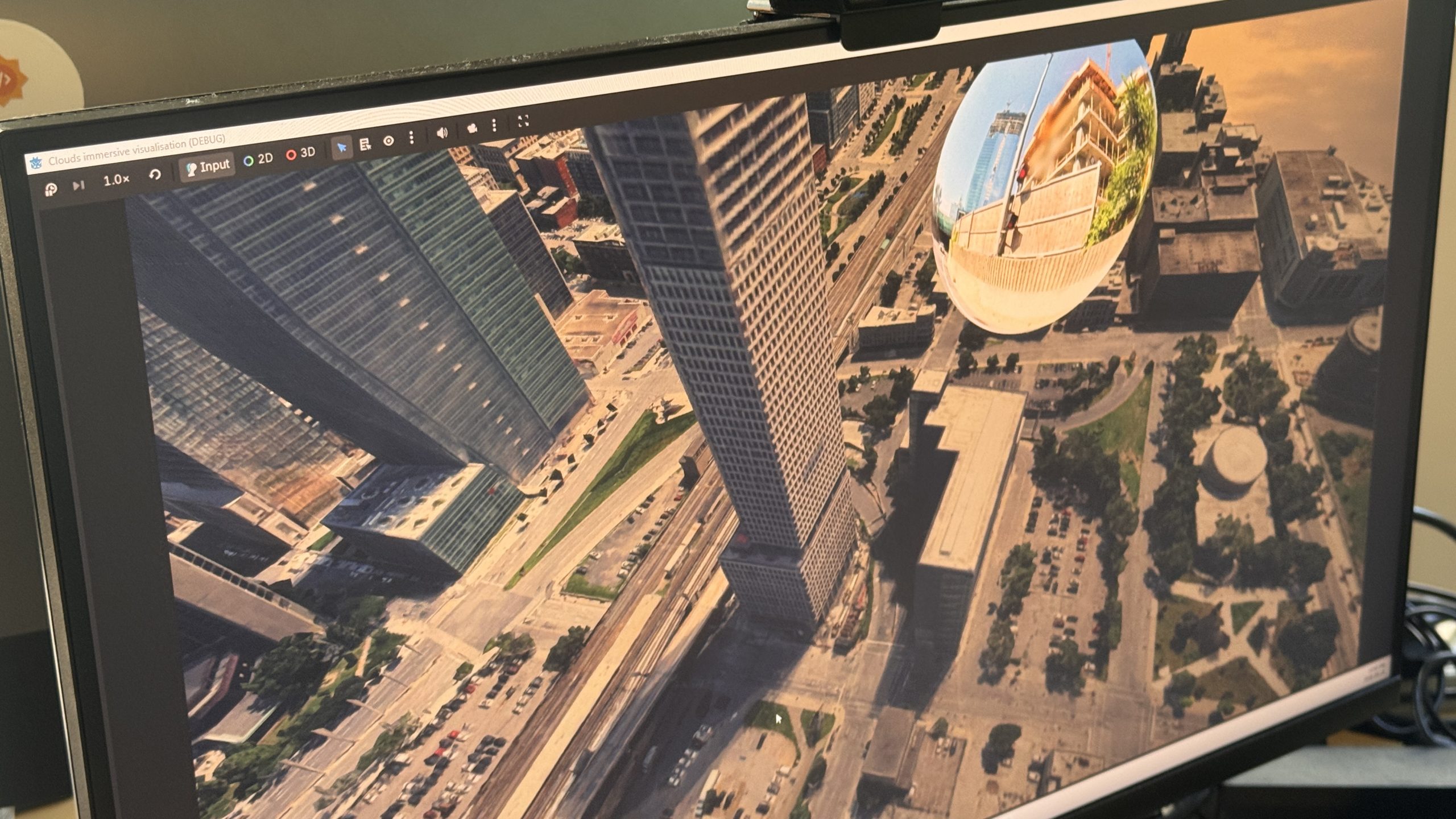
A large monitor displayed a 3D model of downtown Montreal. Bubbles marked data centres hidden inside ordinary buildings. Some filled major facilities. One occupied part of a floor. The researchers found them through provider websites, cross-referenced the addresses and went out to shoot footage.
So much for the cloud.
Buildings. Power. Fibre. Money. Heat. Neighbours.
Point at a building. There is a data centre in there. It consumes energy. It handles systems people use every day. Now the argument has an address.
Outside ALL IN, protesters had marched against AI and data-centre expansion. Police dispersed the march. Mila’s building had been vandalized earlier in the week. Manuel said the general manager of Montreal’s data centres had worried the researchers mapping the sites were connected to the demonstration.
They told him they were doing research.
There it was again: the gap between institutions building infrastructure and a public trying to see what is happening. The farther apart they get, the easier it becomes to label the other side a threat.
The map took the harder route. Show the thing. Name the building. Explain the method. Invite people in before the conclusion arrives laminated.
I heard myself say it on the tape: “The only path towards social licence, man, is through engagement in places like this.”
Waiting until everybody has been sorted into builder or enemy is too late.
I asked what it would take to adapt the map for Vancouver.
Of course I did.
The road west
The airport was waiting. So was the six-hour task of turning a week of recordings, photographs, introductions and conference nutrition into something useful.
I left Moment Factory thinking about a game tracking my feet, an archivist minding the past and whether Mario might remember my name after I die. Israel Goytom showed me the H200 appetite and physical scale of Canadian ambition at Mila. By the time I walked out of SAT, there was a heartbeat under my boots and a map proving that the cloud has neighbours.
The first dispatch began in an airport lounge with a cursed voice-agent phone tree. The next moved between a minister on television and chalk on the sidewalk. Then Uncle Evan appeared beside a backpack heavy enough to summon security.
By Friday, the argument had escaped the conference completely. It was under my feet, behind the glass, tangled in the cables and humming inside anonymous buildings downtown.
AI comes with addresses, power bills, dead colleagues, memories, friendships, protest lines and humans who need to live beside what gets built.
I arrived in Montreal carrying questions. I am heading home with better ones and several more people to call.
Both hands still full.
Previous dispatches
- Headed East for ALL IN Montréal
- Champions, Saplings, and Chalk on the Sidewalk
- ALL IN Montreal, Day Two: Uncle Evan and the Extremely Suspicious Backpack
Further down the rabbit hole
- Moment Factory
- Lumina Night Walks
- Astra Lumina Vancouver
- Mila
- Société des arts technologiques
- Satosphere
- SAT laboratories