The Digital Footprint – Exploring Electronic Consciousness & Online Identity
/
Kris Krüg
/
Article map
The following is an interview with me done by Kemp Edmonds of the British Columbia Institute of Technology. We spent a couple hours talkin’ “Philosophy of the Internet” and this is what came out of it. Thanks a lot Kemp for capturing lots of my ideas and writing them up! 🙂
The original interview appears in 3 parts here:
The Digital Footprint: Lessons from Kris Krug (1 of 3)The Digital Footprint: Internet Philosophy with Kris Krug (2 of 3)The Digital Footprint: Kris Krug Educates (3 of 3)Kris Krug is a technology, idea and thought leader with a strong presence in the digital world. He is also described as ‘a tech-artist, quasi-sage, cyberpunk anti-hero from the future’. The more you get to know him the more that description rings true.
I like to imagine him as a cyber surfer on the front of the wave enabling arts and culture in the internet age. If you’ve never heard of Kris check out his Wikipedia page here. Kris describes himself on www.kriskrug.com as, “a photographer, web strategist and author based in Vancouver.” Kris speaks all over the world on the topics of technology and the arts. I was inspired by his presentation at Pecha Kucha in Vancouver titled, “Open Everything”. In the presentation Kris talks about the move away from traditional blogging towards a digital footprint.
To Kris the ‘digital footprint‘ is represented by his photos on flickr, his videos on YouTube, his blog posts, links he shares, comments he leaves, interactions he has and comments others make about him. See a digital footprint by googling his name or mine. I am writing with many links embedded in the hopes that if you are interested you will explore and try these tools for yourself. Powerful computing tools are increasingly moving online and Kris knows his stuff. So join me as I go into the mind of a current thought leader for a lesson or two.
When did you realize that technology was part of your vocation?I really started working with web technology while I was at University. In early 1996 I was introduced to Netscape(?) and I started creating web pages. It was when my Communications professors approached me to build web pages for them that I knew things were really changing. It was an upheaval of the traditional power structure. Normally students want help from professors, suddenly these same professors were coming to me for help with their work. I went onto to create web pages for my professors, to promote and sell books, and the university.
In 1998 I created Spark-online.com, an online magazine exploring electronic consciousness and digital philosophy. It grew pretty big and we were using content management systems before blogging which required us to build new HTML pages every month. 11 years later my life is a continuation of those explorations and the addition of more. I am publishing online and speaking live exploring how we are changing and how the medium is changing.
On Blogging…
When blogging first started it was for everything [pictures, videos, discussions]. Now each of these media has their own tools outside the blog [flickr, YouTube, Twitter/Facebook]. People are no longer blogging every day; comments on blogs aren’t the place for discussions they once were. One great new tool [Disqus] aggregates tweets about a particular post and then includes a link or embeds those tweets into the blog in the comments section.
Now, instead of writing a blog post after an event I can tweet from the event, post photos and video directly to the web in real time and the day after the event I can do a blog post. I can use tweets from others about the event, embed some of the photos or videos I posted the day before into the post. I feel like we are moving from a web of pages to a web of streams. These streams allow us to aggregate our presence into one central place.
On the Olympics… [from a video of a recent Olympic roundtable w/Kris]
I currently represent “The True North Media House” and we are working to build an independent, alternative media center for the 2010 games. There will be a period of time in the future where the stories we are sharing 20 years after the games will be things that happened online. This is the first Olympics sitting on that brink and I hope to help tip the scales in that way through the organization of this 2010 media house.
A video from Northern Voice 2009 with True North Media House and others
[Also see this post from co-founder Dave Olson]
KE: You often talk about a ‘digital footprint’, what does it mean to you and where do you see it going?
KK: Every time we interact online we are leaving digital breadcrumbs. These little digital ‘bits’ leave a trail of information about us. We reveal things about ourselves and others make statements about us. This could be what you read, when you favourite a video or post a comment. It’s an amalgamation of what you do online. Even when we think we don’t exist on the net in fact we do.
[Google your name and add your main city of residence to see for yourself]What do you think of Aggregators? Will that be the digital footprint?
Tumblr is one aggregator but it sucks things from other people and puts it together so it is not necessarily original content. Friendfeed is for your own stuff. These days we aren’t spending all our time in one place online so aggregators do a good job of bringing together our online persona. Our information and activity online makes up our persona. I see aggregators like Friendfeed but with better filters and more ways of making things fit together enabling a true digital footprint.
[Get an idea of how FriendFeed represents the digital footprint at Kris’ feed or mine]
Do you see any really good Filters out there?I am currently consulting for 2010 and the David Suzuki foundation, building custom dashboards. I am running searches for “Cultural Olympiad” through PostRank. It tells me who is saying what about this topic anywhere on the internet. I am also using Netvibes and Yahoo Pipesmixing and filtering feeds, Technorati and Google Alerts to track online content in real-time. The really good filters are custom built for their users to enable the most focused result.
[Also try Social Mention or Twitter Search for tracking internet chatter about your topic of choice]Should we be using custom or proprietary filters to gather information?The easiest to use and cheapest solution is good for the average individual. For companies or individuals needing custom in-depth solutions complete with statistics and analytics a custom solution is the way to go. The current market for these custom solutions is a bit of an arms race and the key is to dial in and refine searches and filters. Techniques like keyword segregation and optimization help enable custom solutions to increase the value for users. To those who understand the power of the media, know what’s possible and want to utilize that power will use custom systems going forward.
The internet is an incredibly visual medium, what does this mean for the written word?I don’t know. Media literacy is very interesting. In the advertising age with TV we saw a movement away from literacy and ads towards visuals and real stories. Young people are continually tuning out traditional advertising. The internet is based on text, HTML=Hyper Text multi-language. It’s all about machines being able to read text and understanding linking and language. We are observing changes in communication. Things may not be better or worse, but they are certainly they are different. The approach to media is changing as media power becomes more decentralized. We are now able to receive many different perspectives, a myriad of voices representing different sides of an issue. Biases are now more explicit compared to the old system where biases were less obvious and people were tuning out advertising a lot less.
What would u like to see on the internet/web that is not currently available? I would like to see more philosophical dialogue and less pure entertainment, more art and culture and less funny cat videos. I would like to see more true art online, more cultural interaction and above all; more collaboration. Canada Code is a great example. We now get to tell our own stories. VANOC’s people are doing a great job working inside an organization [the IOC] which is resistant to the internet as a means to create culture and identity. I would like to see us reaching out to artists and Canadians because we can tell the best stories.
You are an artist and creator who wears many hats, how do you keep it all in order?
I am constantly trying to do things that I love. I was raised on TV and the internet. My advice is to stay engaged in your passion projects. My love has resulted in my business. I love teaching, photography, geeking, creation, consulting for and to web design Adelaide companies and promotion. The tools I am leveraging are fulfilling the promise of greater efficiency for me. I see a drastic increase in digital literacy, but there are still a large number of people who believe that if you reveal info online you will be stalked. This is the fear. Geeks used to be loathed and laughed at. Now there is great credibility to the knowledge that former geeks possess. Any people or businesses that steadfastly stay away from the internet will need a new solution to remain relevant in the digital age.
What about bloggers or creators whose work isn’t really seen by anyone? 😉
In regard to doing stuff that no one sees, if they keep it up people will eventually stumble upon it. Do it for the love of subject matter and it will come; the audience and the money. Learn more about your subject matter and figure out how to use it. I am a firm believer that there are different strokes for different folks. ‘Create your own reality’ with these tools and a community will grow around you if you engage them.
Do you think the sale of the Pirate Bay is a turning point in the proliferation of piracy on the net?
People’s attitudes about piracy are changing. BitTorrent is becoming like TCP/IP to email. In the sense that everyone uses email but few people know its backend is TCP/IP. People will get content anyway using peer to peer sharing. BitTorrent is a way to handle billions of users.
KE: Is web video the new billboard?
KK: A billboard thinks one message is good for all. The internet is the best place to spend your ad dollars because you can customize your message to your audience. It’s the best bang for your buck and you can’t argue with the measurability of it. Billboard analytics are messy at best. They’re hard to track while web tracking and analytics are freely available and very measurable; segment and target. I see more Facebook ads of friend’s businesses. Targeting ads to my interests is pushing me to click more. We want to know more about what we are interested in. Advertisers are picking up on this and making smarter decisions based on that data. -kk Photo Tim Bray[For great free analytics for your site check out Google Analytics]In your opinion are Facebook Apps an effective way to engage your audience?I love connecting other info into my Facebook account using Facebook Connect. Spammy apps, like quizzes, will eventually die off. Smart apps are rad. They can now add cool functionality to Facebook through outside sites and applications. The old way of site transition was difficult and now with various API (application programming interface) I can integrate everything. This is the promise of the internet. Using widgets and linking I can unlock true power by transferring my work, stories and reputation from one medium to another.
[Check out Kris’ Netvibes page it is a great showcase of some of his ‘hats’]You have spoken in the past about the ability to access your all of your personal information online from any internet terminal anywhere on earth, how does that work?
Storage is the essential thing in this concept. Amazon s3 (simple storage services) is the simplest storage area right now. That is where I would store files and information. You can use Plaxo to store all of your contacts online, while videos can be stored in one place and pictures in another. Using web based email access allow you to access your email from anywhere. (Gmail, Hotmail, etc.)
What do you think the iPhone will do to the mobile computing landscape?
The iPhone essentially puts the power of a printing press in your pocket. It has the power of video creation and study with YouTube integration. Oh yeah, it also has access to all of mankind’s knowledge. It allows us to be always connected to everyone and to all the information in the world. All consumers of this product also have the ability to produce as well as consume. It will help bridge the digital divide. With an iPhone I can do 70-80% of the work I normally do on the computer. The iPod Touch and the iPhone are available to a larger group of the people than conventional computers. This fact has the potential to allow a whole new group of people access to computers.
What do you think educational institutions should be doing with new media/social media that you don’t see them doing right now?
A lot of the changes we see in the classroom will be around wikis and online collaboration. Students and teachers are moving towards posting homework online. They are using technology to create roundtables and meetings, to share more freely. The essence of this shift is the integration of collaboration. I have really enjoyed the benefits of using twitter at events and conferences by putting a Twitterfall on a background at the front of the room. The discussion is democratized and leads to more diverse feedback.
Some teachers are using Twitter in the classroom to aid and encourage discussion
How do you think higher education institutions could be using new media and social media to improve recruiting practices?
Recruiting is only one area where social media should be used. Collaboration is the most interesting aspect of these tools in education. It changes recruiting from a traditional top down system to an inside out system. It’s about drawing people into the real community/culture that is going on around the institution. There is an opportunity to highlight the content being created from inside institutions. It’s about being a storyteller inside the institution not about marketing and sales. It puts the responsibility on the institution to have programs, research and teachers to draw in students in a real way.
What is your least favourite thing about all of these new tools?
I love all of these tools although I can’t see my screen very well at the beach. So I have to be inside too much. The one thing I miss is being outdoors more because this stuff ties you indoors. Also because it’s always on, sometimes it feels like a moving goal post. There is a feeling that, whether we are present or not, things continue to go on without us. It’s hard to get away from. There is no more end of the work day. These tools bring the world into our lives 24/7.
[Kris’ photography was brought to global prominence by a bizarre situation where another user attributed his work as theirs.] Can you tell us about that incident?
It was back in 2004-5, I had developed an audience online and they had a good sense of the style of my work. Eventually it came to my attention that this young photographer was passing off my work as his. It was obvious that it was my work. I proceeded to blog about it and the blogosphere was angry and pushed back at this guy. The subsequent blog posting was picked up by Digg resulting in over 1700 ‘diggs’. I was then was sent a phony cease and desist order to try and get the post taken down. You see because of the strength of my blog in search engines whenever anyone searched his name this story about how he stole my work and passed it off as his own would come up at the top of the search results.[Three years later the incident is still the top three search results from the thief’s name]
Kris talks with Leo Laporte about Creative Commons License
He was trying to pull a fast one on the internet, but it didn’t work. Legal academic journals have used this case study as an example of intellectual property rights and the internet. After I was served this fake cease and desist order he has continued to beg me to take down the blog post, but it remains up to this day. At one point I even told the guy that he should change his name, it’s the best option.
Thanks so much for all of your great insights Kris it’s greatly appreciated. I look forward to speaking again in the future. –Kemp Edmonds
Kris Krüg is an AI keynote speaker, creative technologist, photographer, and community builder working across BC + AI, Vancouver AI, and Futureproof Festival, and a living network of AI-era projects.

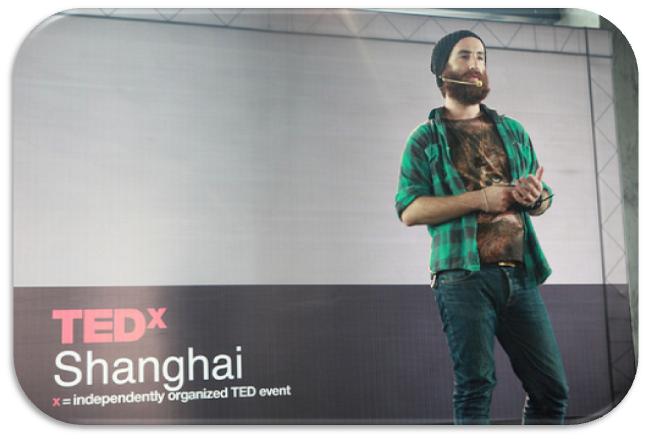
 Kris Krug is a technology, idea and thought leader with a strong presence in the digital world. He is also described as ‘a tech-artist, quasi-sage, cyberpunk anti-hero from the future’. The more you get to know him the more that description rings true.
I like to imagine him as a cyber surfer on the front of the wave enabling arts and culture in the internet age. If you’ve never heard of Kris check out his Wikipedia page here. Kris describes himself on www.kriskrug.com as, “a photographer, web strategist and author based in Vancouver.” Kris speaks all over the world on the topics of technology and the arts. I was inspired by his presentation at Pecha Kucha in Vancouver titled, “Open Everything”. In the presentation Kris talks about the move away from traditional blogging towards a digital footprint.
To Kris the ‘digital footprint‘ is represented by his photos on flickr, his videos on YouTube, his blog posts, links he shares, comments he leaves, interactions he has and comments others make about him. See a digital footprint by googling his name or mine. I am writing with many links embedded in the hopes that if you are interested you will explore and try these tools for yourself. Powerful computing tools are increasingly moving online and Kris knows his stuff. So join me as I go into the mind of a current thought leader for a lesson or two.
When did you realize that technology was part of your vocation?
Kris Krug is a technology, idea and thought leader with a strong presence in the digital world. He is also described as ‘a tech-artist, quasi-sage, cyberpunk anti-hero from the future’. The more you get to know him the more that description rings true.
I like to imagine him as a cyber surfer on the front of the wave enabling arts and culture in the internet age. If you’ve never heard of Kris check out his Wikipedia page here. Kris describes himself on www.kriskrug.com as, “a photographer, web strategist and author based in Vancouver.” Kris speaks all over the world on the topics of technology and the arts. I was inspired by his presentation at Pecha Kucha in Vancouver titled, “Open Everything”. In the presentation Kris talks about the move away from traditional blogging towards a digital footprint.
To Kris the ‘digital footprint‘ is represented by his photos on flickr, his videos on YouTube, his blog posts, links he shares, comments he leaves, interactions he has and comments others make about him. See a digital footprint by googling his name or mine. I am writing with many links embedded in the hopes that if you are interested you will explore and try these tools for yourself. Powerful computing tools are increasingly moving online and Kris knows his stuff. So join me as I go into the mind of a current thought leader for a lesson or two.
When did you realize that technology was part of your vocation?
 I really started working with web technology while I was at University. In early 1996 I was introduced to Netscape(?) and I started creating web pages. It was when my Communications professors approached me to build web pages for them that I knew things were really changing. It was an upheaval of the traditional power structure. Normally students want help from professors, suddenly these same professors were coming to me for help with their work. I went onto to create web pages for my professors, to promote and sell books, and the university.
 In 1998 I created Spark-online.com, an online magazine exploring electronic consciousness and digital philosophy. It grew pretty big and we were using content management systems before blogging which required us to build new HTML pages every month. 11 years later my life is a continuation of those explorations and the addition of more. I am publishing online and speaking live exploring how we are changing and how the medium is changing.
On Blogging…
When blogging first started it was for everything [pictures, videos, discussions]. Now each of these media has their own tools outside the blog [flickr, YouTube, Twitter/Facebook]. People are no longer blogging every day; comments on blogs aren’t the place for discussions they once were. One great new tool [Disqus] aggregates tweets about a particular post and then includes a link or embeds those tweets into the blog in the comments section.
In 1998 I created Spark-online.com, an online magazine exploring electronic consciousness and digital philosophy. It grew pretty big and we were using content management systems before blogging which required us to build new HTML pages every month. 11 years later my life is a continuation of those explorations and the addition of more. I am publishing online and speaking live exploring how we are changing and how the medium is changing.
On Blogging…
When blogging first started it was for everything [pictures, videos, discussions]. Now each of these media has their own tools outside the blog [flickr, YouTube, Twitter/Facebook]. People are no longer blogging every day; comments on blogs aren’t the place for discussions they once were. One great new tool [Disqus] aggregates tweets about a particular post and then includes a link or embeds those tweets into the blog in the comments section.
 Now, instead of writing a blog post after an event I can tweet from the event, post photos and video directly to the web in real time and the day after the event I can do a blog post. I can use tweets from others about the event, embed some of the photos or videos I posted the day before into the post. I feel like we are moving from a web of pages to a web of streams. These streams allow us to aggregate our presence into one central place.
On the Olympics… [from a video of a recent Olympic roundtable w/Kris]
I currently represent “The True North Media House” and we are working to build an independent, alternative media center for the 2010 games. There will be a period of time in the future where the stories we are sharing 20 years after the games will be things that happened online. This is the first Olympics sitting on that brink and I hope to help tip the scales in that way through the organization of this 2010 media house.
Now, instead of writing a blog post after an event I can tweet from the event, post photos and video directly to the web in real time and the day after the event I can do a blog post. I can use tweets from others about the event, embed some of the photos or videos I posted the day before into the post. I feel like we are moving from a web of pages to a web of streams. These streams allow us to aggregate our presence into one central place.
On the Olympics… [from a video of a recent Olympic roundtable w/Kris]
I currently represent “The True North Media House” and we are working to build an independent, alternative media center for the 2010 games. There will be a period of time in the future where the stories we are sharing 20 years after the games will be things that happened online. This is the first Olympics sitting on that brink and I hope to help tip the scales in that way through the organization of this 2010 media house.

 I am currently consulting for 2010 and the David Suzuki foundation, building custom dashboards. I am running searches for “Cultural Olympiad” through PostRank. It tells me who is saying what about this topic anywhere on the internet. I am also using Netvibes and Yahoo Pipes mixing and filtering feeds, Technorati and Google Alerts to track online content in real-time. The really good filters are custom built for their users to enable the most focused result.
[Also try Social Mention or Twitter Search for tracking internet chatter about your topic of choice]
Should we be using custom or proprietary filters to gather information?
I am currently consulting for 2010 and the David Suzuki foundation, building custom dashboards. I am running searches for “Cultural Olympiad” through PostRank. It tells me who is saying what about this topic anywhere on the internet. I am also using Netvibes and Yahoo Pipes mixing and filtering feeds, Technorati and Google Alerts to track online content in real-time. The really good filters are custom built for their users to enable the most focused result.
[Also try Social Mention or Twitter Search for tracking internet chatter about your topic of choice]
Should we be using custom or proprietary filters to gather information?
 The easiest to use and cheapest solution is good for the average individual. For companies or individuals needing custom in-depth solutions complete with statistics and analytics a custom solution is the way to go. The current market for these custom solutions is a bit of an arms race and the key is to dial in and refine searches and filters. Techniques like keyword segregation and optimization help enable custom solutions to increase the value for users. To those who understand the power of the media, know what’s possible and want to utilize that power will use custom systems going forward.
The internet is an incredibly visual medium, what does this mean for the written word?
The easiest to use and cheapest solution is good for the average individual. For companies or individuals needing custom in-depth solutions complete with statistics and analytics a custom solution is the way to go. The current market for these custom solutions is a bit of an arms race and the key is to dial in and refine searches and filters. Techniques like keyword segregation and optimization help enable custom solutions to increase the value for users. To those who understand the power of the media, know what’s possible and want to utilize that power will use custom systems going forward.
The internet is an incredibly visual medium, what does this mean for the written word?
 I don’t know. Media literacy is very interesting. In the advertising age with TV we saw a movement away from literacy and ads towards visuals and real stories. Young people are continually tuning out traditional advertising. The internet is based on text, HTML=Hyper Text multi-language. It’s all about machines being able to read text and understanding linking and language. We are observing changes in communication. Things may not be better or worse, but they are certainly they are different. The approach to media is changing as media power becomes more decentralized. We are now able to receive many different perspectives, a myriad of voices representing different sides of an issue. Biases are now more explicit compared to the old system where biases were less obvious and people were tuning out advertising a lot less.
What would u like to see on the internet/web that is not currently available?
I don’t know. Media literacy is very interesting. In the advertising age with TV we saw a movement away from literacy and ads towards visuals and real stories. Young people are continually tuning out traditional advertising. The internet is based on text, HTML=Hyper Text multi-language. It’s all about machines being able to read text and understanding linking and language. We are observing changes in communication. Things may not be better or worse, but they are certainly they are different. The approach to media is changing as media power becomes more decentralized. We are now able to receive many different perspectives, a myriad of voices representing different sides of an issue. Biases are now more explicit compared to the old system where biases were less obvious and people were tuning out advertising a lot less.
What would u like to see on the internet/web that is not currently available?
 I would like to see more philosophical dialogue and less pure entertainment, more art and culture and less funny cat videos. I would like to see more true art online, more cultural interaction and above all; more collaboration. Canada Code is a great example. We now get to tell our own stories. VANOC’s people are doing a great job working inside an organization [the IOC] which is resistant to the internet as a means to create culture and identity. I would like to see us reaching out to artists and Canadians because we can tell the best stories.
You are an artist and creator who wears many hats, how do you keep it all in order?
I would like to see more philosophical dialogue and less pure entertainment, more art and culture and less funny cat videos. I would like to see more true art online, more cultural interaction and above all; more collaboration. Canada Code is a great example. We now get to tell our own stories. VANOC’s people are doing a great job working inside an organization [the IOC] which is resistant to the internet as a means to create culture and identity. I would like to see us reaching out to artists and Canadians because we can tell the best stories.
You are an artist and creator who wears many hats, how do you keep it all in order?


 I love connecting other info into my Facebook account using Facebook Connect. Spammy apps, like quizzes, will eventually die off. Smart apps are rad. They can now add cool functionality to Facebook through outside sites and applications. The old way of site transition was difficult and now with various API (application programming interface) I can integrate everything. This is the promise of the internet. Using widgets and linking I can unlock true power by transferring my work, stories and reputation from one medium to another.
[Check out Kris’ Netvibes page it is a great showcase of some of his ‘hats’]
You have spoken in the past about the ability to access your all of your personal information online from any internet terminal anywhere on earth, how does that work?
I love connecting other info into my Facebook account using Facebook Connect. Spammy apps, like quizzes, will eventually die off. Smart apps are rad. They can now add cool functionality to Facebook through outside sites and applications. The old way of site transition was difficult and now with various API (application programming interface) I can integrate everything. This is the promise of the internet. Using widgets and linking I can unlock true power by transferring my work, stories and reputation from one medium to another.
[Check out Kris’ Netvibes page it is a great showcase of some of his ‘hats’]
You have spoken in the past about the ability to access your all of your personal information online from any internet terminal anywhere on earth, how does that work?

