
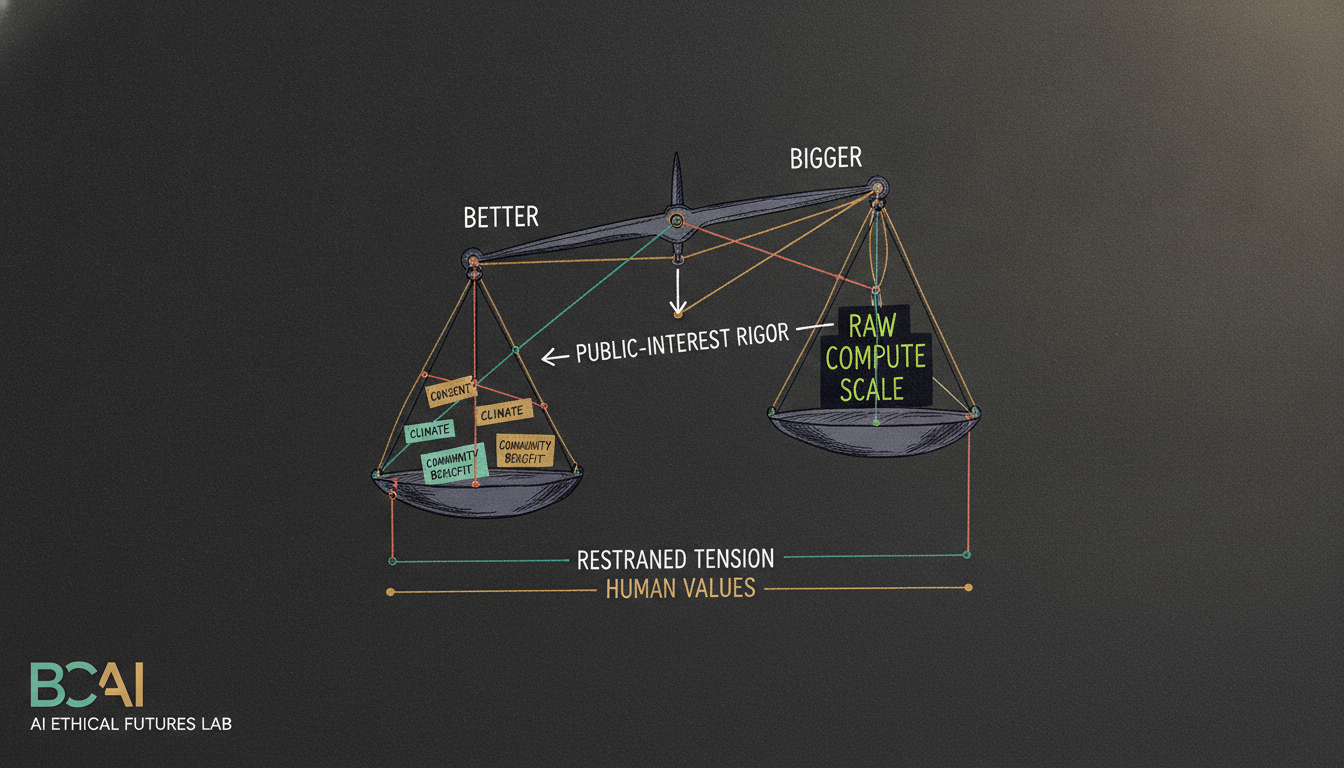
Canada Doesn’t Need a Bigger AI Machine. It Needs a Better One.

Canada does need AI infrastructure. But without consent, climate discipline, Indigenous governance, and community benefit, bigger just means faster extraction.

Hand-drawn balance scale weighing 'Better' (consent, climate alignment, accountable governance, community benefit) against 'Bigger' (raw compute scale).

Rainy Vancouver night. Somebody’s laptop is open. Somebody else is asking the kind of question that makes a room go quiet: Who owns the data in an AI future? Not “who stores it” or “who can query it,” but who actually holds the power to say yes, to say no, to set the terms, to change them later, to benefit when value is created.

This is the part of the AI conversation Canada keeps dodging: we don’t just lack compute. We lack consent architecture.

Meanwhile, Maxime C. Cohen drops a clean, sharp white paper that basically says: Canada is in trouble. Not vibes-trouble. Measurable-trouble. His warning is blunt: we’ve been “too slow, too fragmented, and too modest in scale.”

He’s not wrong.

Cohen’s paper is one of the most coherent “Canada must get its act together” documents I’ve seen. It lays out the structural hits: compute scarcity, weak commercialization, adoption lag, and a real brain drain pipeline that keeps dumping Canadian talent into U.S. gravity wells. He cites a study where “two-thirds of Canadian software engineering students” from a cohort ended up in the U.S. within 5 years. He points at a 46% compensation premium for U.S. tech workers over Canada, and the practical effect that has on retention.

On compute, Cohen highlights Canada’s share of global AI compute capacity as 0.7%. That number isn’t just a flex metric. It’s an indicator of who gets to do frontier-scale experiments, who gets to train, who gets to iterate, who gets to publish, and who gets to set standards by sheer repetition.

On adoption, he cites an AI adoption rate of 12.2% for Canadian enterprises and frames it as a competitiveness problem, especially for SMEs.

Then he does what policy people do when they’re being serious: he proposes infrastructure and governance that match the size of the problem.

He calls for national GPU superclusters in the 10,000-50,000+ range. He wants a national compute governance body and emphasizes “low-carbon infrastructure.” He proposes a CAD $1-2B commercialization fund to deal with the scale-up gap. He wants industry acting as “anchor customers” and procurement that actually scales Canadian startups.

And he wants a “strong, active National AI Governance Council with a real mandate and accountability.”

So yeah. Diagnosis is solid.

Now the hard part: Cohen’s paper is necessary, but it’s not sufficient.

Because the thing Cohen barely touches is the thing BC keeps tripping over (and learning from) in real-time: if we scale AI without stewardship, we just build a more efficient extraction machine.

The part Cohen nails (and we should steal shamelessly)

1) Publish the feature: “We Agree on the Diagnosis. Our Cure Is Different.”

This long-form piece: Canada doesn’t win a compute war by pretending compute doesn’t matter.

Cohen is correct that “sovereign compute” is not optional if you want domestic research capacity, domestic products, and domestic sovereignty over sensitive workloads. Without it, you become what he warns against: “a research supplier to other nations.”

He also correctly calls for coordination across stakeholders and faster commercialization mechanics. His recommendations are built for execution, not for panel discussions.

BC + AI should take those tools and upgrade them with our missing ingredient: governance that doesn’t treat community wellbeing as an afterthought.

The part Cohen misses: trust is the limiting reagent

Cohen’s paper is framed like a national competition problem. But in BC, we’re living inside a trust problem.

And trust is not a PR issue. It’s an adoption ceiling.

BC public opinion research from SFU’s Morris J. Wosk Centre for Dialogue says three-quarters of British Columbians do not trust tech companies to manage and develop AI carefully and with public wellbeing in mind. Two-thirds don’t trust government or NGOs either. Academic institutions do better, but even there it’s split.

This is the social reality any “national AI strategy” has to operate inside. If you try to force adoption without rebuilding trust, you don’t get acceleration. You get backlash, refusal, and quiet sabotage.

The same report says 82% feel “nervous” about AI in society, 86% worry about losing personal agency if companies and governments use AI to make decisions affecting their lives, and 56% don’t believe benefits outweigh risks.

And here’s the kicker: despite low trust in government, BC residents still want regulation. 74% want government to impose regulations on companies developing or using generative AI systems to address false or misleading information.

So if we’re designing a future AI economy, we’re not optimizing for “compute first.” We’re optimizing for “trust and consent first,” because without that, compute just scales conflict.

What BC+AI has that Cohen’s framework doesn’t: a proven community engine

Cohen is solving for institutions. BC+AI has been solving for people.

The Vancouver AI Community Meetup case study in BC Studies describes something most policy frameworks can’t see: a grassroots practice community that becomes infrastructure.

They reported “an average audience size… around 150 people,” with total attendance “around 2,400” in 2024, and “the community built itself without corporate sponsorship or government funding.”

It’s also not just quantity. It’s format: open mic, demos, rapid iteration, “digital platforms,” and “dedicated physical spaces” where people keep showing up.

That’s not a meetup anecdote. That’s an adoption mechanism. It’s how SMEs actually move: seeing real workflows, talking to peers, stealing patterns, trying again next week.

Cohen’s procurement reforms and commercialization funds become radically more effective when there’s already a living lab generating demand and talent attachment.

The Indigenous governance gap is not “inclusion.” It’s strategy.

Here’s where BC’s West Coast model stops being “nice” and becomes nationally differentiating.

The BC AI Symposium Final Report explicitly calls out Indigenous rights and governance frameworks as real components of responsible AI. It notes that participants underscored the need to integrate “Indigenous rights and governance principles in AI development,” including UNDRIP and OCAP.

The report also flags the environmental footprint of compute, calling for greener infrastructure and “green data centers,” and explicitly ties that to the “increasing computational power needed by AI systems.”

And it doesn’t stop at principles. It points at practical governance and procurement problems: if we don’t build best practices and accountability frameworks, we get a “move fast and break things” import with a Canadian flag sticker slapped on top.

This is the missing layer in Cohen’s blueprint: stewardship. Not “ethics as a PDF,” but enforceable consent, reciprocal benefit, and governance with teeth.

The BC AI JEDI Report uses a metaphor that’s almost too perfect: building the ecosystem as a “mycorrhizal web,” where exchange is mutual and regenerative, not extractive. It also names “Indigenous data sovereignty and stewardship” as a core necessity.

That’s not a vibe. That’s the blueprint for how Canada becomes globally distinctive without trying to out-America America.

So what do we do with Cohen’s paper?

We don’t dunk on it. We remix it into something Canada can own.

Cohen says Canada needs scale. I’m saying: fine, but only with stewardship.

Cohen says Canada needs compute. I’m saying: fine, but only with consent, climate discipline, and value staying local.

Cohen says Canada needs governance. I’m saying: fine, but governance must include Indigenous jurisdiction and community accountability, or it’s just a nicer-looking extraction layer.

That’s the synthesis.

The plan: a concrete “West Coast Response” that can ship

Here’s what I’d publish, and how I’d execute it, fast.

1) Publish the feature: “We Agree on the Diagnosis. Our Cure Is Different.”

This long-form piece (the thing you’re reading) becomes the public-facing bridge: respectful to Cohen’s rigor, brutally honest about what’s missing.

Include short direct quotes from Cohen (no cherry-picking). Example: Canada has been “too slow, too fragmented, and too modest in scale.”

Include real BC receipts: Vancouver AI’s scale and independence.

Include the trust reality: three-quarters don’t trust tech companies.

2) Convene a national “Stewardship + Scale” roundtable (not a conference)

60-90 days. One day. No panels. Just working sessions.

Invite Cohen. Invite Indigenous data governance leaders. Invite BC Hydro or energy system folks. Invite SMEs. Invite labour.

Output is not a “statement.” Output is a draft spec.

Deliverable: The Stewarded Compute Accord (v0.1)

A short, enforceable set of requirements for any publicly supported AI compute capacity in Canada:

OCAP/UNDRIP-aligned data governance pathways for sensitive datasets. PDF-FinalReport-AISymposiumLow-carbon infrastructure requirements (Cohen already flags low-carbon compute as a priority).Public reporting on access, usage, and benefit distribution.Clear “no extractive deals” clauses for public assets.

3) Build a BC pilot: “Compute Commons + Consent Commons”

If Cohen wants 10,000-50,000 GPU superclusters, BC can pilot the governance model for how that compute gets used.

In 6-12 months:

Stand up a small “Compute Commons” allocation model (even if the hardware is modest at first).Pair it with a “Consent Commons” toolkit: reusable legal templates, data-sharing agreements, and audit patterns aligned to OCAP/UNDRIP principles referenced in the symposium report.

This turns “responsible AI” from branding into operational controls.

4) SME adoption: copy Cohen’s speed, use BC’s community engine

Cohen emphasizes procurement and pilots that scale.

BC’s move:

Run 90-day “SME AI Sprints” that start in community (meetups, practice labs) and end in procurement-ready outputs.Use the Vancouver AI pattern: live demos, open mic, show your work.Track outcomes: time saved, error rates, employee satisfaction, risk incidents, and whether value stayed local.

5) Trust rebuilding isn’t optional. It’s a parallel workstream.

The SFU public opinion report literally says any action will be “severely hampered” by lack of trust and will require “trust re-building” efforts. Public_Opinion_Research-British…

So we treat trust like infrastructure:

publish plain-language model cards for community-built tools,publish impact assessments for pilots,run public “AI office hours” in multiple regions,measure sentiment quarterly, not annually.

6) Capital stack: take Cohen’s money, change the rules

Cohen proposes a CAD $1-2B national commercialization fund.

BC’s demand should be: if public money builds capacity, public benefit must be contractually real.

revenue-share or equity-return terms that recycle value into regional capacity,cooperative options for SMEs (shared infrastructure, shared governance),open-source requirements where appropriate (JEDI’s ecosystem logic explicitly pushes open, collaborative building). BC AI JEDI Report 16cc6f799a338…

Closing: Canada’s real advantage is not speed. It’s legitimacy.

The U.S. can brute-force frontier scale. The EU can brute-force regulation. Canada’s best move is neither. Canada’s best move is to build AI that people will actually consent to live with.

Cohen is building the scaffolding: compute, commercialization, coordination.

BC+AI is building the missing organs: community practice, Indigenous governance, trust repair, non-extractive value flow.

Put them together and Canada stops copying Silicon Valley’s worst habits with a polite smile. We become the place that figured out how to scale AI without hollowing out the people it claims to serve.

That’s the West Coast contribution: scale, yes. But stewarded. Or it’s not progress, it’s just a faster leak.

Cohen White Paper Critique: BC+AI West Coast Alternative

Subject: Strategic Analysis of Maxime C. Cohen’s “State of AI in Canada” vs. BC + AI Community Model

Executive Summary

Maxime C. Cohen’s white paper diagnoses Canada’s AI crisis with academic rigor: talent drain (2/3 of software engineers leave), compute shortage (0.7% of global capacity), industrial adoption lag (12.2% vs. OECD average), and fragmented governance. His recommendations are policy-sound: build sovereign compute capacity, modernize tech transfer, establish a National AI Governance Council.

Yet Cohen operates within a traditional innovation paradigm, scale through capital investment and institutional coordination, that BC+AI’s West Coast model fundamentally challenges. Cohen assumes Canada must race the U.S. on frontier models. BC+AI evidence suggests Canada leads differently: through Indigenous-grounded community stewardship that other nations want to replicate.

Strategic Reality: Cohen’s framework is necessary but insufficient. His approach risks building better extraction without addressing the core tension between economic growth and community wellbeing. BC+AI’s Indigenous-led framework prevents that extraction while positioning Canada as globally distinctive.

Section 1: Points of Strong Alignment

Brain Drain Crisis (8/10 alignment)

Cohen documents the talent exodus with precision: compensation gap of 46% (US tech workers earn more), top PhD graduates fleeing within one year, Canadian universities unable to retain faculty facing U.S. offers of $300K-800K USD for senior AI engineers versus CAD $150K-300K domestically.

BC+AI operates from the same diagnosis but attacks via different mechanism. Rather than salary competition (unwinnable against Silicon Valley), Vancouver AI grew from 80 to 250+ monthly participants in 21 months by embedding community identity, Indigenous ceremony (Gabriel George, Tsleil-Waututh Nation), and board representation (Carol Ann Hilton, Nuu-chah-nulth Nation). This suggests talent retention compounds through belonging, not just compensation.

The Integration: Cohen’s retention strategy (better pay, access to compute) is necessary. BC+AI’s community stewardship is the force multiplier. Combined: competitive compensation within a distinctive cultural ecosystem.

Industrial Adoption Gap (9/10 alignment)

Cohen correctly identifies the SME adoption crisis: 12.2% adoption rate (among OECD lows), two-thirds of Canadian businesses with no AI plans in next 12 months, 99.8% of Canadian businesses are SMEs left behind by enterprise-focused solutions.

BC+AI’s emerging supplier ecosystem (Baseline, Genia) specifically targets SME execution, automating repetitive workflows without requiring data science expertise. But more importantly, Vancouver AI created a practice community where practitioners develop locally relevant use cases. This is adoption acceleration through proximity, not procurement reform.

The Integration: Cohen proposes top-down solutions (modernize government procurement, reform tech transfer). BC+AI demonstrates bottom-up adoption pathways (community laboratories where SMEs see working examples). The policy levers work faster when community adoption has already created demand.

Section 2: Fundamental Divergences

The Scale Paradigm (8/10 disagreement)

Cohen’s entire framework rests on one assumption: Canada must compete at scale or face irrelevance.

He benchmarks Canada’s 0.7% global compute capacity against the U.S. (74%), China (14%), and UAE (100+ billion in AI investment). His conclusion: Canada must make “multi-billion-dollar investments” in sovereign compute, venture capital scaling, and frontier model development to preserve global position.

BC+AI’s implicit challenge: Scale without stewardship amplifies extraction.

Peter Lucas Jones (Haisla Nation, Time’s 100 Most Influential in AI) articulates this through Indigenous data sovereignty, “Data extraction is colonialism in digital form.” The question Cohen never asks: Whose benefit? Who bears the cost?

Amsterdam (5 million people, no sovereign compute) punches above its weight in AI by setting standards (not owning infrastructure). Canada’s opportunity may not be racing the U.S. on frontier models but leading on responsible, community-grounded AI, which other nations actually want to replicate.

Real-World Test:

U.S. dominates frontier models (GPT, Claude) but faces recurring AI ethics crisesEU leads on regulation (AI Act) but lags on innovationCanada positioned to pioneer: Research excellence + Responsible AI positioning + Indigenous leadershipVancouver AI’s global recognition comes from replicability of the model, not from compute infrastructure

Cohen’s strategy risks: Building better extraction. BC+AI’s framework prevents it.

The Extraction Problem (9/10 disagreement)

Cohen never addresses the core question: Who benefits from Canada’s AI competitiveness?

His framework:

Assumes “raising Canadian GDP” benefits allTreats AI as neutral productivity toolDoesn’t center Indigenous rights or community agencyProposes infrastructure (compute, capital, governance) without addressing value capture

BC+AI’s operating principle: “Non-extractive economics”, value stays in BC, not Silicon Valley.

This matters because Canada’s historical pattern: Build research (universities capture prestige), build companies (VC captures returns), lose both to U.S. acquisition (Element AI to ServiceNow, Maluuba to Microsoft). Cohen documents this pattern but doesn’t fundamentally address it.

Indigenous data sovereignty framework fills this gap: Communities must control their own data. AI trained on Indigenous knowledge requires consent and reciprocity. Current trajectory = digital colonialism.

The Gap: Cohen’s recommendations could strengthen Canadian AI while leaving Indigenous communities data-extracted and communities value-extracted. BC+AI’s framework prevents that.

Regional Distinctiveness vs. National Centralization (6/10 disagreement)

Cohen proposes: “Unified national strategy that includes shared KPIs and cross-provincial coordination” with a “strong, active National AI Governance Council with real mandate and accountability.”

BC+AI operates from an insider/outsider position: Direct government access (Innovate BC partnership, federal AI Minister connections) and freedom to critique, refusing top-down mandates. The voice profile captures this: “Insider/outsider is where I operate best.”

The disagreement isn’t whether coordination matters (it does). It’s whether coordination must precede regional success versus whether regional success enables coordination.

Cohen assumes: National framework ? regional implementation

BC+AI evidence: Regional momentum ? national network formation

Vancouver AI didn’t wait for national AI strategy to build. Five cities are now requesting the framework as replication model, creating de facto national network without formal governance.

Strategic Implication: Regional leaders set national pace (not vice versa). BC+AI’s regional distinctiveness becomes Canada’s national competitive advantage.

Section 3: Cohen’s Blind Spots

Indigenous Framework (Critical Gap)

Zero mention of Indigenous leadership, data sovereignty, or UNDRIP principles across the entire white paper. Yet:

OCAP (Ownership, Control, Access, Possession) governance framework exists and directly addresses data sovereignty concernsPeter Lucas Jones’s four pillars (Data Sovereignty, Relationship-Based Design, Seven-Generation Thinking, Interconnected Systems) directly solve problems Cohen identifiesIndigenous communities represent 5% of Canadian population but hold 30% of Canada’s remaining natural resources and data rights

What Cohen Misses: If Canada embedded Indigenous principles in AI development, we’d be globally distinctive. Every technology is a choice about who controls data, who captures value, whose future we’re building for.

Community Economics (Overlooked Model)

Cohen analyzes venture capital, corporate adoption, institutional coordination. He doesn’t explore:

Cooperatives and community ownership modelsNon-profit infrastructure (Vancouver AI’s proven scalability)Consortium approaches for SMEs (pooled investment, shared infrastructure)Revenue-sharing models that keep value local

What Cohen Misses: SMEs might organize differently if alternatives existed. Cooperative AI development (owned by users/workers, not distant VC) might solve adoption gap more sustainably than procurement reform.

Cultural Dimension (Invisible to Framework)

Cohen focuses on infrastructure (compute, capital, talent). He doesn’t address:

AI as mirror revealing who we are (Kris Krüg’s insight)Ceremony and cultural grounding as innovationCommunity culture as retention force (Vancouver AI 212% growth without higher salaries)”Shipping culture, not content” as competitive advantage

What Cohen Misses: Distinctive competitive advantage comes from authenticity, not speed. Vancouver AI gets copied because communities see their values reflected. Silicon Valley doesn’t.

Section 4: BC+AI Blind Spots (For Balance)

Scale Questions

Vancouver AI thriving at 250 people. Canada has 40 million. How does intimate, ceremony-grounded community model scale without losing authenticity?

Gap: Replication pathway clear for cities of similar size/Indigenous population. Unclear for national scale. Cohen’s centralized coordination actually solves this (though West Coast prefers network approach).

Research Infrastructure Needs

Cohen correct: Foundation model research requires GPU access. Canada’s 0.7% compute capacity is real constraint limiting research advancement.

Gap: BC+AI focused on adoption/community doesn’t address where foundation models get trained. BC’s clean energy makes sovereign compute infrastructure strategically sensible, but requires scale investment Cohen proposes.

Capital Sourcing Tension

BC+AI accepts corporate sponsorships (Microsoft, KPMG) while advocating “non-extractive economics.” Tension between principle and pragmatism.

Gap: How to source growth capital without extractive logic? Cohen’s growth funds suggestion (not just venture capital) potentially addresses this.

Section 5: Strategic Synthesis

What Cohen’s Framework Needs from BC+AI

1. Indigenous Framework Integration

Embed Peter Lucas Jones’s data sovereignty principles into national strategy. Effect: Canada distinctive by actually operationalizing responsible AI (not just publishing principles).

2. Community-First Growth Model

Recognize regional hubs (Vancouver, Montreal, Toronto) as drivers rather than expecting national coordination as prerequisite. Fund community infrastructure (meetups, local incubators, ceremony spaces) as economic development.

Effect: Cheaper talent retention (community belonging beats salary competition).

3. Non-Extractive Economics

SME adoption pathways through cooperatives and community ownership. Indigenous communities benefit from AI development (not exploited by data extraction).

Effect: Sustainable, locally-grounded competitiveness.

What BC + AI Needs from Cohen

1. Research Infrastructure Investment: Sovereign compute capacity isn’t extractive; it’s research enabling. BC’s clean energy + tech talent = legitimate competitive advantage for computing infrastructure.

2. Policy Specificity: Tech transfer reform (university startups faster), procurement modernization (government as anchor customer), immigration pathways (talent retention support). Effect: Community thrives when policy enables it.

3. Growth Capital Strategy: Series B/C funding gap is real (Cohen’s data). Government growth funds (not just venture capital) solve scale-up challenge without requiring extraction logic.

Section 6: West Coast Alternative Strategy

Regional Distinctiveness as National Advantage

Rather than racing U.S. on frontier compute, Canada leads through regional specialization grounded in Indigenous values:

BC: Clean energy + Indigenous leadership + tech talent = Responsible AI infrastructure + Research advancementMontreal: Deep learning heritage + Responsible AI thought leadership + French ecosystem positioningToronto: Venture capital concentration + Enterprise adoption maturity + Multinational presenceAlberta: Energy systems AI + Conservation research + Indigenous consultation modelsAtlantic Canada: Marine/fisheries AI + Coastal resilience + First Nations partnerships

Effect: Each region distinctive. National coherence through shared principles (Indigenous data sovereignty, seven-generation thinking, community stewardship), not through centralized mandates.

Competitive Advantage (Not Race)

Stop competing on U.S. game. Lead on global game:

Frontier models: U.S. wins (accept this, collaborate instead of race)

Responsible AI: Canada opportunity (Cohen acknowledges, BC+AI operationalizes)

Indigenous-led AI: Global leadership (no other nation positioned; replicable globally)

Regional distinctiveness: Competitive advantage (Amsterdam doesn’t have GPU farms; it sets standards)

Effect: Canada distinctive, not derivative. Globally replicable model (Vancouver getting copied; Silicon Valley doesn’t invite replication).

Recommendations for BC + AI Strategic Response

1. Frame as “We Agree on Diagnosis, Offer Different Cure”

Cohen’s brain drain, compute shortage, adoption gap, fragmented governance, all valid. Your innovation: Address these through community stewardship + Indigenous leadership rather than just capital/infrastructure. Positioning: Not critique. Integration.

2. Publish “West Coast Response to Cohen” Document

Affirm: His diagnosis is rigorous and urgent ?Diverge: National centralization not only pathway; regional momentum sufficientPropose: Hybrid model, Cohen’s infrastructure + BC+AI’s cultureEvidence: Vancouver AI 212% growth, 5+ cities requesting replication

Effect: Intellectual leadership positioning.

3. Embed Indigenous Framework in Government Relations

Active funding pursuits (Innovate BC, BC AI Institute) already positioned. Integrate: “Our competitive advantage is Indigenous-led responsible AI.”

Not charity. Strategic difference.

Effect: Distinguish BC+AI from other regional players nationally.

4. Engage Cohen Directly

His network (McGill, IVADO, Scale AI) spans Canada. Propose: His next analysis might feature regional models. Regional distinctiveness chapter in future white papers.

Effect: Intellectual integration at senior level.

Conclusion

Cohen’s white paper is institutionally necessary. It diagnoses Canada’s AI competitiveness crisis with rigor and proposes policy solutions required for research infrastructure and national coordination.

BC+AI’s West Coast model is existentially important. It demonstrates that community-led, Indigenous-centered AI development creates distinctive competitive advantage (proven: 212% growth, global replication requests, authentic responsible AI).

Neither alone sufficient. Together, powerful.

If Canada built sovereign compute infrastructure (Cohen’s call) while grounding it in Indigenous principles and community stewardship (BC+AI’s call), we’d pioneer a model the world actually wants to replicate, instead of copying Silicon Valley’s errors.

Currently, Cohen’s recommendations risk building better extraction. BC+AI’s framework prevents that and makes Canada’s AI future sustainable and genuinely distinctive.

The West Coast Contribution: Move from scale race to cultural leadership. That’s the gap Cohen’s framework leaves open, and where BC+AI adds irreplaceable value.

References:

Cohen, Maxime C. “The State of AI in Canada,” Section 3.1, pp. 9-10; compensation data from DAIS and personal anecdotes cited

BC+AI Indigenous-Led AI Framework, Case Study section; Vancouver AI Community growth metrics, 2024-2025

Cohen, Section 3.3, pp. 11; Statistics Canada AI adoption rates cited

Cohen, Section 1.3, p. 4; Section 3.4.1, p. 11

BC+AI Indigenous-Led AI Framework, Peter Lucas Jones keynote synthesis, section on Data Sovereignty

Cohen, Section 1.1, p. 2; “AI could add on order of several hundred billion dollars to Canada’s GDP by 2035”

BC+AI Voice Profile and Worldview documentation; core principle of non-extractive economics

Cohen, Section 3.2, p. 10; Element AI and Maluuba acquisitions documented

Cohen, Section 3.5 (Fragmented National Coordination) and Executive Summary, p. 1-2

BC+AI Worldview document, “Insider/Outsider Positioning” section

BC+AI Indigenous-Led AI Framework, replication requests mentioned in Executive Summary

Peter Lucas Jones keynote framework: Data Sovereignty, Relationship-Based Design, Seven-Generation Thinking, Interconnected Systems (all absent from Cohen analysis)

KK Worldview: “AI as Mirror, Not Tool” – core philosophical difference

Cohen, Section 3.2, pp. 10-11; funding gap documented across Series B and beyond for Canadian companies

Public source checks


Discover more from Kris Krüg | Generative AI Tools & Techniques

Subscribe to get the latest posts sent to your email.

About Kris

Kris Krug is an AI keynote speaker, creative technologist, photographer, and community builder working across BC + AI, The Upgrade AI, Indigenomics.ai, and a living network of AI-era projects.