
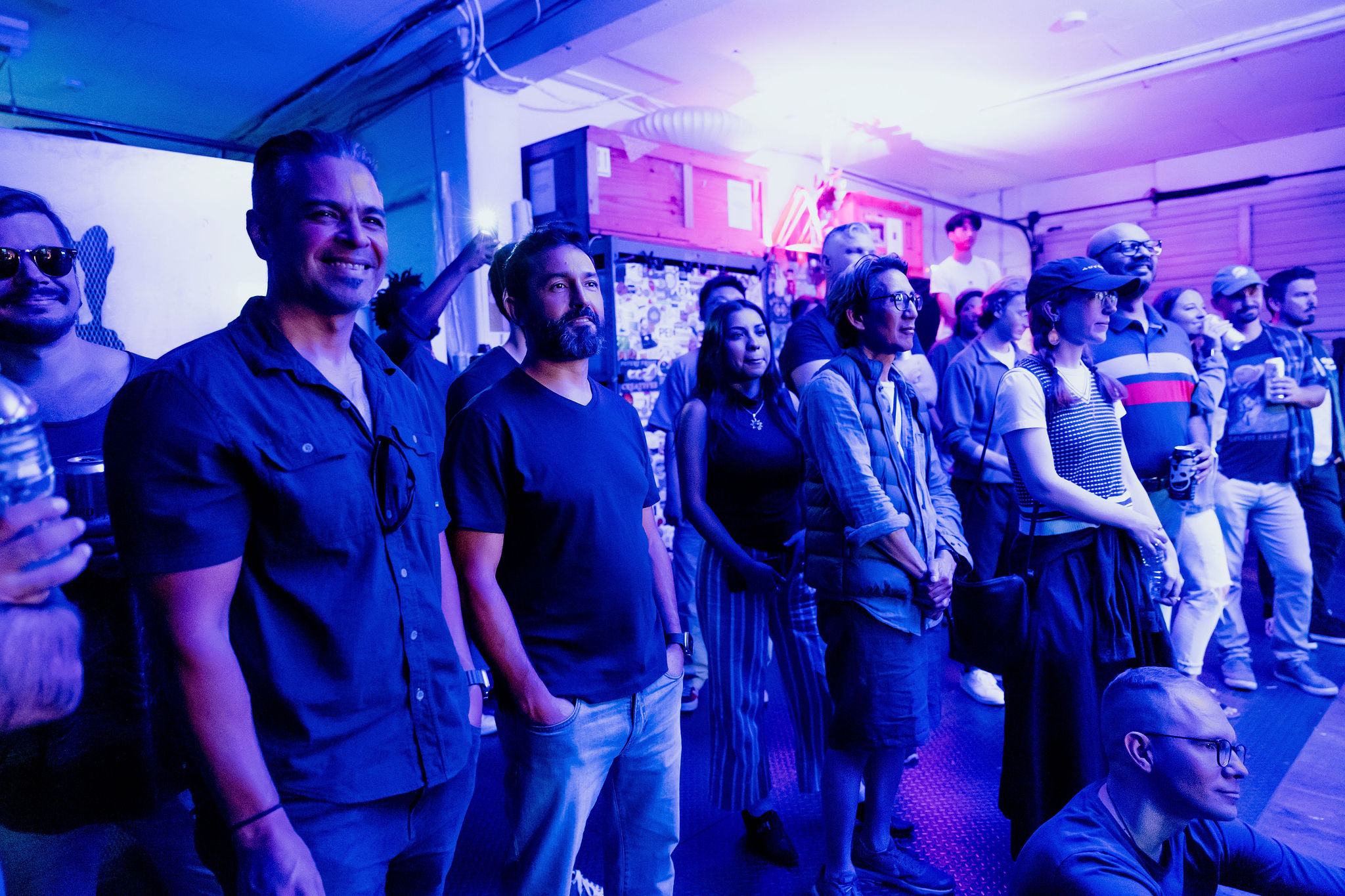
In January 2024 I opened my studio doors for a meetup and 80 people showed up. Less than two years later, BC + AI was British Columbia’s largest grassroots AI ecosystem: a registered nonprofit with Indigenous board leadership, 300 members, and regional chapters across the province. This is the story of how we built something Canada had not seen before. Receipts included.
The spark: 80 people in my studio
Vancouver’s AI community didn’t exist as an organized force until January 25, 2024, when I opened the doors of MØTLEYKRÜG Media for the first Vancouver AI Community Meetup (#VAI01). The event sold out immediately: 80 people packed into my studio at 290 W. 3rd Avenue, tucked inside the Vancouver Biennale Art Warehouse. We put Indigenous ceremony at the centre from day one. Gabriel George Sr. of the Tsleil-Waututh Nation opened with traditional songs, and that set the pattern that never changed: ceremony before innovation, relationships before transactions.
That first night featured Vancouver City Councillor Mike Klassen, researchers from SFU and Emily Carr University, and AI artists showing interactive installations. My ethos was simple: welcome everyone intrigued by AI’s potential, from seasoned researchers to budding artists, from tech enthusiasts to curious students. Nobody pitched. Nobody recruited. People taught each other.
The timing helped. ChatGPT had exploded into public consciousness just months earlier, and Vancouver’s creative and tech communities were hungry for a room to process the implications together. Word of mouth alone drove consistent sellouts for the next several months.
Four months in, we outgrew the room
By May 30, 2024 (#VAI05), attendance passed 135 people, nearly double what my studio could hold. Monthly meetups on the last Thursday of each month had become the AI event in Vancouver, and the mix in the room was the point: developers next to photographers, Indigenous knowledge keepers talking data sovereignty with machine learning researchers, performance artists running generative music through their sets.
Gabriel George’s Eagle Song opened every gathering, creating what members started calling a “sacred container” for technical discussions. His teaching that “our people saw it coming, they said one day our world would be connected by a web” tied ancient Indigenous prophecy to modern AI development. You hear that at enough meetups and it changes how you think about what a network is for.
We needed a bigger room. By mid-2024 I had worked out a partnership with the H.R. MacMillan Space Centre, whose Executive Director Lorraine Lowe saw the fit between space exploration and AI’s frontier territory right away. The planetarium holds 200+ people and comes with professional AV. The partnership stuck: Lorraine later joined the nonprofit board.
Indigenous wisdom as the operating system
Plenty of tech events open with a land acknowledgment and move on. We built it differently: Indigenous perspectives became BC + AI’s philosophical operating system. Gabriel’s teachings shaped how the community understood networks, data, relationships, and collective responsibility.
Gabriel’s great-great grandmother lived in the village where the Space Centre now stands, before colonial authorities forcibly relocated her family. That made every gathering there an act of return and reclamation. His grandfather was Chief Dan George, the Oscar-nominated actor and cultural icon, and Gabriel carries that legacy of bridging Indigenous wisdom with contemporary society.
From Gabriel we learned that Indigenous elders described the internet centuries before its invention: “a web covering the world,” “longhouses reaching to the sky.” They prophesied that “when the eagle landed on the moon,” Indigenous communities would begin their revival. In 1969, NASA transmitted “the eagle has landed.” Gabriel connected those prophecies to AI: technology is the latest iteration of the planetary web the ancestors foresaw.
Those teachings did operational work. OCAP protocols (Ownership, Control, Access, Possession) became non-negotiable for data governance. The Indigenomics framework, relationship over transaction, long-term thinking over extraction, guided partnership decisions. And we adopted Gabriel’s teaching that attendees are “human recorders responsible for sharing what they learn.” Show up, learn something, carry it out the door to someone else.
Teaching AI without the gatekeeping
While the meetups built community, The Upgrade AI, which Peter Bittner and I co-founded in late 2023, handled structured professional education. The first cohort for creative professionals launched March 11, 2024: a 6-week certification program built on treating AI as a “force multiplier for human expertise, not a replacement.”
The numbers tell you it worked. By November 2025, The Upgrade had trained over 1,000 professionals through 50+ workshops. 92% wanted sector-specific training next, 88% of graduates were using AI tools in their work, satisfaction ran at 95%, and graduates reported average productivity gains of 40%.
Access stayed the design constraint. 40% of participants came from underrepresented groups: women, Indigenous peoples, visible minorities. A partnership with Circle Innovation’s RISE in BC program covered 30% co-funding for eligible British Columbia SMEs so cost didn’t decide who got to learn. Through 2024-2025 the program grew to serve journalists (with Google News Initiative), PR professionals, sales leaders, and healthcare workers.
In parallel, the ED + AI initiative launched in 2024-2025 to bring educators in. The second ED + AI meetup in October 2025 drew a packed house of K-12 teachers, post-secondary instructors, parents, students, and EdTech builders. Working groups formed around Human-Centered AI in Education guidelines: assessment redesign, youth data consent, access gaps between districts. The principle we wrote down for it still holds: “Education should not be an afterthought in the AI conversation. It should be a central force shaping how AI is imagined, designed, and applied.”
Surrey AI: the model leaves Vancouver
The first real test of the distributed vision was Surrey AI’s launch on March 11, 2025. Matthew Schwartzman, just 19 years old and based in Maple Ridge, had been making the grueling commute to our Vancouver meetups. As he told the room at #VAI13 in January 2025: “After sitting on Highway 1 for an hour, I’m pretty sure I saw my life flash before my eyes.”
Matthew and Ryv Valiquette (from White Rock) announced a “Surrey style version in Surrey”: half the price of Vancouver events, lighter programming, better parking, and accessible to people working until 5 PM. The timing was smart. Surrey has serious AI activity in logistics, transportation, mechatronics, and agritech, and Fraser Valley folks often couldn’t justify the Vancouver commute.
Surrey AI #1 launched at Royal Canadian Legion Branch #8 on a second-Tuesday schedule that wouldn’t collide with Vancouver’s last-Thursday rhythm. The response answered any doubts: nine consecutive monthly meetups through November 2025, professional photography, steady attendance, growing institutional support.
By November 12, 2025, Invest Surrey (the city’s economic development agency) had committed to joining BC + AI and partnering on a December Innovation Boulevard-themed meetup. Tyler Westover, who leads Invest Surrey as the City of Surrey’s Director of Business and Government Relations, saw Surrey AI as essential infrastructure for positioning a fast-growing city as an innovation hub. Plans took shape for a quantum computing event at SFU Surrey in February 2026.
Surrey AI made the case: community-led AI education can thrive outside the big tech hubs. Young leaders ran it, local needs shaped it, and it paid its own way with grassroots and institutional support. That success sparked more regional nodes: Victoria, Squamish, and conversations in Kelowna, all following the same blueprint of ceremony, inclusivity, and radical localism.
Carol Ann Hilton’s five minutes that changed everything
Gabriel gave us ceremonial grounding. Carol Ann Hilton brought the economic and philosophical framework. As CEO of the Indigenomics Institute and a board member of the emerging nonprofit, Carol Ann had spent years building Indigenomics, a movement toward a $100 billion Indigenous economy in Canada that reframes economic relationships through Indigenous values.
At the August 27, 2025 nonprofit launch (#VAI20), right after Gabriel’s Eagle Song, Carol Ann delivered what members still describe as “5 minutes that laid the philosophical foundation for everything that followed.” She opened with the Indigenomics Institute’s guiding question: “How are you showing up tonight?” That question now sits inside how the AI community governs itself.
Her framework asked: “What are we responding to? Why are we here?” No platitudes about the chaotic state of the world. She reframed chaos through the Chinese symbol: “Chaos = creative potential. AI transformation is opportunity for conscious creation, not fear.”
The most radical part was her teaching on decolonizing prescribed meaning: “As much as meaning has been prescribed to us and each one of our heritage and legacies… there was a prescription of meaning applied onto our humanity.” Colonial systems imposed meanings and limits on all peoples. Carol Ann’s argument: AI gives us a chance to rewrite meaning around real values, because once you can see the imposed prescription, you can choose differently.
Then she challenged the room: “What does it feel like to put love in the code? Love in the land? Love in the culture?” She meant it as protocol, love as an organizing principle. That speech locked in what the BC AI Ecosystem Association would be: ceremonial practice as governance structure, technology grounded in traditional wisdom, relationships over networking, and AI connected to economic justice and decolonization.
Carol Ann and I also built together: as CTO of the Indigenomics Institute I worked with her on the indigenomics.ai platform, AI tools that carry Indigenous values and support economic sovereignty. That collaboration put Indigenous perspectives at the foundation of the build.
The decision to formalize: nonprofit status in August 2025
By spring 2025, after more than a year of grassroots organizing, we faced a real decision. Stay an informal network, or build formal structure so the thing could sustain itself?
The debate ran through planning meetings into early summer 2025. The case for nonprofit status was strong:
- Credibility for funding: government grants and corporate sponsorships require formal entities
- Collective voice: aggregate community power for policy advocacy
- Sustainable operations: move beyond “duct tape and vibes” to professional infrastructure
- Resource circulation: province-wide learning and knowledge sharing
The worry was losing the grassroots spirit. We were determined this would NOT become “Silicon Valley 2.0” or another corporate-controlled industry association. Whatever structure we chose had to preserve ceremony, radical inclusivity, Indigenous leadership, and community-first decision making.
By mid-August 2025 we made the call. BC + AI registered as the BC AI Ecosystem Association nonprofit society under the BC Societies Act, with three founding board members:
- Carol Ann Hilton (Indigenomics Institute): Indigenous leadership and the philosophical framework
- Lorraine Lowe (H.R. MacMillan Space Centre): institutional partnership and venue support
- Kris Krüg (me): founder and community organizer
That composition made Indigenous leadership a governing position, not an advisory one: Carol Ann’s seat meant every major decision would filter through Indigenomics principles and protocols.
August 27, 2025: the launch party
Vancouver AI Community Meetup #20 doubled as the nonprofit launch party. Approximately 250 people filled the Space Centre planetarium on August 27, 2025, three times the crowd from the first studio night a year and a half earlier. The program held everything BC + AI had become:
6:00 PM: Doors opened to networking and food
Indigenous Ceremony: Gabriel George’s Eagle Song filled the planetarium dome
Carol Ann Hilton: Five-minute philosophical framework address
Jos Duncan-Asé (flying in from Philadelphia): “Love + AI” ethics framework
Peter Bittner (flying in from Seattle): “The Future of Work” and the urgency of upskilling
Hackathon winners: $2,500 prizes for data storytelling projects
8:20 PM: Official nonprofit announcement and founding member roll call
The timing was deliberate. Registration had gone through about a week earlier, around August 20, 2025, but we held the public celebration for the milestone 20th meetup. Commemoration and declaration of intent in one night.
Thirty-four members signed up that first night. The hybrid model held: free or low-cost events for accessibility, paid membership for people who wanted deeper benefits. Membership now sits at 300.
How we priced membership
The founding member drive (which ran through December 31, 2025) offered five tiers for different corners of the community:
- Student: $80/year (1 seat, proof of enrollment required)
- Individual: $340/year (1 seat for freelancers and independent practitioners)
- Micro Pack: $600/year (5 seats for small teams)
- Growth Pack: $1,400/year (12 seats for growing organizations)
- Enterprise Patron: $3,000/year (30 seats for large organizations)
The first 100 members locked in “Founder ’25” badges and the right to shape bylaws: governance by the people who showed up early. Benefits stacked: 25% off Vancouver AI meetups, training discounts, coworking access, weekly Office Hours, the Discord, the member directory, and a voice in policy decisions.
One debate from the August 25, 2025 onboarding meeting stuck with me: should the founding period be time-limited (December 31) or capped at the first 100 people? We went time-based with no numeric cap, leaving room for Prince George, Kelowna, and Vancouver Island to join before the founding period closed. The logic: a network of 250 founders beats an exclusive club of 25.
Behind the scenes: duct tape and vibes
The nonprofit formation wasn’t smooth. Website payment integration got finished in a rush right before the August 27 launch. The membership model meant wiring Stripe to a brand-new bank account, building a member database with sequential numbering, and automating email sequences for 15,000+ contacts.
The most delicate move involved existing Vancouver Core AI annual ticket holders who had paid $450 for year-long event access. The new membership cost $340/year and came with more benefits. We sent voice messages to those early supporters laying out the change, offered BC + AI membership at approximately $200 to those early ticket holders, and moved the Core AI channel to a members-only space. Transparency over perfection kept the trust intact through the switch.
Geographic equity took creative work. Surrey AI ran half-price tickets and better parking than downtown Vancouver. The BC + AI Youth Access Fund covered scholarships for participants under 20 or over 80, plus bus rides to hackathons and certification costs. The philosophy: “Small, real dollars to the exact places that open doors.”
Documentation was its own problem. 23+ monthly meetups had generated hours of video, transcripts, and photos. We built recording systems, Notion databases, and custom AI tools trained on our own transcripts, and kept professional photography at every event. The result is a searchable knowledge commons: a talk from a year ago is still findable, quotable, and useful.
The connective tissue: hackathons, Office Hours, partnerships
Beyond the monthly meetups, we ran programs to build out British Columbia’s AI ecosystem:
Data Storytelling Hackathon (launched February 26, 2025): Rival Technologies put up $10,000 across four rounds for stories told with data and AI. The first winner, Sev Geraskin, built “Hot Dogma”, a data-driven philosophical analysis with 3D visualization answering “Is a hotdog a sandwich?” Later rounds took on Canadian identity, BC’s AI story, and the soundtrack of human experience.
Office Hours (launched September 2025): weekly Thursday sessions that became the operational backbone of BC + AI programming. Equal parts creative jam, civic briefing, and peer mentoring: project collaborations, funding conversations, GitHub tutorials, member connections. By November 2025 Office Hours were on fire, with founders meeting investors and new collaborations launching weekly.
Creative Mornings partnership (announced August 2025): we linked up with Creative Mornings Vancouver, Mark Busse’s decade-old tradition of free creative gatherings, billed as uniting “two of Vancouver’s most generative creative forces,” with a “Creative AI Jam” planned for spring 2026. Both organizations center creativity, ethics, and the Commons while refusing Silicon Valley monoculture.
Academic partnerships: MetaCreation Lab at SFU donated $15,000+ in equipment. UBC’s Emerging Media Lab collaborated on research. Northeastern University plugged in industry programs. These partnerships kept BC + AI connected to the research frontier without giving up its community-first approach.
Government relations: we prepared briefings for provincial ministers, took part in federal AI Task Force consultations, and positioned the community as a grassroots counterweight to corporate AI advocacy. Three BC women sat on Canada’s national AI Task Force, keeping provincial and Indigenous voices in federal AI strategy.
Community culture: stoked and careful at the same time
By November 2025 the culture had its own vocabulary. The touchstones:
“Stoked + careful at the same time”: critical optimism instead of techno-utopianism or techno-pessimism.
“In this canoe together”: Carol Ann’s metaphor for the collective journey, adopted community-wide.
“Ceremony first, then innovation”: Indigenous protocols as prerequisite. Every event, policy discussion, and partnership started from values.
“Amplifying creativity, not replacing humans”: The Upgrade’s core philosophy.
“Multi-modal, multi-cultural, radically local, and future-facing”: the community’s self-description.
“No gatekeeping”: radical inclusivity we inherited from Creative Mornings Vancouver, all skill levels and backgrounds welcome.
The attendance numbers carried the growth story: 80 people in a studio (January 2024), 135+ in an overcrowded venue (May 2024), 250+ at the Space Centre (August 2025 on), selling out along the way. The demographic mix stayed rare for AI gatherings: 35% technology workers, 25% creative industries, 20% academia, 10% public policy.
Other people started writing it down too. UBC’s BC Studies Journal published a case study on the Vancouver AI Community Meetups, noting that early successes “offer valuable lessons for emerging AI communities worldwide.” The community picked up recognition as “British Columbia’s largest grassroots AI network” and “Canada’s premier monthly gathering focused on ethical, community-driven AI development.”
The turning points
Certain moments changed BC + AI’s trajectory:
The first sellout (January 25, 2024) validated the appetite and set the format that stuck: ceremony, speakers, demos, performances, networking, all in service of collective learning rather than individual gain.
135+ attendees (May 30, 2024) forced the move to the Space Centre, which opened up 3x growth and made the last-Thursday meetup the AI gathering in Vancouver.
Surrey AI’s launch (March 11, 2025) showed the distributed model worked: 19-year-old Matthew Schwartzman leading a regional chapter without top-down control.
Carol Ann Hilton’s board appointment and August 27 speech embedded Indigenomics principles in the nonprofit’s DNA.
The nonprofit registration (August 2025) opened up sustainable operations, grant access, and collective advocacy, while the board composition and governance design protected the grassroots values.
Reaching 300 paid members validated the membership model and created financial runway for 2026 programming expansion.
The Creative Mornings partnership was the coming-of-age signal: one of Vancouver’s most respected creative institutions wanted to build with us.
The ecosystem map: 480 organizations and counting
Behind the scenes we maintained an ecosystem map tracking 480 British Columbia AI organizations: startups, research labs, nonprofits, government agencies, educational institutions. The map was a working tool. We used it to introduce organizations that should have known each other already, spot collaboration openings, and map the province’s AI capabilities.
We also built out funding resources covering 200+ grants, loans, and investment programs for nonprofits, startups, and researchers working with AI in BC. Updated monthly, tested by the community, and credited with helping dozens of members land funding. Information that usually sits siloed, made open. That’s the values statement in practice.
Three rounds of public opinion research (with Angus Reid and Rival Technologies) surveyed 1,001 British Columbia residents about AI attitudes, concerns, and priorities. That data shaped programming and armed the policy work. When we walked into a government meeting, we came with actual data about what British Columbians wanted from AI development.
Where that left us
By November 2025, BC + AI was proof that grassroots organizing could build significant AI infrastructure outside corporate control. Monthly Vancouver meetups kept rolling (#VAI23 in November, #VAI24 set for December with the BC AI Awards). Surrey AI ran its ninth consecutive meetup. ED + AI working groups drafted Human-Centered AI in Education frameworks. The Upgrade ran multiple certification cohorts at once across professions.
The founding member period ran through December 31, 2025, with expansion pointed at Prince George, Kelowna, and Vancouver Island. We aimed the December BC AI Awards at recognizing British Columbia’s AI innovators, builders, and ethical leaders, lined up the Creative AI Jam with Creative Mornings for spring 2026, and saw Web Summit Vancouver as a chance to make it BC + AI’s home base, with community activations and hackathon sprints.
The numbers tell part of the story. The culture is the part I care about most: ceremony before innovation, Indigenous wisdom guiding technical decisions, education without gatekeeping, communities outside Vancouver counting for something, love as a technical specification, AI amplifying human creativity instead of replacing it.
From 80 people in a studio to 300 paid members of a nonprofit with regional chapters, Indigenous board leadership, and national recognition, all in under two years. No venture capital. No corporate sponsor steering it. Ceremony, community, and careful optimism. That’s our story: the grassroots journey from meetup to movement. Another way of building AI’s future is already happening in British Columbia.