
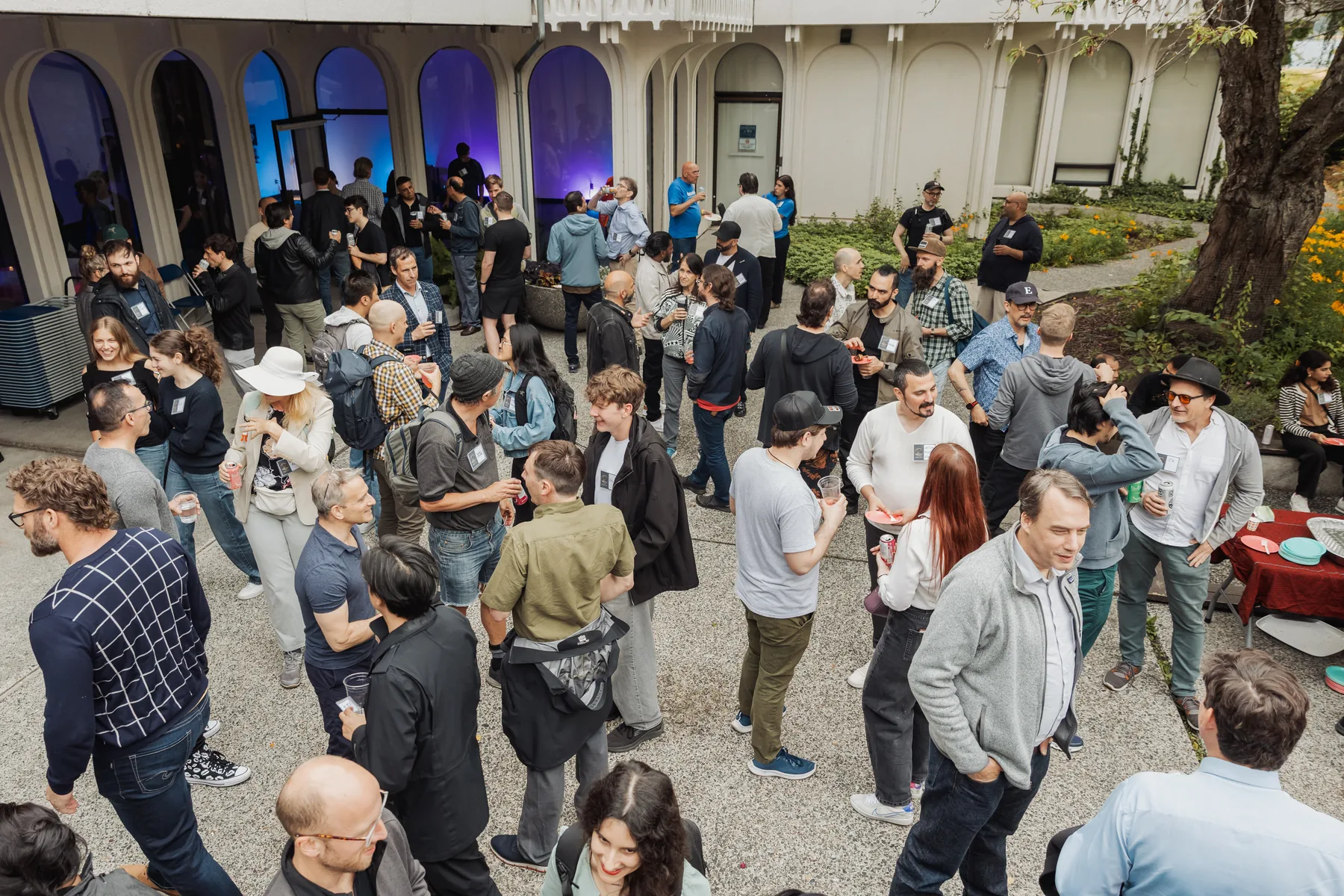
Daisy Xiong asked me a clean question for Business in Vancouver: why does B.C. need a stronger AI community?
I gave her the most honest answer I had.
Because artificial intelligence does not stay inside an AI sector.
It lands inside healthcare systems deciding what clinicians can trust. Inside government offices writing procurement rules for tools nobody fully understands yet. Inside game studios and film pipelines rewriting how production work gets done. Inside HR teams drowning in synthetic job applications. Inside schools, law firms, credit unions, unions, and nonprofits trying to adopt without getting played.
If your map of “the AI ecosystem” only includes companies with AI in the pitch deck, you are missing most of the people who will live with the consequences.
Artificial intelligence lands inside every single profession; not just inside an AI sector.
as printed in Business in Vancouver, July 31, 2026
That is the line Daisy put in the paper. Here is the rest of the story: the part that does not fit in a news brief.

We do not lack talent. We lack connective tissue.
B.C. already has researchers, studios, startups, adopters, investors, and public servants doing serious work. Rob Goehring at AInBC is right that the province’s applied AI base is large, diverse, and still young. Sev Geraskin at the Economy of Wisdom Foundation is right that we need better measurement and clearer power-capacity decisions. Three groups, one shared problem, honest differences in approach. Good.
What we have underbuilt is the boring, recurring infrastructure that turns scattered excellence into a region that can learn together, hire across silos, form companies, and show up in policy conversations with a shared memory.
And here is the thing: B.C. has done this before. Our interactive and digital media economy did not happen by accident. People sat down, built the tax credits, built the industry associations, and stitched studios, schools, and government into a cluster on purpose. Ask anyone who was in those rooms in the 2000s. I have been making the case that AI deserves the same deliberate treatment since the very first weeks of this project. The entry-level jobs that built those talent pipelines are exactly what AI is dissolving first, and nobody had started building the replacement.
Not another isolated lab.
Not another one-off summit.
A drumbeat.
The room came before the plan
The Vancouver AI meetup started in my studio in January 2024 because I needed a room before I could figure out anything else. I had spent a year deep in the machine, testing tools, talking to labs, watching the ground move. And the conclusion kept getting louder: the world did not need another AI content company. It needed an AI community company.
Eighty-five people crammed into that studio by the end. We were bursting. Then Lorraine Lowe came to me with an offer I still think about: the H.R. MacMillan Space Centre was reimagining itself as an innovation hub, and she wanted the AI meetups there. A fifty-year-old cultural institution looked at a scrappy community of builders and artists and said: you belong under the planetarium dome. That is not a venue rental. That is a city deciding to take its own future seriously.
A year later we made it official as the BC + AI Ecosystem Association, a member-funded nonprofit. I wrote the origin arc separately. The short version of where that stands today:
- about 300 paid annual members who actually know each other
- 11 community subgroups: an AI Film Club run by Kevin Friel on a philosophy of “every human in every loop,” an AI Ethical Futures Lab, education circles, and regional rooms in Surrey, Squamish, and the Comox Valley (first Thursday of the month, if you’re on the Island)
- weekly programming, not just a monthly flagship. The events calendar does not take weeks off
- more than 3,000 people through the door since launch
- Responsible AI Professional training in active use
- hackathons that put real money into builders’ hands
- Futureproof Festival, October 28–30, 2026, at the Space Centre. The long-dreamed homegrown annual gathering, now with dates and a speaker lineup


We are bootstrapped on memberships, tickets, certifications, and sponsorship. That is a design choice, not a romance about grit. Community infrastructure that only exists when a grant arrives is not infrastructure. Most funding in this space flows to research institutes, large companies, and intermediaries, and community gets treated like a nice-to-have layered on top. We flipped that. We are not waiting for someone to fund us to do these ideas.

The rooms multiplied
“Eleven subgroups” is an org-chart fact. Here is what it feels like from inside.
The AI Ethical Futures Lab meets at Parker Street Studios, and somewhere around its fifth session it stopped feeling like an event series and started feeling like civic infrastructure: a room people can come back to, where somebody can raise disability access and somebody else can raise data-centre heat and both threads belong to the same conversation. Public AI discourse keeps getting flattened into the shiny demo or the red-alert siren. The Lab is where we stop pretending that contradiction is a branding problem.

The Film Club is where the professions argument gets cinematic. Kevin Friel spent twenty-five years at DNEG, BRON, and MPC; now he calls this the orchestration era: not one model, but a pipeline you conduct. And he gives away every shortcut he knows on a Wednesday night. When we ran the first AI Animation Accelerator, one of our filmmakers showed a thirty-second commercial he had made for about a hundred dollars. Work that would have carried a six-figure budget at his old studio. Two hundred and fifty people packed the Space Centre for our first film festival to watch six AI-made shorts. That is a profession renegotiating itself in public, in real time, in our rooms.
And it is not a Vancouver story anymore. When we took the meetup to Courtenay, I called the first one Meetup #0 because I did not want to show up from the city pretending to know what the Island needed. We expected a dozen people. About sixty-five showed up: farmers, teachers, local government folks, software people, artists, retirees. The valley was already having the conversation. You just have to give it a room.

What it looks like up close
A health-tech CEO cornered me at one of our gatherings with a question that has stayed with me: when is this technology trustworthy enough for patient outcomes, for the responsibility that used to live entirely in the hands of doctors?
You do not answer that question with a keynote. You answer it with practice: rooms where people deploying AI in consequential settings can compare notes, pressure-test vendors, and learn from each other’s near-misses. That is why we built the Responsible AI Professional certification: in every room, hands go up for deployment and down for governance, and that gap is where the damage happens.
It is also why I keep saying adoption is not the goal. AI amplifies whatever process it lands in (I watched this play out in city halls and wrote about it in AI Won’t Fix Your Broken Permit Process), and “ask the chatbot” is not a governance plan. Professions adopting AI need judgment, and judgment is a team sport.
The product is interconnectedness
Three hundred people who do not know each other are a labour market.
Three hundred people who share context, trust, and practice are a capability.
The people in these rooms have each other’s numbers in their phones. That sounds small. It is not. A region gets smarter when ideas can travel between a life-sciences operator, a procurement officer, a creative technologist, and a founder without waiting for a conference badge or a ministerial panel.

Do not take my word for it. UBC researchers Patrick Pennefather and David Gaertner studied this community and published the result with me as a peer-reviewed case study in BC Studies: “Building a Grass Roots AI Community of Practice” (No. 224, April 2025). Their finding on what makes a local technology community hold together: not a platform, not a growth hack. Regular gatherings, porous participation, continuous documentation, and room for both formal and informal learning. In other words: the boring, recurring infrastructure. The stuff nobody funds.
Ecosystem is not a vibe. It is repeated contact with consequences.
Brain circulation, not brain drain
Young people will leave for larger hubs. Some should. The failure mode is not departure. The failure mode is a province with no serious pathway home.
I want sea turtles: people who go get scars, capital, networks, and taste elsewhere, then return because B.C. has rooms worth rejoining, companies worth building in, and public institutions that know how to work with them.
Retention slogans are cheap. Return pathways are policy.
A B.C. lane, not a Silicon Valley cosplay
Vancouver is a ninety-minute flight from Silicon Valley, in the same time zone, with completely different defaults available to us. That proximity is an advantage. Copying the hyperscaler playbook and calling it strategy is not.
B.C. can combine applied AI, creative technology, university research, clean electricity, Indigenous ownership and data-sovereignty principles, and a livable Pacific coast into something distinct. I have made the long version of this argument in Sovereign AI for Whom? and Canada Doesn’t Need a Bigger AI Machine. It Needs a Better One.
Ottawa is starting to notice. When Canada’s AI Task Force ran its national consultation, 645 British Columbians answered: a fifth of every response in the country, second only to Ontario. We took the community a platform built from those rooms, and then I read all thirty-two expert reports, because somebody should. Buried in them: three different Task Force experts, independently, naming Vancouver as a strategic location for federal AI investment. Specific proposals about specific capability, not vague nods to “regional representation.” The ground truth we have been building is starting to show up in the national paperwork.
That includes compute. We have a chance to build clean, green, Indigenous-owned, hydropower data centres as a counterpoint to extractive defaults, if communities help write the terms instead of rubber-stamping blank cheques (You Can’t Drink Data). The Tyee carried a piece of that argument on July 24. The point is simpler than the policy detail: infrastructure without public agency is just someone else’s factory on our grid.

Three groups, one page
Here is what I appreciated most about Daisy’s reporting. She came to this story after moderating AI panels around the city, where the same theme kept surfacing from every direction: the ecosystem question. Then she did the thing good journalists do: she put an industry association, a grassroots community, and an ethics-and-measurement foundation on the same page and let each be what it actually is.

Advocacy work, recurring community, ethics and measurement, research pipelines, capital. A healthy region needs all of those layers, run by people with different mandates who talk to each other. The job is to stitch them together without flattening them into one logo. Nobody owns “the ecosystem.” That is the point of the word.
I have been telling this story since before it had institutions attached, and writing it down the whole way. The 2024 sketch is still up: Future Proof: Inside Vancouver’s Thriving AI Ecosystem. Then the BC + AI Report 2024 and a field map of the provincial AI economy that December. Then a province-wide listening exercise asking British Columbians what the ecosystem actually needs, because the people living inside an ecosystem should shape it before decisions get announced. Watching a business paper treat community infrastructure as economic news two years into that paper trail? That is the drumbeat working.
If you want in
If AI is landing in your profession and you do not have a room yet, that is the product.
Join BC + AI. Come to a meetup. Bring the people from your sector who are making decisions in the dark. The point is not to cheerlead AI but to build enough shared practice that this province can compete, govern, and create on purpose. (If you want the long version first, my Whistler Institute talk Inside Vancouver’s AI Boom is on YouTube.)
Daisy got the thesis right.
Now we keep building the rooms that make it true.