
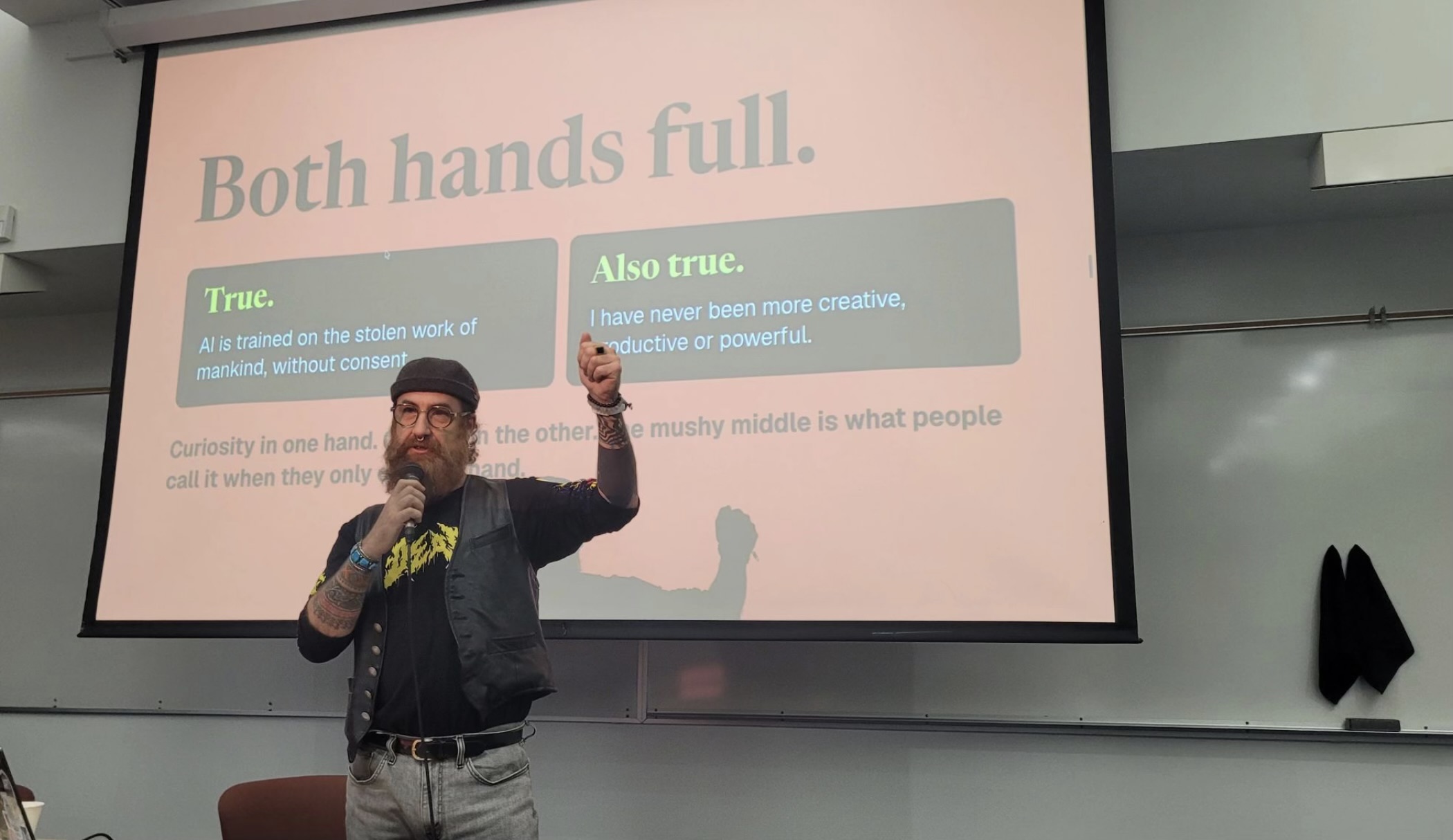
A keynote recap from AI Day, the IIBA x DAMA joint gathering at Robson Square, Saturday September 26, 2026. Fifteen minutes on stage. This is what came out.

Saturday morning, 9 AM, Robson Square. The IIBA and DAMA Vancouver had filled the seats for the second edition of AI Day, and the universe had decided my fifteen minutes would also include a live AV stress test. One mic that barely works. A Zoom handoff nobody tested. One bar of wifi. “Then grab me the HDMI, please.”
Fifteen minutes. Both hands. No pom-poms, no pitchforks. And the line that mattered most wasn’t even mine. It was written in chalk on a Montreal sidewalk the week before.
Both hands full

I opened with the only honest starting position I know:
“AI has been trained on all the stolen works of mankind without our consent. And I’m more creative, productive, and powerful than I’ve ever been in my whole life. Both those things are true.”
Every AI conversation right now tries to push you into one camp. The boosters: get on board or get left behind, loser. The burn-the-data-center crowd, angry about the non-consensual way AI kicked over the table, and I get the anger, but pearl-clutching doesn’t tell you what to say when your kid asks what careers will exist in ten years.
“So I don’t want to be in some sort of mushy middle ground. I think we need to walk forward with both hands full.” Curiosity in one. Critique in the other.
Montreal: the governance nobody gets to slogan away

The week before, I was at ALL IN, Canada’s biggest AI conference, in Montreal. It came days after Mark Carney’s economic summit in Toronto, $1.4 trillion of Canadian mega projects pitched to worldwide investors. Then in Montreal, AI minister Evan Solomon brought in his German counterpart and started making announcements.
The one to watch: Yoshua Bengio, the most cited AI researcher on the planet, founder of Mila, has a new safety and governance nonprofit called LawZero. Canada put in $150 million. Germany matched it. A middle-power path between hyperscaler America and hegemon China, with Germany, the UAE, Australia and Finland signing on. And alongside that, Mila and Mozilla launched an open-source AI initiative with federal backing: Mozilla put in the first $5 million, Hypertec added another million, to build a sovereign open-source AI foundation layer that Canadian organizations can own and operate locally.

Outside the convention center: hundreds of pissed off Quebecers in the streets. “Not without our consent, not without a seat at the table.” That morning, protesters broke the windows of Mila, the Montreal Machine Learning Institute, which is paradoxically ironic, because Mila is one of the best organizations on Earth doing exactly the safety and human-centered governance work the protesters want. Their fears are valid, even when their arguments are pretty weak. There is no real place to have the both-hands-full conversation, so people have it with bricks.
On the slide behind me, the protest chalk from the sidewalk: “There is no slogan that gets us out of doing the governance.”
A label is not accountability

Back home, we did the governance. The federal AI transparency consultation closed September 23, and it asked ordinary Canadians to answer hard questions about AI safety and transparency. Most Canadians don’t have the lexicon for that. So BC + AI downloaded the whole consultation, ran a two-month facilitated process at two of our monthly meetups, recorded and transcribed everything, built a knowledge base out of it, and pulled the patterns, quotes and findings into a formal submission, delivered through Taleeb Noormohamed, our MP.
The whole thing is public: What BC told Ottawa about AI transparency, with the full public record on GitHub.

The headline finding fits on a label: a label is not accountability. A label is a cigarette warning. Nobody ever got their money back from a cigarette warning.
Twelve hours a day to press enter

Then the one that’s been making its way around the internet all week. An engineer’s viral post, 5.8 million views and counting: “People are working 12 to 13 hours a day just to press enter.”
“We’ve got all this power, all these capabilities, and yet are we making ourselves dumber? Do we even know how to code at all anymore?”
That is not a strategy. That is a high five for a drowning person.
Ask who holds its memory

The assistant race went full sprint this month. Meta Muse connects to twenty-odd services on top of everything Meta already knows about you. “You’ve been talking to it for twenty years.” It’s a genuinely insightful portal into what assistants look like outside the chat box. Then the open and local end of the grid: OpenClaw, self-hosted, any model. Hermes Agent from Nous Research, yours. Grok Bot spawning sub-agents that make their own channels to talk to each other, which is quite incredible and slightly unhinged.
The axis that matters: open and local on one side, cloud and corporate on the other. Everybody shipped a personal assistant. Ask who holds its memory.
Jev doesn’t chat. It decides.


The drop of the week: Jev, from TypeSafe AI, founded by Diogo Almeida, co-author of the instruction-following research behind ChatGPT. Not a chatbot. Not an LLM. A decision model. Cheap on input tokens, zero cost on output, because it doesn’t output chat. It outputs decisions: yes, no, a score, with probabilities you can log, audit and argue with.
“Thirteen percent of paid Vercel users downloaded it within twenty four hours.” Fastest adoption in AI gateway history.
I put it to work immediately: “I ran through twenty seven thousand pages of documentation this week to look for drift. The document either drifted or not.” Drifted docs went to the LLM, came back in modern state, not stale state. That is the discipline half, shipped as an API.
The knowledge base is the asset

Then the close I actually care about. David Cox was up front with his Plaud on, I had mine on my wrist, and the advice is the same either way:
“Data is the new oil. Make personal data. Collect everything. Put it in a knowledge base. Use AI to analyze it. Deploy agents on top of that.”
“Any time I sign a new project for anything: start a new GitHub, make a knowledge base, build an agent, then get to work.” The tool I recommend is Obsidian: free, open source, your knowledge as local markdown with a knowledge graph on top. Models churn. Tools die. The knowledge base is the asset.
The most important graphic on the internet

Then I showed them my GitHub contribution graph. 32,780 contributions in the last year. “Who knows what this is? Come on, y’all. The most important graphic on the internet.”
You can read a life in it. “I dated a girl for two weeks right here. I went on a one-day vacation there in the sun.” And then the serious point: if you’re job hunting and don’t know what to do with AI, make your dot greener. Build the knowledge base, build assistants on top of it, get it running automated. Some of my dots happen without me logging in: agents checking email, making issues, reviewing them, turning them into PRs. That graph tells me more about a technical person than anything they could show or say.
The invitation


And then the pitch, because of course: Futureproof Festival of AI, October 28 to 30 at the Space Centre. “Our community’s response to Web Summit, which we find superficial and full of hype.” Thirty of the best speakers from around the world: Brewster Kahle, who started the Internet Archive. Philippe Pasquier, running the Metacreation Lab at SFU. Jos Duncan-Asé. The crew from Ethos Lab teaching STEM and AI to Black and Indigenous teenagers. Innovation leadership from the Buckminster Fuller Institute, for the Bucky fans. Practitioners, not pundits.

The code from stage: KK-LOCAL50, half off the Festival Pass, “only good for this weekend, only for us here.” The pricing was set for the Americans flying in, so the locals in the seats get the break. “I’ve been pouring my blood, sweat, and tears into it for the last three months.”
Walk forward

The Q&A after was the good kind: an audience member who only knew Copilot, asking how fast this moves. A month ago it was terrible at decks, a month later it’s fast. That’s the answer. There was a major Anthropic drop on Tuesday. OpenAI moved its models up a full version. Every week is a big week now.
The moment didn’t ask permission. Governance won’t do itself.
Walk forward with both hands full.
Kris Krüg is the Executive Director of the BC + AI Ecosystem Association. The original Both Hands Full talk is on YouTube and bothhandsfull.com. Futureproof Festival of AI runs October 28 to 30 in Vancouver: futureproof.website.