
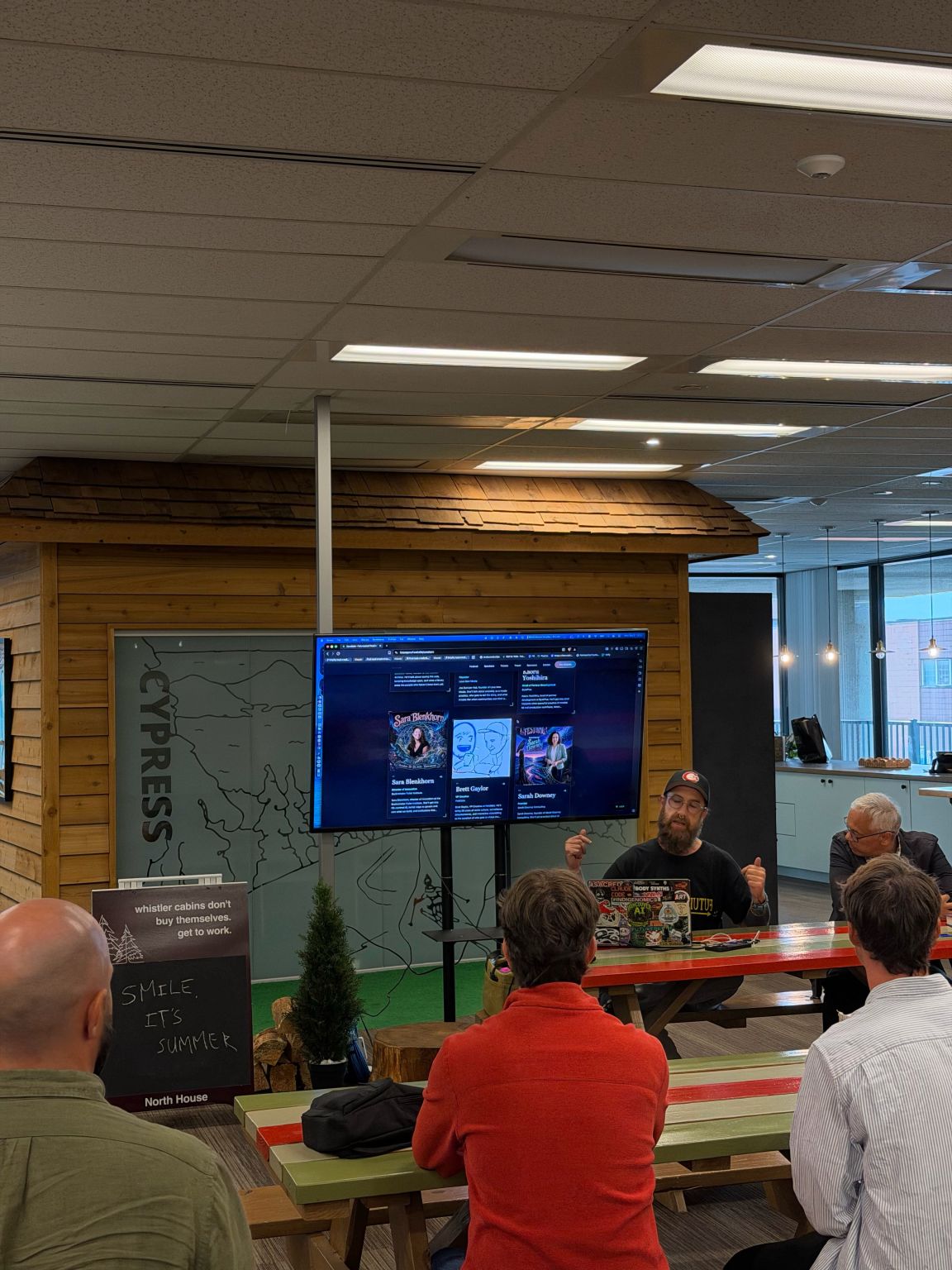

Joel Hansen put me and Praveen Varshney in front of the League of Innovators and North House founder cohorts yesterday. An hour, a picnic table, and a room that had clearly sat through enough AI panels to be suspicious of another one.
So I did not do the panel. I opened a laptop and showed them the thing I actually do every day.
The whole workflow is one habit
I do not start anything anymore without starting a GitHub repo.
That is the entire trick. New assignment, new project, any discrete chunk of work: step one is a repo. Then I go to Claude and say here is the brief, let us set up a project for this. Now the thing has a home, it is backed up, I can roll it back, and every agent I point at it knows where to look.
Then I fill it. I talk my ideas into it as prompts, and I have agents go pull the context from wherever it already lives, my Google Drive, my local drives, the transcript of the call where I got the assignment. If I am wearing my executive director hat, that means the mission statement, the vision, the customer notes, the strategy docs, the brand guidelines, my voice guidelines. All of it goes in as context.
That is a second brain, scoped to one project. And it compounds. When the next project starts, I port the useful parts of the last one across, so every project starts about twenty percent smarter than the one before it. Sedimentary layers.
The part that made the room sit up
The day before the talk, at four in the afternoon, I took a Word doc, a pile of meeting transcripts, and a GitHub repo full of other people’s comments, and turned it into a public web page for Canada’s AI Transparency Task Force.
Explainer sections for what the federal consultation is even asking. A little interactive widget so people can poke at the transparency principles themselves. Anonymized quotes pulled from the transcripts. The themes that actually emerged. Diagrams of who the interested parties are. Photos from the night we held the meetups.
I worked on it from four to five fifteen, about seventy five minutes, then I had to leave the house and the agents kept going without me. I rolled into the six o’clock meeting with my laptop half open under my arm, still running.
The point is not that it was fast. The point is that when you work this way you can turn anything into anything else whenever you need it to be something. The submittable report and the public page came out of the same pile.
And it was all built in the open. People responded in public, in the repo, and the analysis happened there too.
Nobody in that room wanted the booster pitch
Every AI conversation tries to sort you into one of two camps. Boosters: get on board, you snooze you lose. Doomers: no data centres in our backyard, you cannot drink data.
Both of those are true at the same time. There are real societal risks around education, careers, and our identities as they relate to our own work. And the transformational power of this stuff in our businesses and our communities is undeniable. You do not get to put either one down if you want to be honest about the moment.
I have concerns about surveillance and about power consolidating into a handful of corporations and governments. I also just built a public policy report in seventy five minutes. Both.
The BC argument, with the actual numbers
Canada has three federally funded AI centres of excellence. Mila in Montreal, the Vector Institute in Toronto, and Amii in Edmonton. About a billion dollars between them, and the federal government’s own study puts the economic return at four to five times that. Mila employs around seven hundred AI PhDs. Amii around four hundred.
British Columbia has none of that. We have the Cedar supercomputer, the most powerful in the country. We have thirty year old labs at SFU and UBC full of first order researchers. And no centre.
Meanwhile the province capped data centre power at one hundred and fifty megawatts a year for two years. Three hundred megawatts total. Two allocations of seventy megawatts a year are already spoken for, so about half is gone before anyone else applies. The ones going up in the States are 1.5 gigawatts each. The one Alberta is talking about is 1.7 gigawatts in a single building.
So the honest options are: buy our tokens from Alberta, buy them from Silicon Valley, or build here in a way that fits our values. I want the third one. Clean, green hydropower data centres, and if a chunk of that compute is going to national defence and Telus, then some of it flows back to schools and communities. We want to be part of the bargain, not a business tech ghetto.
That is why the BC + AI Ecosystem Association exists. One year old, about three hundred members. Coming together is how you get a phone call returned. The rooms we run are the whole mechanism.
The best question was the skeptical one
Somewhere in the middle a founder pushed back properly. His argument: the tooling is obviously valuable to people like us, but there is a big gap between that and any measurable effect on the real economy. Enterprise integrations are struggling. He wanted to know whether the hype can hold up long enough to get to the robots, and whether small startups are just going to get eaten by the inference layer.
I could not give him a clean answer, because there is not one. My own technical capability is genuinely ten times what it was. I deploy servers, set up DNS, run web apps I built myself, wire it into automations. I could not do any of that before.
But he is right about the gap. We went from maybe ten thousand power users to a million. Going to a billion needs power, data centres, and robotics arms that do not exist yet. General Electric is roughly six years backlogged on the turbines that would spin the chips. Somebody else in the room, who lives in Accra and spends time in China, pointed out that a copper mine takes fifteen years to spool up. Big energy builds take longer still.
You cannot agent your way around a copper mine.
The thing I keep thinking about
That same guy said something that stuck. Nobody where he lives is a doomer. It does not matter what age you are, there is no debate about whether AI is good or bad. It is happening, it is good, and the question is how to be part of it. Super intelligence works the same in Accra as it does in Vancouver.
Then he comes here and finds us tearing each other apart about it.
I do not think that means they are right and we are wrong. Central planning buys speed and costs something else, and I would rather argue in public than be pointed in a direction five years at a time. But it is worth noticing that the divisiveness is ours. It is a choice we are making, not a property of the technology. I have written about that before.
One challenge to take home
If you want a concrete thing to try: use your favourite AI as your interface and do the rest of your work through it.
I authenticate into everything. Drive, mail, calendar, CRM, Canva. I have repos living in Claude Code and I talk to all of it through one assistant. I do not check email. I send a text, it triages, archives the notifications, unsubscribes me from whatever crept in, finds the ten things that actually need me, drafts them, and tells me what order to deal with them in. I can launch a full agent workflow by voice while I am driving.
My voice model has been getting trained for two and a half years and it is close enough now that I am mostly making stylistic tweaks rather than rewriting answers. It is self recursive, too. Every email I send goes back into the knowledge base.
That is the whole talk, really. Not a tool list. One habit, applied until it compounds.

Thanks to Joel Hansen and North House for the room, and to Praveen for being a genuinely good foil. If you want the longer version of this argument with a lot more people in it, that is what Futureproof is for.