
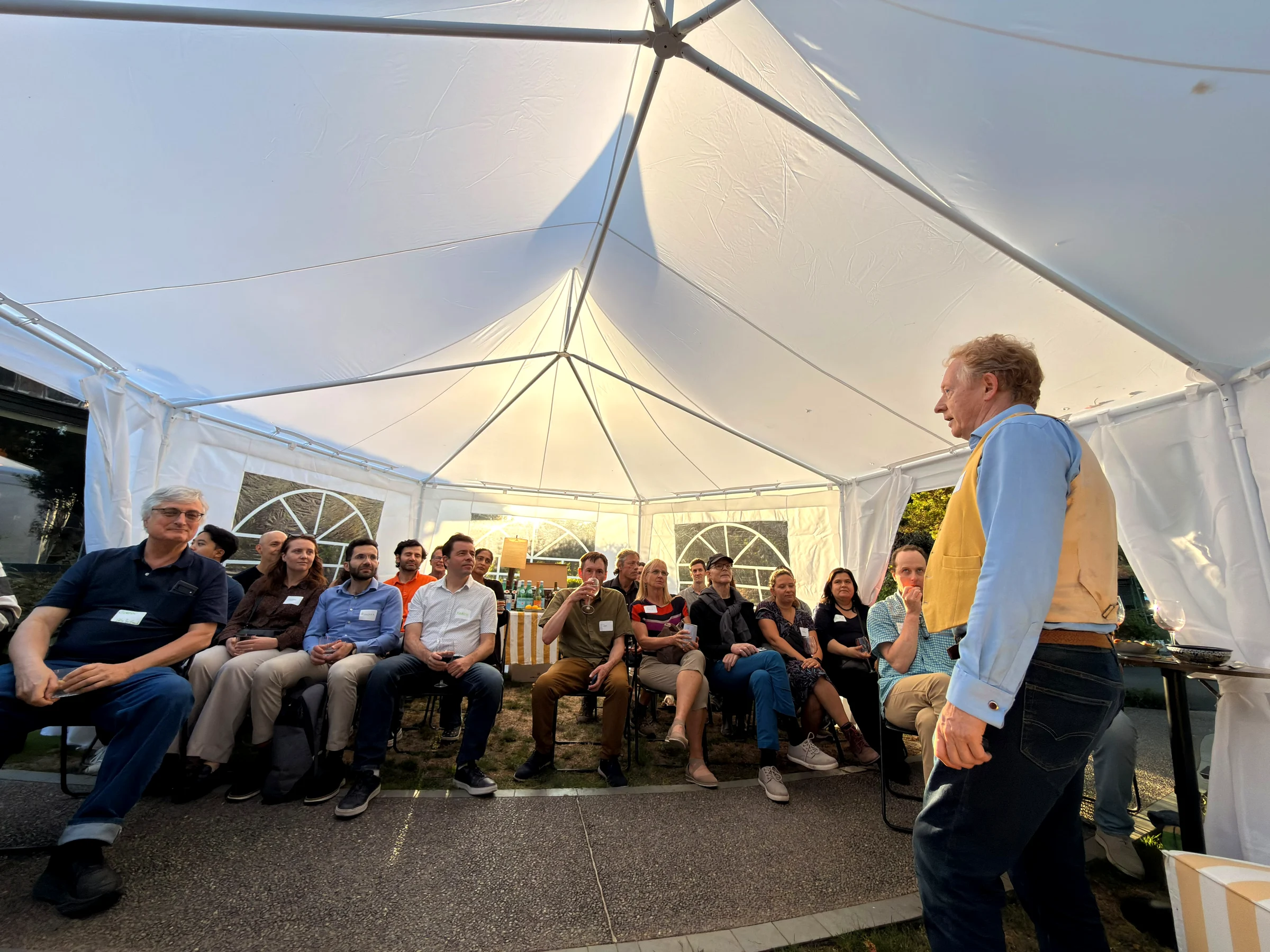
Above: the September 8, 2026 Life Sciences gathering. Photo: BC + AI Life Sciences community. View the full photograph · Gallery and recap.
I’ve known Sarah Blyth for a long time. Seeing her work connect with our AI and life sciences community gets my attention. There are people in that room who know how to design molecules. Sarah knows what happens to people while the rest of us are still discussing the possibilities.
Simon Haworth wrote a piece for Vancouver Tech Journal about the Life Sciences group’s visit to the Downtown Eastside. Mauricio Penteado helped organise it. Sarah and the Overdose Prevention Society welcomed them in.
I like Simon’s piece. He lets his discomfort into the story. He pays attention. He comes away with specific ideas about where the group might help.
This is the part of building BC + AI that gets me going. You bring people together, feed them, give them somewhere to think out loud, and eventually somebody takes the conversation somewhere it needs to go. In this case, East Hastings.
I want to follow that conversation a little further. I’ve been carrying a camera through this city for years. I’ve also spent enough time around technology to know how easily we confuse being clever with being useful.
I’ve brought an expensive gadget here before
In 2010, I wrote Photography Ethics on Vancouver’s Downtown Eastside. I was working on a project for Lookout Shelters, with Buschlen Mowatt Gallery and Joshua Dunford, asking how to photograph people in difficult circumstances with some decency.
I called the DTES my neighbourhood. That made the questions personal. I could make a photograph, publish it, get something out of it. What did the person in the photograph get?
Sixteen years later, I can ask much the same thing about a transcript, a dataset or an AI system. The equipment has changed. We still need to talk about permission, control and who gets paid in something more substantial than exposure.
You can know how to use a camera and still have a lot to learn about looking at people. I suspect knowing how to use AI works much the same way.
That includes me. I love these tools. I build with them constantly. My enthusiasm gives me plenty of reasons to check my own work.

There’s a person inside the name
The Ashtrey Recovery Resource Centre is at 450 East Hastings. Food, showers, laundry, housing support, recovery-focused programming. The ordinary things that become very difficult to organise when your life is coming apart.
The name honours Trey Helten, who went from peer support to managing OPS and spent years helping people in the neighbourhood. Ashtrey. There’s a life in that spelling.
OPS has been responding to the overdose crisis since 2016. Alongside overdose response, its work includes recovery support and connections to medical and mental health care. The province’s September statement describes the Ashtrey’s role in providing essential services.
Think about the knowledge behind that work. Which referral might actually go somewhere. What makes it possible for someone to accept help. How to keep working with a person who has good reasons to distrust an institution.
You learn some of that by staying. Sarah and the people around her have been staying for years.
So yes, bring the technical skills. I’m interested in what happens when people with those skills are also willing to be the least knowledgeable person in the conversation for a while.
Simon keeps making the table bigger
Simon Haworth works on AI and drug discovery at Intellomx. He also feeds people. I appreciate both qualifications.
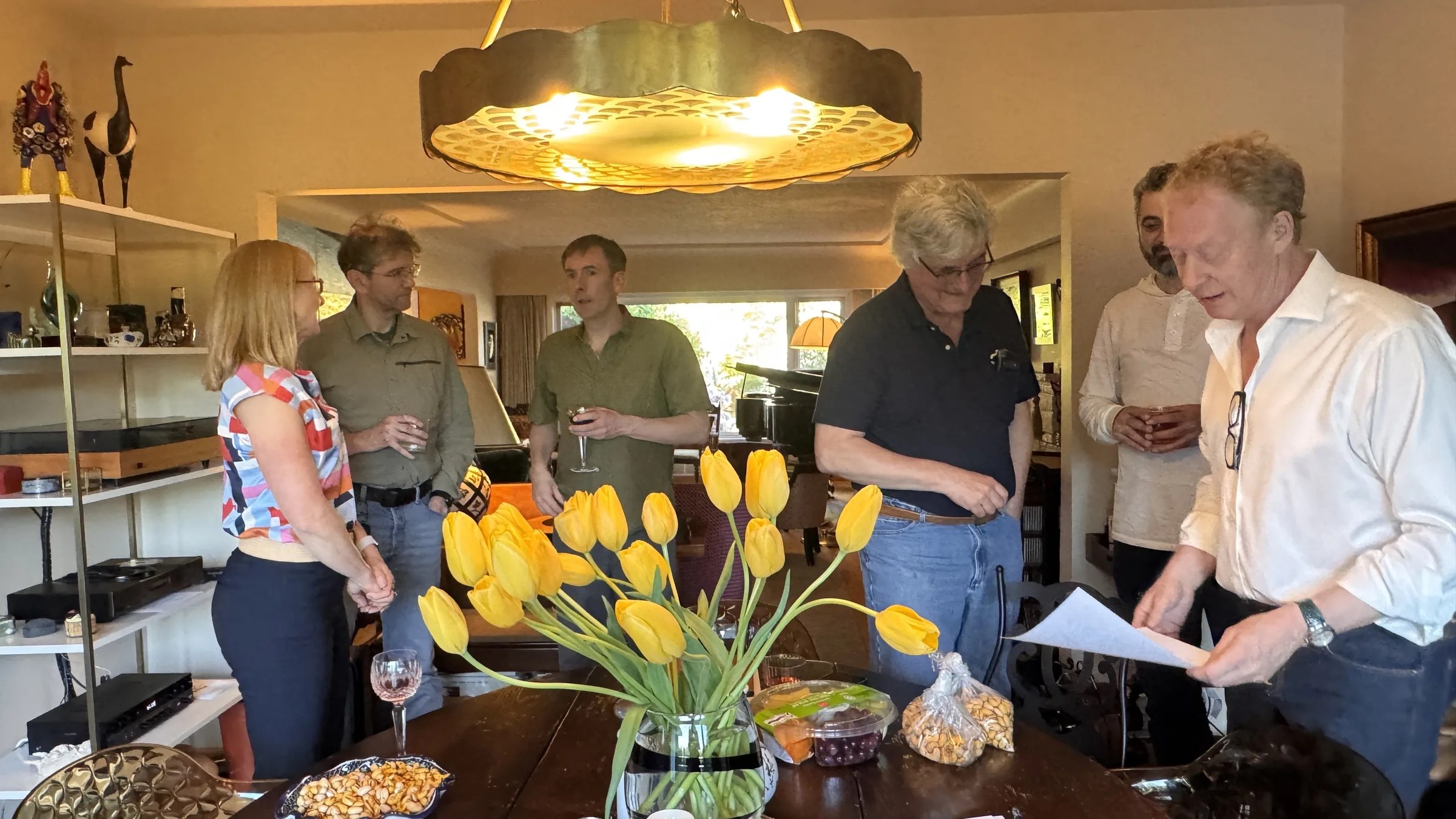
The BC + AI Life Sciences group brings clinicians, researchers, engineers and health system people into a conversation that has grown from a supper table into a backyard marquee. You can follow it through the May gathering, the August supper, and the September evening.
Somewhere in all our enthusiasm for organising events, we can forget what a host actually does. Somebody makes room. Somebody notices who hasn’t spoken. Somebody puts dinner on the table so people have a reason to stay after the presentation.
Simon is doing that work. It’s part of why people with very different kinds of knowledge are finding one another.
I helped build BC + AI for conversations like these. I want the people who understand the software to know people whose work gives that software a reason to exist. And I want those relationships to be strong enough to survive somebody saying, “Actually, that won’t help us.”
Start with the paperwork
The work Simon describes falls into three areas: administration and data, checking public claims, and biotech research. Each asks something different of the people offering to help.
The paperwork is where my builder brain goes first. Simon describes paper records that take time to process. I’ve spent a lot of time turning my own scattered notes, conversations and transcripts into a knowledge base I can ask questions of. I know the pleasure of finding something without conducting an archaeological dig through my own files.
Could those methods help OPS assemble a funder report? Find an earlier decision? Stop someone retyping information they’ve already recorded twice?
I’d start by sitting beside the person doing the task. Let them walk through it. Find out which parts consume their day and which parts require judgment a stranger might not even notice.
Then try something small enough to check. Keep the records under OPS’s control. Make it easy to find the source behind an answer. Ask the person doing the work whether it actually helped.
If a model invents a number in a funder report, Sarah’s crew gets to spend the time we supposedly saved cleaning up our bullshit. That belongs in the calculation too.
Keep the source attached
The second area is helping OPS respond to public claims about the DTES. Following coverage, finding the original statement, checking what it rests on: all of that takes time.
I can see a useful role for software that gathers the material and keeps a clear trail back to the source. Who said it? When? What evidence was offered? Has it been corrected since?
The person reviewing it needs to be able to disagree with the machine and show why. An answer that arrives with perfect grammar and no checkable source is a fairly expensive rumour.
The same standard applies when the answer happens to support something I already believe. Especially then.
Give the science enough room to be science
Simon also points to research involving GLP-1 drugs and antibodies that bind fentanyl. This is where his drug discovery background brings a different set of possibilities into the conversation.
Penn State describes early GLP-1 clinical research alongside existing medications for opioid use disorder. Cessation Therapeutics is developing an experimental anti-fentanyl antibody. There is research to follow, and evidence still to establish.
Meanwhile, BC’s clinical guidance supports established treatments including methadone and buprenorphine. A promising research direction gives us no reason to dismiss care people can receive now.
I’m interested in what Simon and other researchers can contribute. I’m also unwilling to turn an early trial into a promise made to somebody whose life is on the line. We owe people a straight answer about how far along the work is.
Mauricio is doing the connecting
Mauricio Penteado helped coordinate the OPS visit. In his community spotlight, he talks about the Life Sciences group’s work with OPS and supporting both the people using its services and the people delivering them.
That connection matters. You can have a room full of expertise and still need somebody who gets the right people talking to each other. Mauricio is putting time into that. Give him a couple of minutes here.

The DTES has something to teach AI
There’s another conversation already happening in this neighbourhood that belongs beside this one.
Sev Geraskin and April Ai, through the Economy of Wisdom Foundation, have been asking people in the Downtown Eastside what AI should learn from humans. I wrote about their work in The AI Values Gap. Compassion is central to the findings. Their working paper, Whose Values Train AI?, draws on 51 interviews. The foundation publishes the findings and methodology together, so you can see what they asked and how they interpreted the answers.
I keep coming back to the direction of that question. People whose lives are so often discussed by somebody else are being asked what the technology should learn from them.
That should affect more than the introduction to a research paper. If somebody tells you compassion matters, what changes in the thing you build? Can a person correct it? Refuse it? Get help from another person when the software gets stuck?
In The AI Trust Gap Is Not an Education Problem, I argued that people have reasonable questions about who makes the decisions and who carries the risk. Explaining a model more enthusiastically doesn’t answer those questions.
Sarah knows things about care that a software developer could spend years failing to notice. People using OPS know things about access, dignity and institutional failure that ought to change the design. Simon brings knowledge of biology and drug discovery. Mauricio is helping make the connections.
I want to see what they can figure out together. Each has something to contribute, and each has something to learn. That’s a much more interesting prospect than another room of AI people agreeing with one another.
Be useful enough to get invited back
If you have data skills, research experience or a knack for making an administrative mess less painful, start with the Life Sciences group. Read Simon’s piece. Learn about OPS. Be specific about what you can offer and how much time you can actually give it.
I want to come back to this story with something we can examine: what Sarah’s crew asked for, what got built, whether it saved them any time, and who’s still answering when something breaks.
That feels like a decent way to find out how intelligent we’re getting.