
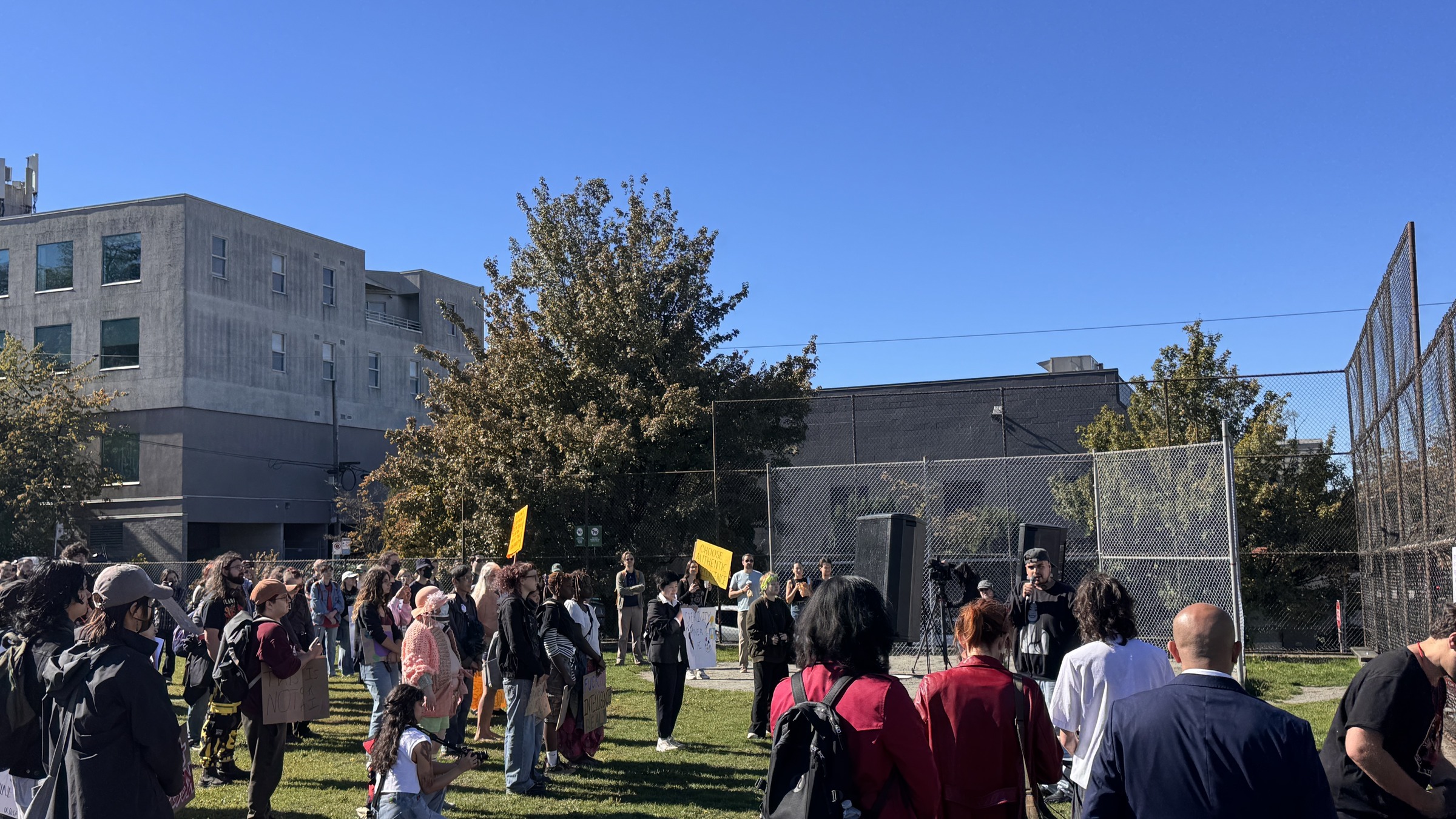
Featured photo: Kris Krüg.
vancouver’s ai data center fight
Vancouver, October 3, 2026.
Cedar George-Parker started with the moss.
Elders taking children onto the water, into the mountains, teaching them that the moss was a relative. Then his grandmother’s account of what it meant to be rich: how much you give. He thanked people for giving their time to stand up for the land and the people who live on it.
At an AI protest. Before the candidates got to the microphone.
I run BC + AI. I spend plenty of time talking about what these machines can do. Cedar was talking about what we owe. The moss wasn’t waiting for a product demo.
He moved from salmon to forests, from the health of the water to the health of future generations. He connected the data-centre fight to pipelines and dredging, and asked why public money couldn’t go toward restoration and social programs instead. Different projects, the same questions about whose home becomes somebody else’s business opportunity.
That’s where this gets interesting. A sign can tell you somebody hates AI. Cedar was describing a relationship to the land that puts obligations on anybody who wants to build anything there. Much harder to wave away.
The pipeline. The dredging. The server warehouse. I heard him tying the movements together, widening the fight beyond which machine we were supposed to be mad at today.
Who’s a thirsty little capitalism?
There it is. The appetite behind the appetite. My useful little tools have a power cord, and the cord leads to land, water, money and decisions about who gets to use them. I can be delighted by what I make and still follow that cord all the way to the people carrying the cost.
Both hands full. Especially here.

The inlet is not a backdrop

After Cedar’s opening, I talked with him about Gabriel, somebody I know through our community work. It was a small overlap between people who know people, right there at the protest. The connection mattered to me. It didn’t settle the argument.
Gabriel George Sr. has opened our AI community gatherings with prayer, song and stories. My relationship with Tsleil-Waututh Nation belongs in this story, with its limits intact. Nobody’s welcome becomes the Nation’s endorsement of my politics or a data-centre proposal.
I live and work on unceded Coast Salish territories. I’ve said that publicly. Cedar’s opening gave that sentence work to do.
He spoke about permission carrying responsibilities to the water, the land, healthy people and future generations. He described wealth through giving rather than accumulation. By the time he got to the salmon, the usual growth pitch had a considerably harder job ahead of it.
I want to build things. So what am I giving? Who gets authority over what I’m proposing? Can they refuse, or have I already decided that their participation means helping me get to yes?
Tsleil-Waututh calls itself the People of the Inlet and describes responsibilities to water, land, air and resources across generations. The inlet isn’t available to become a scenic illustration of my clean-compute pitch. It’s somebody’s home, with rights and obligations that don’t begin when a developer submits an application.
I had a correction to carry from Montreal too. I reached for the easy clean-hydropower story. Jeff Ward of Animikii pushed back about hydro’s difficult history with First Nations.
Right. Green electricity doesn’t finish the argument about the river. My enthusiasm doesn’t get to delete the inconvenient paragraph.
Later, Cedar came back to connect people with the water-protection organizing around dredging. The AI gathering could help people find another struggle instead of guarding its own little patch of attention. That was the part I wanted to stay with: people joining their gifts, their time and their pressure across causes.
The demand gets bigger than stopping one building. What would we restore? What would we fund? Who would have power over the answer?
Stephanie brought the questions a slogan can’t answer
Then Stephanie Smith, running for council with the Vancouver Greens, got into the details.
Public power. Public land. Industrial space. Local jobs. Data in the hands of city government. She asked who controls the systems and who benefits from them, and challenged the habit of building first and sorting out the rules afterward.
This was the critical dialogue I had been wanting more of at these protests. The speech gave me things to interrogate, not simply a louder version of no.
On municipal AI, she asked what the systems would touch: constituent correspondence, personnel files, procurement documents. Where would the information be hosted? Who trained the systems? Where would the outputs go?
Good. Those questions survive whether you think AI is miraculous, monstrous, or mostly a very confident autocomplete with a marketing budget.
Her energy argument was about choices. Power allocated to a data centre can’t simultaneously do every other job we want electricity to do. She challenged the claim that the proposed use of downtown land and Mount Pleasant industrial space would serve local employment well enough to justify it.
Those were her arguments. They need project documents, energy accounting and employment evidence behind them. I want the answers, not an impressive-looking number that changes every time somebody repeats it.
She also called for binding rules on customer mix and data residency. A sovereignty label ought to have something enforceable underneath it. Put ownership, control and public obligations where somebody can check them.
Then she widened the frame too: extraction of land, water, knowledge and wealth. A municipal land-use decision sitting inside a much larger argument about our future.
That sequence mattered. Cedar began with relatives, giving and responsibility. Stephanie brought the power allocation, the land use and the public-data questions. I didn’t need to share every position on that microphone to recognize a conversation getting more useful.
The earlier AI and Climate Impact panel, including its water-justice and data-centre discussion, is another place to follow those questions. The work didn’t begin this afternoon.
The ballot was already in the street

The organizers acknowledged disagreement about how far to go. Some wanted enforceable regulation; others wanted to stop the projects altogether. A moratorium was the floor they were trying to stand on together.
Useful. An imperfect coalition can still agree on the next decision it wants changed.
COPE’s published platform calls for an AI data-centre moratorium, an acceptable-use policy for city officials and employees, and challenges the rollout of Copilot in schools without meaningful consultation. Those are the party’s positions. My attendance doesn’t turn this article into its campaign copy.
I had already written AI Is Already a Campaign Issue in Vancouver. Here were the land, labour and public-data questions, out in the street with people attached.
The procedural distinction still matters. In July, council reversed the referral of the Mount Pleasant M3 application to a public hearing. Daily Hive reported that it went back to staff, with further consultation expected after the election. Neither approval nor rejection.
Organizers described their pressure as a win. Time is worth winning. Somebody still gets to decide what happens next.
The BC + AI civic voter guide’s municipal record keeps the proposals, the council vote and the limits of the evidence together. Requested power and actual use are different figures. Water withdrawal and water consumption are different figures. Unknown is not zero.
I wrote about the less photogenic part of organizing in What Twenty People in a Studio Told the Federal Government About AI: reading the questions, arguing through them, writing the response. The signs get people looking. Somebody has to keep doing the homework after they look away.
I photographed the earlier May march too. Different day. Same obligation to carry the argument beyond the cardboard.

Show me the deal

Back in May, I made WHO’S A THIRSTY LITTLE DATA CENTER? with AI. Baby-talk aimed at industrial infrastructure, generated by the machinery whose appetite I was questioning.
MY POSITION: YES. ALSO: HELP. Ruthlessly optimistic and absolutely terrified. Both hands full. Still inconvenient for anybody trying to sort me into a useful marketing segment.
AI is trained on stolen work without consent, and these tools have made me more creative and productive. I carry both. The contradiction includes me, and staying involved means I have to answer questions too.
I want small crews of beautiful weirdos to get useful tools and affordable compute. I want people who will never come to my meetup to have a real say in what gets built around them. Their objections don’t become less legitimate because they haven’t enjoyed my demo.
Sovereign AI for Whom? remains the question. A Canadian address tells me where the building is. I still need to know who owns it, who controls access, who benefits and who pays.
The BC + AI version puts trust, consent and accountability into the infrastructure argument. Our AI Task Force platform calls for clean-energy data centres, heat reuse, public dashboards and community compute. Those are asks, not proof that a proposed facility has delivered them.
I worked through the energy and ownership questions in Both Hands on the Power Cord, alongside the Power Struggle conversation republished on my channel. The earlier interview is below.
Earlier interview, republished on my channel with permission. Not footage from today’s protest. Watch on YouTube.
Show me the receipts before you pour the slab. Disclose ownership and resource use. Make the load pay for its load. Put Indigenous authority into governance from the start. Reserve affordable capacity for public-interest work. Specify the jobs, procurement and value that stay here.
Tell us who checks, who pays when a promise fails, and who can stop the thing. Then write it where those answers can be enforced.
Cedar’s account of wealth through giving stays with me. Stephanie’s questions about public power and public land stay with me. Together they make my favourite thirsty-server joke do some actual work.
The appetite isn’t only in the building. It’s in the deal that decides what the building can take, and what the people living around it get to demand in return.
Who’s the thirsty little democracy?
The people making signs shouldn’t have to become unpaid forensic accountants to find out. The people making useful things with AI shouldn’t have to cheer for every warehouse proposed in their name.
I want to keep building. I want people to be able to say no. Now show me a deal that can hold both.
Other people doing the homework
These are earlier reports, not dispatches from today’s protest. Credit where it’s due. Read them alongside this dispatch.
- Capilano Courier, October 1: No AI in Vancouver – How a student’s Instagram account became a movement, with the council process and election attached; cardboard doesn’t organize itself.
- Canada’s National Observer, June 29: In cities across Canada, hundreds gather to oppose unchecked AI data centre proliferation – Pulls back from Vancouver to the national fight over who gets information, time and a say before the servers arrive.
- Martlet, August 27: AI data centers are coming to Vancouver, but the community is pushing back – Follows the July council reversal into the election fight: buying time matters, but it isn’t the same as stopping a project.
- The Tyee, July 10: Vancouver’s growing anti-AI movement – Gets inside the early organizing and the grievances wider than data centres; useful if you’ve been filing the whole crowd under people who don’t understand computers.
Election information: The City of Vancouver’s official notice lists the remaining advance-voting dates as October 7, 10 and 13, with Election Day on October 17. Voting places are open 8 am to 8 pm. Check the City’s eligibility, ID and voting-place information directly.