
I had not even boarded the plane to Montréal when Canada started making its case to me in the departure lounge.
One guy had a voice model waiting for a benchmark. Another guy, once I finally got on the plane, had a room he wanted to teach how to play with the people inside it. Somewhere between those two conversations I got in the wrong boarding line and started thinking about national technological sovereignty.
This is more or less how my life works now.
Crazy times. Crazy people building strange machines. Crazy words everywhere. Sovereignty. Sentience. World models. Autonomous systems. Most of them sound impressive right up until you put a human being in front of the thing and ask it to work.
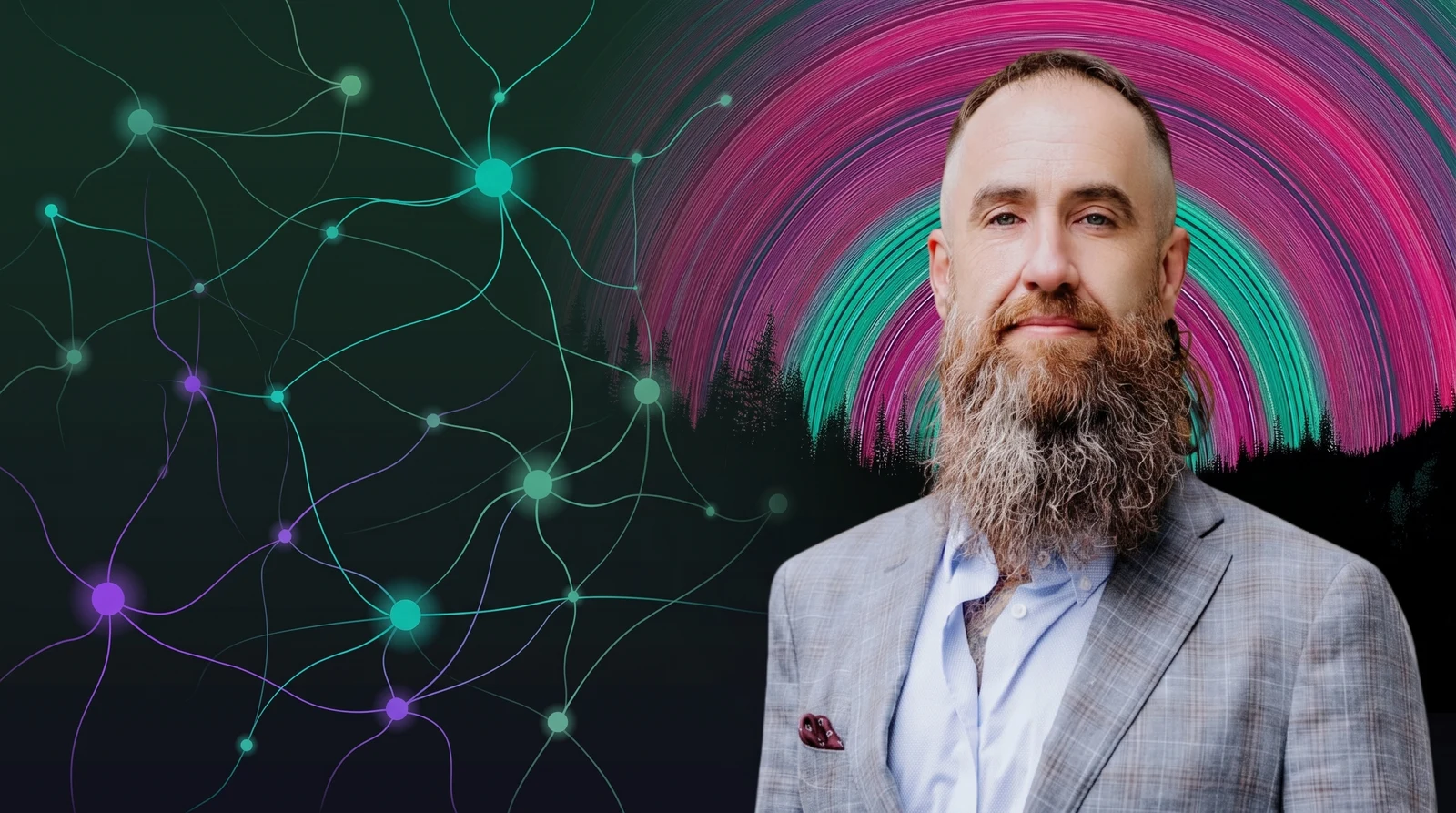
That is what I am carrying into ALL IN in Montréal on September 16 and 17. I am there as accredited media, but I am not a neutral observer floating above the action in a clean white lab coat. I run the nonprofit BC + AI Ecosystem Association. I teach people to use this stuff. I organize Futureproof Festival. I build with agents every day and swear at them most days.
I am reporting on a world I am also trying to build. Both hands full, as usual. Curiosity in one. Critique in the other.
The voice in the departure lounge
The first conversation was with Justin Hinchcliffe, VP of commercialization and operations at Alebex, a Vancouver company built out of the Alexander Innovation Centre.
Alebex has been working on education technology and voice agents for admissions follow-ups. According to Justin, unreliable answers and a voice pipeline that drove the crew nuts pushed them toward building more of the underlying technology themselves.
I love this part of the Canadian AI story. Somebody gets sick of a thing being shitty and decides to make the thing.
The model is streaming speech recognition. That means it cannot simply produce the right sentence eventually, after everybody has died of old age. It has to hear you, work out whether you are finished talking, and return useful words fast enough to keep a conversation alive.
Anyone who has been trapped in one of those cursed phone trees knows the stakes. You say your name. It guesses the name of a town in Ohio. You correct it. It apologizes with all the warmth of a parking meter and sends you back to the beginning.
Justin said they were waiting on an independent benchmark and hoping for a top ten result. I have not seen that result. I have not tested the model. I am stoked about the attempt, which is not the same as certifying the achievement.
So I started poking.
Where did the training data come from? The engineers could answer that, he said. Who was using it? He described an education technology partnership using voice agents for admissions follow-ups. How does it behave when somebody interrupts, changes direction halfway through a sentence, or has a name the model has never seen before?
Mine, for instance.
Then I asked for a developer account, because I am incapable of hearing about a new machine without wanting to push all its buttons.
This is the useful tension. A small Vancouver crew taking a serious swing at speech technology gets a hell yes from me. Then it gets my questions. If we want Canadian technology to matter, we have to be willing to try it, break it, inspect it and tell the truth about what happened.
We talked about Canadian hosting, compute, funding, and the special species of engineer who can drag a research result out of a paper and make it survive contact with Tuesday morning.
Everybody is going to say “sovereign AI” this week. Fine. Show me the machinery.
Which parts can we actually operate? Which parts can we repair? Who controls the data? Who trained the model, on what, and with whose permission? What keeps working when a supplier in another country wakes up and changes the price, the terms, or the politics?
You cannot run a sovereign stack on sovereign vibes.
A Canadian mailing address is not an architecture diagram. Independence takes people who understand the machinery, enough compute to run it, and enough money to keep those people from leaving.
At roughly this point I realized I was standing in the wrong boarding line.
Humbling. One minute I am interrogating the operating conditions for national technological independence. The next minute I cannot independently operate myself onto an airplane.
The room on the plane
My seatmate was Milton Lim, a performance creator, game designer, Concordia PhD researcher, and co-founder of Vancouver’s STUDIO FUNFUG. He also works with Moment Factory‘s innovation group.

I started interviewing him before establishing that he was not going to ALL IN. He was going home.
Classic Krüg fieldwork.
Milton described an exploratory idea for a “sentient venue,” a behavioural agent that could respond to a room and the people inside it.
My brain immediately hijacked the concept and moved it into the H.R. MacMillan Space Centre.
Lights. Sound. Projection. Sensors. Documentation. Hundreds of people moving through a building over three days. Could the room notice what was happening? Could it answer back? Could it surprise us? Could the venue become a participant instead of a container?
This is where the language gets dangerous and fun. “Sentient” is a hell of a word. It drags consciousness, agency and a century of science fiction into the room before the prototype has even found the light switch.
Milton was careful. This was an exploratory direction, not a finished autonomous venue. He also told me about a separate participatory experiment that got caught in its own logic. He did not think it succeeded.
I leaned in harder.
Anybody can give you the polished demo story. The interesting people can tell you where the thing folded in on itself, what the room did that the designers did not expect, and why the failed attempt still mattered.
That is where the actual knowledge lives.
Milton’s work with Patrick Blenkarn on asses.masses gives you a taste of the territory. A live audience plays a video game about unemployed donkeys trying to get their jobs back. One controller moves through the room. The audience has to decide how to proceed together.

Who gets the controller? Who accepts the rules? What happens when the game on the screen becomes a negotiation among actual bodies in actual seats?

Labour and power stop being panel topics and become something happening in the room.
To be clear, asses.masses is their artistic practice, not a demo of the sentient venue idea. Both involve rooms, people and computers, but I am not going to throw them into the same conceptual blender just because the smoothie comes out sounding futuristic.
Milton also told me about I am Echoborg, where a performer delivers the words of an AI-generated character while an audience tries to influence the conversation. Again, the machine is not the whole show. The social negotiation around the machine is the show.
That distinction matters.
We spend an absurd amount of time asking what AI can generate. I am more interested in what it makes people do together.
Downstairs with the artists
Then Milton told me a story about a gathering at the National Arts Centre.
His group was downstairs talking about technology, performance and the environment. Upstairs, as he recalled it, was a military conference with Lockheed Martin in the mix. He suggested they go upstairs and participate.
People laughed.
I cannot stop thinking about those stairs.
There it is. The whole bloody problem in one building.
Downstairs, artists and cultural workers asking what technology does to bodies, stories, environments and relationships. Upstairs, people with budgets, procurement systems and the power to put technology into the world at scale.
The answer is not that one floor contains virtue and the other contains villains. That is too easy and mostly useless. The problem is that they can occupy the same building without meeting until every important decision has already hardened.
An artist notices something an engineer misses. A clinician sees a consequence a founder has described as a feature. A community organizer knows who will pay for the friction everyone else has hidden in the slide deck.
Bring those people in early enough and the work can still change. Invite them after procurement and you have mostly commissioned commentary.
This is why I keep building rooms.

The archive is alive too
Milton co-founded videocan, a performing arts video archive. He described a process where artists are paid to revisit recordings of performances while someone asks questions.
Stop there. Why did you make that gesture? What was supposed to happen in the room? What failed? What did the audience understand that the camera missed?
I have spent years documenting people. A recording preserves the event, sort of. The commentary preserves decisions, relationships and little flashes of intelligence that the image alone cannot carry.
I immediately wanted to connect Milton with Andrea Mills at Internet Archive Canada.
And then the next problem arrived right on schedule.
An archive being available to watch does not mean it is available to train a model. Public access is not blanket permission. A performance contains artists, bodies, rights, context and relationships. If we are going to give archives a new life through AI, then consent and compensation have to come with them.
The archive is not dead material waiting for a hungry machine. It is the residue of living people.
Meanwhile, Vancouver is arguing about zombies
Back home, Dr. Loki Jörgenson convenes our Mind, AI & Consciousness group. They read and argue about embodiment, free will, philosophical zombies and synthetic biological minds.
A philosophical zombie is something that behaves exactly like a conscious person while having no inner experience. It does not tell us whether a particular AI is conscious. It asks what behaviour could ever prove.
Milton came at related territory through virtual companions. What happens when an entity travels with someone through years of their life? What happens to the data and the relationship when that person dies, or the company folds, or the service simply disappears behind a cheerful sunset email?
I do not need to settle machine consciousness before breakfast to care about a human becoming attached to a machine.
The human obligation arrives before the metaphysical answer.
Dr. Angelica Lim, the SFU roboticist and Amii Fellow, is scheduled at ALL IN to speak about world models and autonomous systems. I want to ask her what happens to evaluation when the person interacting with a system understands it very differently from the person who designed it.

The engineers measure one thing. The person in the room experiences another. Somewhere in that gap, the real system appears.
Point the questions at my laptop
I use AI agents constantly. I love them. I also know exactly how weird this can get.
Before leaving for Montréal I had an agent pulling together a view across financial accounts, tickets, course sales, balances and recurring revenue. That is astonishingly useful.
I have also watched agents personalize a message from my notes and completely fumble the relationship. They know facts about the person but do not know how I know them. They invent familiarity. They sand off the odd little detail that made the relationship real. They produce perfect sentences that sound like nobody alive.
Knowing information about a person and knowing how to speak to them are different kinds of intelligence.
That is not an abstract concern. Our AI Ethical Futures Lab spent weeks examining what happens when agents can do things with real consequences. One participant asked the question that keeps following me around: what system is built in to make it right when the machine gets it wrong?

I want the brilliant assistant. I also want a precise account of its authority.
What can it read? What can it change? What can it spend? Who gets notified? Who carries the damage when it confidently does the wrong thing at machine speed?
The questions I bring to somebody else’s demo belong beside my own laptop too.
Why I am headed east
Canada has strong AI institutions. Mila in Montréal, Vector in Toronto, Amii in Edmonton. British Columbia has excellent researchers, builders, artists and communities doing the work, but no enduring institutional anchor on that scale.
I am going east to learn what is actually being built, meet the people behind it, and make the case that BC should be connected to the national effort as a full participant.

I have meetings with Mila, Vector and Amii. I am interested in useful first moves: reciprocal event access, introductions, teaching partnerships, research connections, and experiments we can run in public where people can inspect the results.


Then we keep building at home.
The next Responsible AI Professional cohort starts September 18. The next meetup still needs a room. Futureproof Festival runs October 28 to 30 at the Space Centre. Brewster Kahle, Amber Case, Ana Serrano, Stephanie Dick and a growing crew of builders, artists and public-interest troublemakers are joining us in Vancouver.

That festival is the room I want the country to walk into.
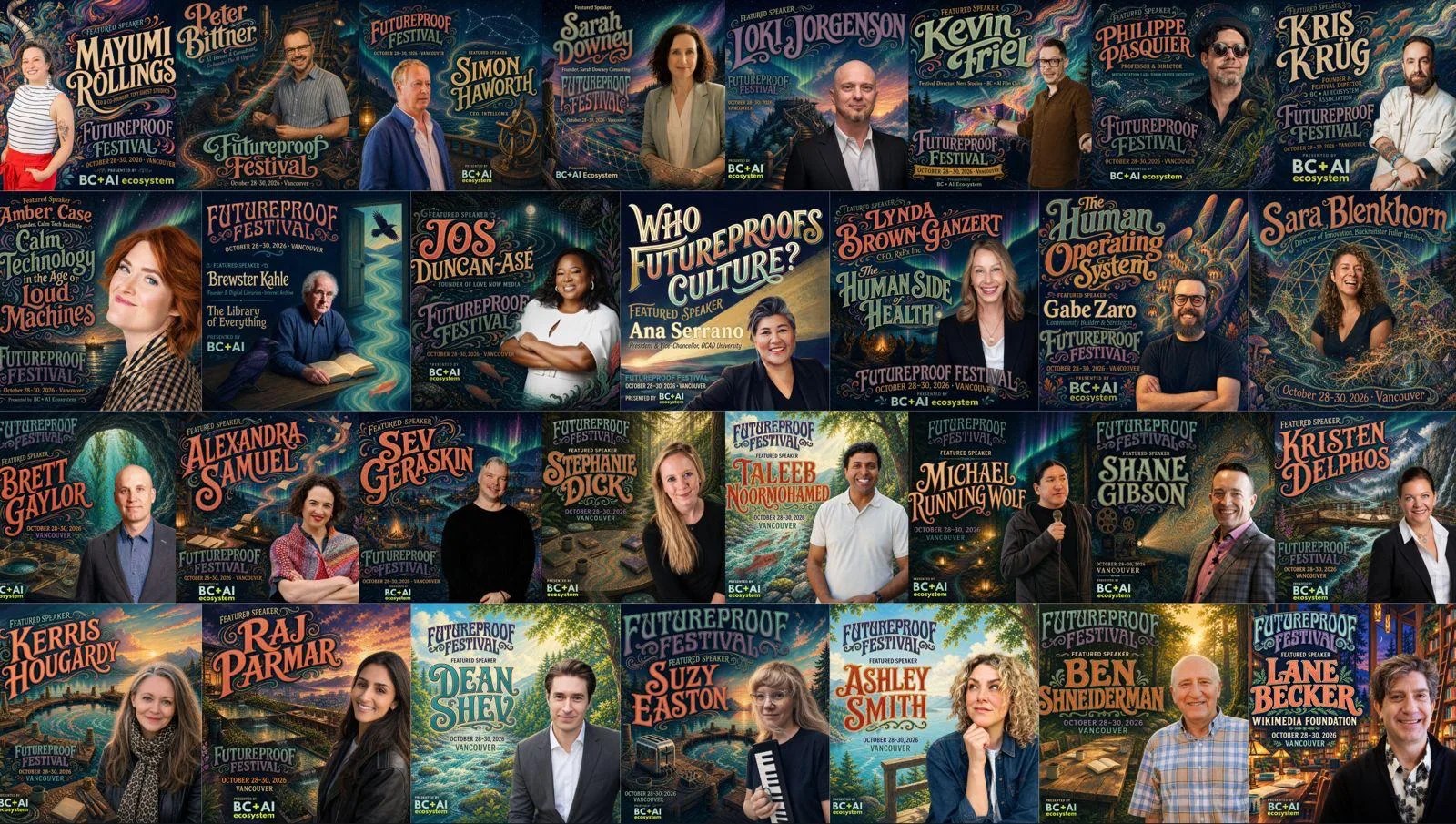
A place where frontier technology, cultural practice, policy, business and community do not occupy separate floors pretending the others are decorative. A place where somebody can show the exciting thing and then hand it to the person most likely to ask the question that ruins the easy story.
Good. Ruin it early. Then build something better.
Milton’s stairs are coming with me to Montréal. So is Justin’s benchmark. So are the people back home arguing about zombies, training professionals, building archives, making art, writing policy and trying to keep the machines accountable without draining all the weird possibility out of them.
If we cross paths at ALL IN, bring me the thing you are excited about and the part you have not figured out yet.
I will show up with both hands full.
And please, before we get into sovereign AI, make sure I am in the right boarding line.
