
The night before Canada’s biggest AI conference, in a bistro full of chandeliers and QR codes, the minister was already on television. By the next morning the sidewalk outside had its own opinions, written in chalk: AI 4 ALL. GENOCIDE 4 ALL. ALL OUT.

This is day two of the dispatches. The trip out, the seatmate, and the setup-day walk are in yesterday’s post. This one follows the people I found between the announcements, and the street that had notes for all of us.
The room with the chandeliers
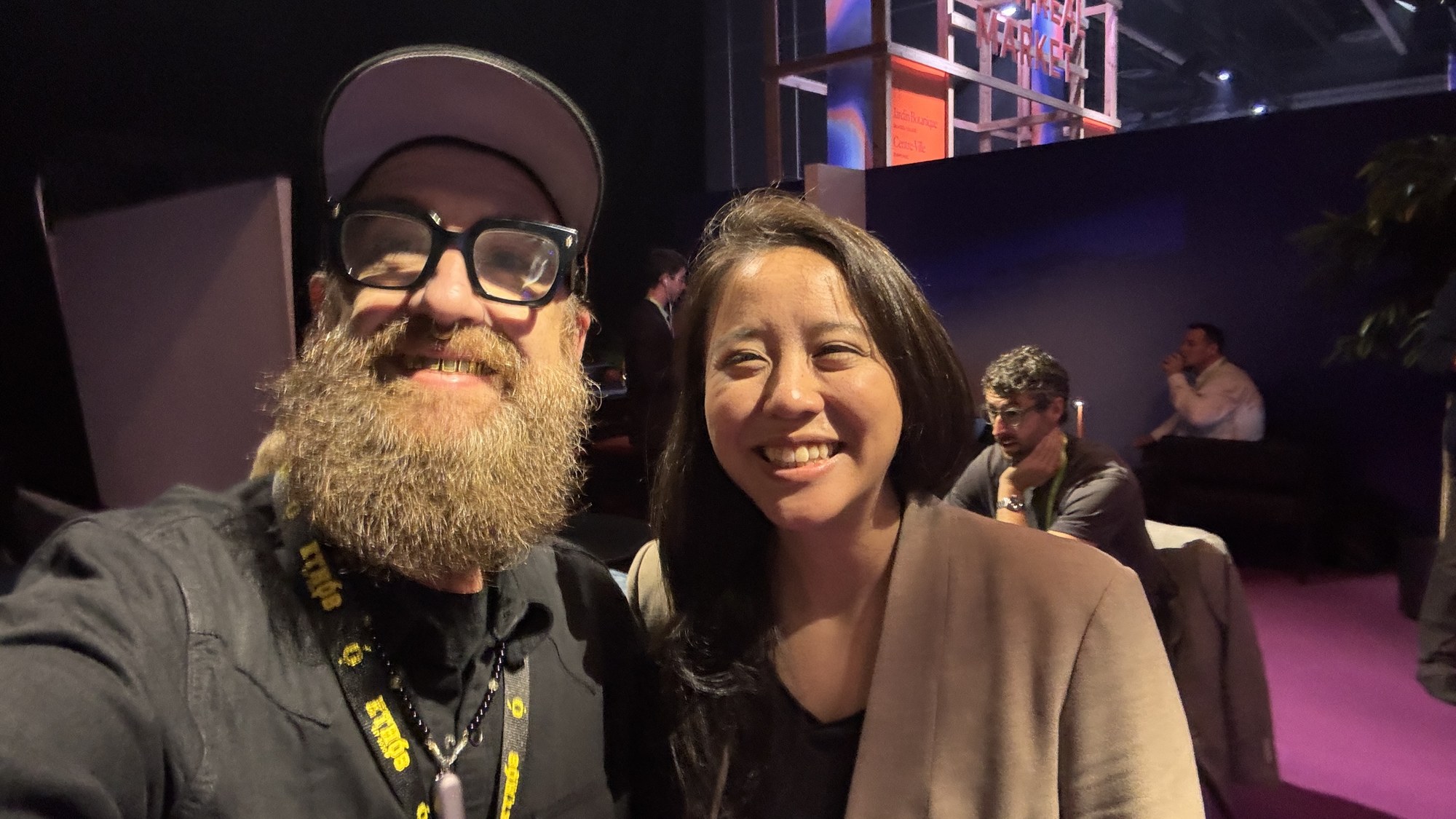
GaZette Bistro|Bar, the night before. Julie Bui and Arjun Kadaleevanam from ProjEx had the room, and the room was good: founders, funders, the odd banker, everybody wearing the lanyard a day early like a concert wristband. People remember a useful conversation as something they stumbled into. Somebody made that room possible. Credit where it is due.

Maureen Ososo got up and talked about Pioneer House in Nigeria, and for a minute the whole Montreal-venture-industrial complex went quiet and listened to somebody building the thing an ocean away.
I met Prashant Agrawal – Mr. P from Canada Preneur, part of the Team BC crew – and David Gratton, and if you don’t know Gratton, he is one of the people who has been building technology community in Vancouver since before it was a brand. Norbot is the current machine. There have been others.
Gratton and I got into it, in the friendly way, about Web Summit Vancouver. He saw a good deal for the local community. I thought we should have put that support into building something homegrown. We have enough shared history to argue without mistaking it for the end of civilization, so I came away dictating notes about the disagreement. It was the useful kind: two people who care about the place, arguing over what would help it.
Champions and saplings
Underneath the event economics was the bigger question, and it turned out to be the question of the whole week: do you place one million dollars in ten companies, or a hundred grand in a thousand companies? Champion the champions, or water the saplings?
You can guess which side the federal government is on this week. You can guess which side I’m on, because I’m the guy who talked the Internet Archive into putting money into a nonprofit community association, and then talked them into doubling the builder awards so two projects instead of one got built. Fifty-one submissions. Six-week build. The winners present at Futureproof in October, flights and beds covered.
I know the honest answer involves both. A country needs serious research institutions. It also needs ways for a strange little project to survive long enough to become useful. The people capable of surprising us do not all arrive with a grant writer and an existing relationship with the minister’s office. Some arrive at a meetup carrying a laptop full of half-working shit.
I would like them to have a chance.
The civic information hiding in plain sight
Also in the ProjEx room: Kate Milne and the Cordata Intelligence crew, building the least glamorous and most useful thing I heard about all week.
Two related pieces of work. One reads published municipal documents – council minutes, budget statements, the paper mountains. The other, Cordata Civic, pulls scattered bylaws, services and resources into a knowledge base people can actually ask questions of. In the language they actually speak. The example in our conversation was Tagalog. There is a phone service too, for people whose way in is not a website.
I was already running ahead of the explanation – journalism, local records, the things happening in a neighbourhood that nobody has time to pull out of a four-hundred-page PDF. They brought me back to accessibility. Picture the actual person trying to find a service or work out what their municipality just decided. How much effort do we make them spend before they can even ask the question?
I have not tested their answers, and I would want to check accuracy, sources, and what happens when it does not know. But I like the problem they have chosen. The old web taught us how to publish a mountain of information. People are still trying to get through it.
The wall in the atrium
Setup day, I walked in through Square-Victoria, past the Guimard metro gate – a little piece of Paris somebody planted in Montreal a hundred years ago – and into the World Trade Centre atrium, where a genuine chunk of the Berlin Wall stands next to the espresso line.
I am not saying a fragment of the Berlin Wall inside a trade centre atrium inside an AI conference is a metaphor. I am saying I stood in front of it for a while.

Then the Palais: the Lipstick Forest, the pink trunks, the expo floor mid-build, forklifts and gaffer tape and the TEAM BC sign going up. Every conference looks like a barn raising the day before. Then the doors open and it pretends it was always finished.

The sidewalk says otherwise
Wednesday morning, 8 AM. Somebody had been busy overnight.

Poster boards leaned against the building outside the Palais: WANTED. Evan Solomon, Minister of Artificial Intelligence and Digital Innovation. FOR CRIMES AGAINST HUMANITY. REWARD: OUR FREEDOM. Three more boards: Germany’s digital minister, Karsten Wildberger, an executive at a data-infrastructure company, a former UK chancellor now working the OpenAI circuit, each with their own charge sheet and reward. A FUTURE. WATER FOR THE NEXT GENERATIONS.
Those are the protesters’ accusations, on poster board, not mine and not established fact. What is established, per the CBC and Global, is that overnight somebody broke the ground-floor windows at Mila and at ServiceNow’s offices and left “Burn the Data Centers” behind in paint. Police say about ten suspects, one 25-year-old arrested, questioned, released without charges. The reporting does not establish that the people who organized the evening march had anything to do with it.
By midday the SPVM had the building ringed and the back doors were locked. By evening there was chalk on the sidewalk, a full wall of it, pink and blue and green:
AI 4 ALL. DROUGH 4 ALL. ECOCIDE 4 ALL. SLOP 4 ALL. REVENGE PORN 4 ALL. HUNGER 4 ALL. GENOCIDE 4 ALL. UNEMPLOYMENT 4 ALL. THEFT 4 ALL. CYBER THREAT 4 ALL. DEATH 4 ALL. FREE PALESTINE.
And then, biggest, at the bottom: AI will take us ALL OUT.
The drought is misspelled. The anger is not.
Real actions, not talk
Inside, meanwhile, the actual news. I got into the press pen off a media pass and an introduction to the minister’s chief of staff, and stood close enough to Yoshua Bengio’s pink tie to confirm it exists.

Germany is the country of honour this year, which is why the flags were paired and why the podium said Safe and Trustworthy AI in two languages. The announcements, in order of size:

Cohere and Aleph Alpha have signed their definitive merger agreement. Largest large-language-AI company outside the United States and China, headquartered Berlin and Toronto. That is Reuters’ summary, and it is accurate.
LawZero, Yoshua Bengio’s safety nonprofit, is getting up to $300 million from Canada and Germany together. A friend of mine, Justine Gauthier, a lawyer at LawZero and before that head lawyer at Mila, got to be the one who introduced Solomon and Bengio for it. A friend at the podium on the biggest stage of the morning. That part I loved.

And Mila and DFKI, the German research centre, formalized a partnership on trustworthy and safe AI for industry and energy. Solomon and Wildberger at the photo op, flags, the works.
Solomon, at the podium, not reading from anything: “These are real actions, not talk, not MOUs. Builders build it from the ground up.” And on the merger: “the first sovereign technology alliance… Today, that deal closed.”

The signatures and funding are real. The technology, and who it benefits, still has to be delivered. I watched the cameras gather and kept wondering how the work on those stages would connect with the people I was meeting in the smaller rooms. That was the morning upstairs. The sidewalk was answering it downstairs.
The roboticist brought a mirror
Best conversation of the day, no contest: Dr. Angelica Lim, computing science, SFU. Rosie Lab – Robots with Social Intelligence and Empathy. Even the name gets straight to the part I care about: what happens when the machine meets a person.

Her day job is world models: simulators where robots fail safely. “As a roboticist, I’ve been using simulators for 20 years.” You test in simulation before you break the robot in the real world. Fair. I would also prefer my expensive robot to discover stairs theoretically before discovering them face-first.
She worked on Pepper, a robot that met people in all their unpredictable complexity, and her question for the new generation of world models is whether they can handle that. She was equally frank about her own field: roboticists have “janky simulators,” good physics and less convincing appearances. She can tell you where the exciting new thing falls short, and where her own tools fall short. Now there is somewhere for the conversation to go.
Then the mirror. A viewpoint moves through a generated world – but has the system represented the person supposedly doing the looking? “If I put my world model viewpoint in front of a mirror, what is it going to see?”
Her newer work is the human side of that mirror, supported by the Canadian AI Safety Institute: what is happening in our brains when we interact with language models. She is collecting the stories of people whose chatbots broke something in them. The clinicians have stopped saying AI psychosis. The term now is AI-associated delusions. There is a Quebec project, the Human Line Project, doing exactly that collection. It deserves your click more than anything else I link today.
This got uncomfortably close to home. I told her about being introduced to Midjourney, realizing my industry was changing, and going through a stretch of sleeping about two hours a night. I was describing my experience, not diagnosing myself. But I could recognize the pull. The machine keeps answering. Another idea arrives. You follow it. I want the creative possibility. I also want people studying what sustained contact with these systems does to us. Angelica is doing that work. I am glad she is in the room.
Sovereignty, inside your four walls
Lunch was with Jeff Ward, who founded Animikii Indigenous Technology in 2003 – Ojibwe and Métis, based in Victoria on Lekwungen territory, Canada’s first Indigenous B Corp. They wrote the book on Indigenous data sovereignty, literally, years before the country discovered the word.
What has him excited now is local: local models, local agents, compute moving back onto devices people own. You will still need serious compute for some work, but the useful daily stuff might run where the person and their information already are. His team built Niiwin, a platform that lets communities design, govern and host their own data, and he offered the developer shorthand “Indigenous-owned Firebase,” with the warning that he was oversimplifying. The part I care about is who gets to decide. The people responsible for knowledge should be able to carry those decisions into the software.
He also showed me where his practice puts boundaries around the machinery I live inside. Design meetings at Animikii can include elders and residential school survivors. Somebody begins sharing a story and the meeting changes; you stop and listen. They commonly leave the recording function off. When recording is appropriate, they get consent, transcribe locally, and explain what the notes are for. That is a concrete account of care, reaching all the way down to a software setting. I spend my life recording and transcribing. I want to learn from that.
And he caught me reaching for an easy story about clean hydropower for Indigenous-owned computing. Hydro has its own difficult history with First Nations. Fair correction. Calling the electricity green does not settle what happened to the river, or who had a say.
Then there are the names. Animikii. Niiwin. For twenty-three years, ministers and customers have been learning to say them, which is exactly the point. Jeff described it as his “tricky way to get everyone to speak Ojibwe.” Language activism in the product meeting. You want the software? Start by learning the word.
We also talked about the language rules we give our own AI tools and agreed to swap material. His line on the way out: “We de-colonize your notecard.” That one is coming home with me.
My favourite framing of the whole day is mine, so I can print it: hey Canada, I hear you’re having a problem with your downstairs neighbour. Some of us have been having problems with the neighbours for a while. We have been solving this problem for our own selves. Turns out what we’ve got is what you need.
He also gave me a zipper tie carrying the Seven Sacred Teachings and told me his new single is number 26 on the Indigenous Music Countdown, and that there is no AI on this record, on purpose. A person can build these tools all day and still choose where they belong. Some machines you build. Some rooms you keep human.
The mission, stated out loud
After lunch I sat down with Hanna Demoz from Amii – the Alberta Machine Intelligence Institute, fresh off a $13 million national AI literacy commitment – and said the quiet part into the recorder on purpose:
I believe in the intrinsic power of interconnectedness. Just us knowing each other, knowing what’s going on, is helpful. It’s the first step towards collaboration.

Hanna is an Edmonton lifer, three years at Amii, a team producer for the Venture Track at Upper Bound, and before any of that she worked transit procurement, which is exactly the kind of resume this industry needs more of. She knows what happens after the program ends: the people who flew all the way to Edmonton want things to do in the evening, want to meet the city and each other. The schedule gets them there. Somebody still has to think about what happens between the scheduled things.
When I made the case for the coasts talking to each other, she was already there: “They have all this going on on the East Coast. Like, what about us on the West Coast?” And on what we’re building – the monthly gatherings at the H.R. MacMillan Space Centre, the regional and thematic groups, Futureproof – she said it back to me better than I said it. Not a sales floor. “It’s more so like creating the conversation.”
The explicit goal, and I told her so: BC’s community organization ends this year with formal partnerships with Mila, Amii, and Vector. Logo swaps and member discounts first. Trust after. Fruit on those trees later. I am not announcing a new institutional partnership from a patch of fresh air outside the Palais. I am glad we made the introduction, and we have a conversation to keep going.
And the reason, also out loud: BC wasn’t even submitting proposals when the money that built the institutes went by. Whoever was in charge abdicated. I’m never going to let that mistake happen again. When the calls come, we should at least have a horse in the race.
Two hundred people, but two hundred people
Late afternoon I went looking for the march. First to Victoria Square, which was wrong – a couple of cops, a very nice park, no march. Then to Place Jean-Paul-Riopelle, right across from the Palais, which was very right.

My count, for what a count is worth: I’d say there’s only two hundred people. But there’s two hundred people.
The police had scaled differently than the morning. We got some big-ass riot cops here in full gear. They got the horses. They got the motorcycles. And this is the thing I kept chewing on: there is a significant difference in size between the cops that were all around the convention centre all day and the cops that were here now.

Somebody had taped a mock server to a pole: a cardboard box labelled OpenAI, BLOCK AI in pink tape, cables and a dryer-duct vent hanging off it. The street had its own demo booth. Somebody else had gone to work with paint and a bedsheet: Intelligence Artificielle. Degenerescence Programmee. Tech Bros. Soumission.

Then the loudspeaker, and this part is the police talking, not me: the protest was declared illegal. The announcement asked everyone to protest peacefully and respect all applicable laws and regulations, and warned that behaviour contrary to those laws and regulations may be subject to targeted or coordinated police interventions. Hearing that with the riot gear in view put a different charge into the afternoon.
Well, that’s quite alarming.
Merrick from the SAT – Montreal’s art-tech institution, one of my favourite rooms anywhere – was in the crowd and called it “the first manifestation against AI in Montreal.” Except it wasn’t the first, strictly, because somebody had vandalized Mila overnight, and I told him so. And that is the whole problem in miniature. The fears and concerns are legitimate. Also, Mila is about the most legit instrument we have for achieving the things those fears are about. There is not a lot of space in the dialogue for that conversation. There was no panel at this conference anywhere close to it.
The march filled the street. A speaker stood up on a ledge in front of the coloured glass with a mic. And then the strangest picture of the day, the one that is this whole post in a single frame: the protest line with its red LUTTONS CONTRE L’IA banner, the riot cops, and ALL IN attendees in their lanyards crossing between the two, going to dinner. I have it on video, 106 seconds, shot from across the street at 6:43 PM. It is the whole argument in 106 seconds.
I spent the day doing a gonzo insider-outsider thing, upstairs to the reception, back down to the street, press pass in one pocket and chalk dust on my shoes. The last time I moved between worlds like that was COP15 in Copenhagen, where I went for one reason and ended up spending all my time in the streets documenting the resistance. Montreal felt like that. A building full of people betting that this technology saves something, ringed by people betting it costs everything.
The swag report
Because somebody has to do the accountability journalism: Vector Institute has cool little pouches. But so far, Mistral has the best swag. Sport socks and notebooks. The French understand priorities.
I contain multitudes. Some of them want socks.
Both hands full
I am reporting on a world I am also trying to build. That is not a conflict I plan to resolve; it is the job. My whole message, on every stage they let me near, is both hands full. One hand full of curiosity, one full of critique. To let go of either one is to be lazy. Burn it all down is lazy, and it does not tell a parent what to do about their kid’s education. Onward and upward as fast as we can is lazy too, and it does not answer them either. The people wearing conference lanyards have families, jobs and communities tangled up in this. We need ways to talk that reach those parts of their lives.
Angelica’s mirror. Jeff’s recording boundaries. Cordata’s phone service. Hanna making room for people to meet. The street’s questions, carried back inside. That is the work, and it continues tomorrow.
I went home to dump memory cards, charge batteries, and change into the nighttime fit. If you were in any of these rooms, tell me what I got wrong. And if you want the room where all of these people can find each other, that is what we are making with Futureproof, October 28-30 in Vancouver. Bring the thing you are building. Bring the awkward question. Bring the experience that makes somebody else reconsider their answer.
I will be there with the recorder, asking first.
Further down the rabbit hole
- Post 1: Headed East for ALL IN Montreal – yesterday’s chapter. This one picks up where it left off.
- The Futureproof announcement – the festival thread, from the source.
- BC + AI Ecosystem Association – the nonprofit behind the mission section. Members get a Futureproof discount.
- Reuters: Cohere and Aleph Alpha tie the knot – the wire version of what I watched get announced.
- The Logic: LawZero lands $300M – Bengio’s safety nonprofit gets real money from two governments. Champion-the-champions, exhibit A.
- CBC: windows broken at Mila the night before the summit – the other side of the announcement morning, police version.
- CLAC’s callout for the march – the organizers in their own words. Read it before you decide what you think.
- The Human Line Project – the stories of people pulled into AI-associated delusions. The most important link in this pack.
- Rosie Lab at SFU – Dr. Angelica Lim’s crew.
- Animikii and Niiwin – twenty years of Indigenous data sovereignty quietly becoming the thing Canada suddenly needs.
- Amii’s $13M AI literacy push – a million Canadians, supposedly. Hold them to it. And Upper Bound, their home game in Edmonton.
- National Observer at ALL IN – one of the few other independents in the building.
- Vancouver Tech Journal: BC’s AI builders plot their next move – the home team’s read on the home team.
- Futureproof Festival of AI, Oct 28-30, Vancouver – my room, my rules, my shameless plug. Tickets exist.
Through the viewfinder
Three more frames from the walk in and the street. September 15-16, Montreal. Photographs: Kris Krüg. Select an image to see it larger.


