
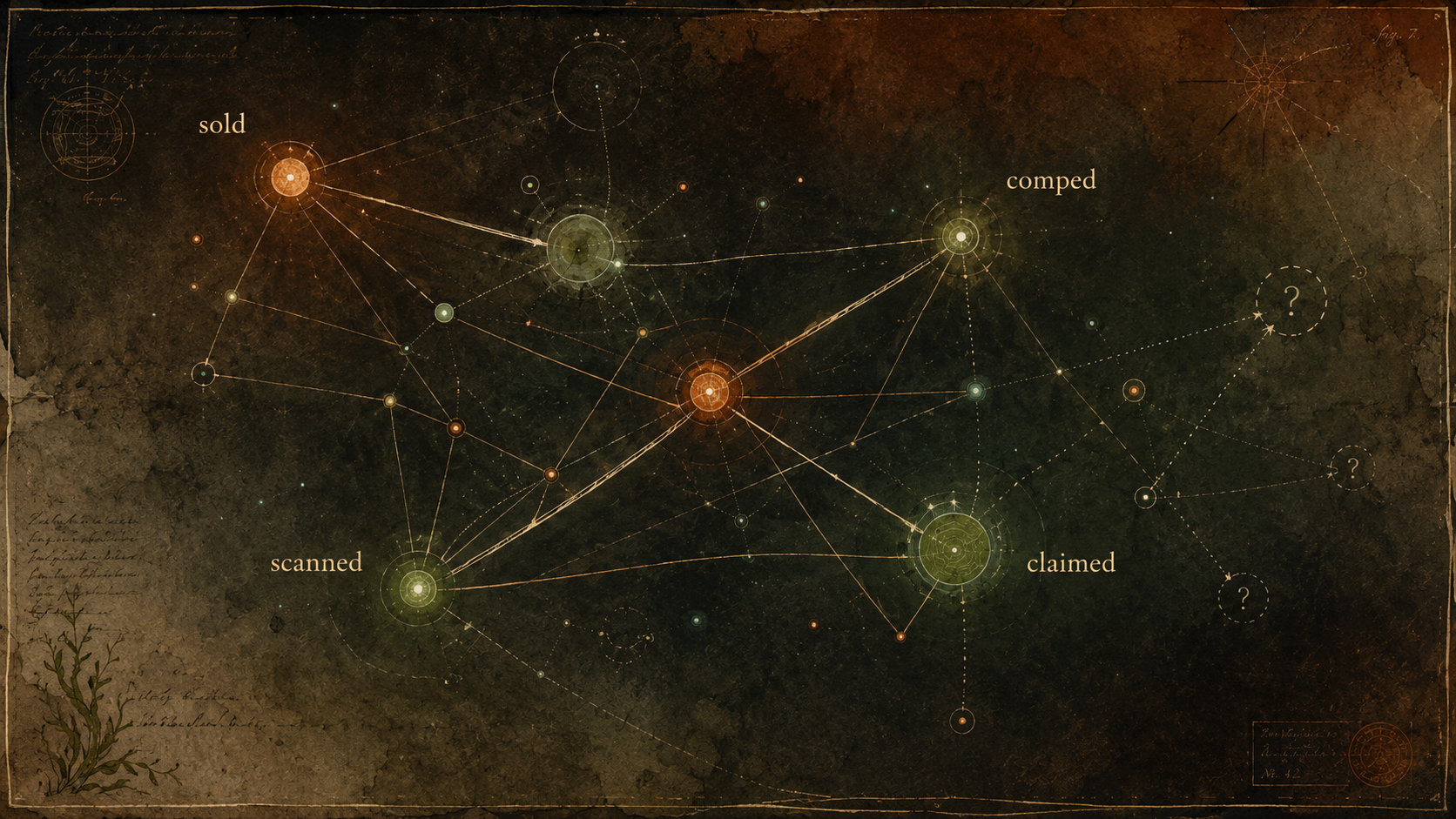
Vancouver's AI community is showing up this week. So should the public metrics.
The signal was already here
Web Summit Vancouver lands again in a city that was already alive with AI energy.
Not because a global conference company discovered us.
Because artists, researchers, founders, educators, policy people, public servants, Indigenous knowledge holders, open-source weirdos, startup mutants, and beautifully unreasonable builders have been doing the work long before the lanyards arrived.
The signal was already here.

It was in the Vancouver AI meetups before anyone knew what to call this moment. It was in the BC + AI rooms where people are trying to make sense of this technology without selling their souls to the nearest enterprise dashboard.
It was in office hours, hallway conversations, artist studios, Discord threads, research labs, community centres, and those late-night "wait, what the hell are we actually building?" conversations that never fit inside a sponsor deck.
This week, some of that signal gets louder. Good.
I want this to win
There are real people doing real work at Web Summit. There are founders who need capital. Artists looking for collaborators. Researchers trying to bring nuance into a market that rewards noise. Public-sector people trying to understand what just hit them. Startups who scraped together a booth and a dream. Visitors who are about to discover that Vancouver's tech ecosystem is stranger, deeper, and more alive than the brochure version.
I want those people to win.
I want Web Summit to succeed.
I want the visitors to feel the weird voltage of this place. I want them to meet the builders, not just the brands. I want them to see that Vancouver's AI scene is not some passive backdrop for a conference company's North American expansion strategy.

We are not scenery.
We are the ecosystem.
And because I want this city to win, I also want the numbers.
Metrics aren't meaning. But meaning needs metrics.
Last year, in my Web Summit Vancouver survival guide, I wrote that "metrics aren't meaning" and that "visibility doesn't equal legitimacy." I still believe that. Maybe more now than I did then. Web Summit can bring infrastructure, amplification, press, investor density, and the temporary gravitational field of a global tech circus. But the soul of this thing is still on us.

This year, the metrics themselves need meaning.
Because once public money enters the story, attendance stops being marketing language and becomes a civic metric.
Where the public money went
The federal government announced $6.6 million in PacifiCan funding to Destination Vancouver to host Web Summit in Vancouver over three years starting in 2025.
BC Business reported that various levels of government are contributing $14.8 million over the planned three-year commitment, while Destination Vancouver estimated $57 million in direct tourism spending and $93 million in total economic impact for the first year.

That is not pocket change. That is public trust.
And public trust deserves receipts.
What are we actually counting?
Here is where the math starts to matter.
A Destinations International case study says Vancouver used the Event Impact Calculator to help secure Web Summit, describing the event as expected to draw 35,000 attendees from around the world and pointing to $57 million in direct economic impact from a single event.
Then Web Summit's own official 2025 wrap-up reported 15,727 attendees from 117 countries, along with 1,108 startups, 681 investors, 159 partners, and 50 trade delegations.
Now the current Web Summit Vancouver 2026 homepage is publicly showing 20,000+ attendees, 700+ investors, and 1,500+ startups.

BetaKit called the 2025 debut a scaled-down version of Collision, noting that Vancouver's first year had nearly 16,000 attendees compared to 38,000 at Collision's final Toronto year. The same piece reported that Mayor Ken Sim hoped to see Web Summit Vancouver grow to 40,000 attendees by 2027, while Web Summit executive Casey Lau said he expected attendance closer to 30,000 the next year.
So, respectfully: what are we actually counting?
This is not me saying the event is fake
This is not me saying the event is fake. It is not me saying the work is not valuable. It is not me saying the people in the building are not real.

The people are real.
The builders are real.
The community energy is real.
The question is whether the public story about scale, impact, and return on investment is being told with enough precision for the public to evaluate it.
That is a grownup question. Vancouver should be able to ask it without everyone getting weird.
Show us the badge math
I do not need a semantic cage match over the word "attendee." But I do need the badge math.
How many tickets were sold?
How many badges were comped?
How many were sponsor passes, speaker passes, media passes, investor passes, startup passes, government passes, staff passes, volunteer passes, or exhibitor passes?
How many badges were issued?
How many were picked up?
How many unique humans physically entered the venue?
How many came from outside Metro Vancouver?
How many stayed overnight?
How many hotel room nights were actually booked?
How many people were counted across multiple days?
How many showed up in the app but not the room, or the room but not the app?
None of this is exotic. These are normal operational metrics for a conference of this size. If the story is solid, the receipts should strengthen it.

I have heard from people inside the ecosystem who are looking at attendee-facing systems and seeing numbers that appear far lower than the big public claims. I am not publishing those numbers as fact.
A visible app directory is not the same thing as total attendance. There are hidden profiles, incomplete profiles, late registrations, sponsor credentials, media badges, and all kinds of boring operational reasons why a public-facing list may not match the backend.
Fine.
Then reconcile it.
That is the ask.
Do not hand-wave. Do not vibe-cast. Do not bury the detail in a glossy post-event sizzle reel with drone shots and adjectives. Give Vancouver a plain-language accounting of what happened.
Because economic impact is not a vibe.
Boosterism is not ecosystem strategy.
Imported spectacle is not the same thing as local capacity.
Pro-Vancouver, not anti-Web Summit
And no, this is not anti-Web Summit. It is pro-Vancouver.
I have spent the last couple of years helping build rooms where people can wrestle with AI as a cultural force, not just a product category. I have watched this community grow from a few curious people trying tools in public into a many-headed organism with artists, engineers, educators, founders, funders, lawyers, neuroscientists, Indigenous technologists, filmmakers, policy folks, and people who do not fit neatly into any LinkedIn taxonomy.
That is the good shit.
That is the thing worth protecting.
And that is why I get allergic when Vancouver gets flattened into someone else's innovation theatre.
Use the platform without becoming platformed
The official conference floor can be useful. I am not too pure for that. Borrow the mic. Take the meeting. Scan the badge. Pitch the thing. Get the investor. Bring the world here. Use the platform without becoming platformed.

But the real city is bigger than the floor.
It is in the rooms around the rooms: Calm Before the Storm, Mind, AI & Consciousness, Vancouver AI gatherings, BC + AI conversations, founder mixers, art-tech crossovers, office hours, walks, coffee meetups, late-night decompressions, and all the strange subnetwork activity that does not ask permission from the main stage.
Those are not "side events."
They are civic infrastructure.
They are how a city metabolizes a global event instead of just renting itself out to one.
Last year, I wrote that some of us are not here to network. We are here to reroute the signal. That still feels right. Web Summit gave us the uplink. We decide the transmission.
Accountability is the next chapter
This year, part of that transmission has to be accountability.
Not rage for rage's sake. Not conspiracy cosplay. Not lazy cynicism. Vancouver has enough of that.
I am talking about adult public scrutiny.
A city that wants to be taken seriously as a global AI and technology hub should be able to hold two truths at once: yes, we can welcome a major international conference; yes, we can ask what public money bought.

That should not make enemies inside government. It should help them. Public servants, economic development folks, tourism people, and elected officials all have a stronger story if the numbers are clean. If the event is working, show the public how. If the first-year projections were too hot, say that. If the 35,000 number was aspirational and the 15,727 number was actual, say that. If 20,000+ is a forecast, say what it is based on. If the impact model depends on non-local overnight visitors, show the hotel-room assumptions. If the public paid to bring the circus to town, show us the ledger.
That is not hostility.
That is stewardship.
Vancouver has a long history of people asking uncomfortable civic questions. We need more of that muscle, not less. Tech has a habit of floating above scrutiny because everyone wants to be in the room, near the money, on the panel, or tagged in the recap post. But a mature ecosystem cannot be built on access anxiety. It has to be able to handle praise and audit at the same time.
My position going into Web Summit week
So here is my position going into Web Summit week:
Welcome to Vancouver.
Seriously.
Come meet the builders. Come see the artists. Come talk to the founders who are trying to build companies without becoming hollow little SaaS goblins. Come listen to the people asking what AI means for labour, creativity, sovereignty, consent, education, climate, consciousness, and the future of being human. Come spend money in our city. Come be surprised.
But do not confuse the conference brand with the ecosystem.
And do not ask the public to accept giant numbers without the backup.

Then count properly
After the lights come down and the lanyards hit the junk drawer, I want to see the actuals: tickets sold, badges picked up, unique venue scans, local-versus-visitor breakdown, comp ratios, hotel room nights, public dollars spent, economic-impact assumptions, and what was learned from year one.
No more naked attendee numbers.
No more "innovation economy" theatre where the same twenty people congratulate each other under different logos.
No more treating community as decorative proof-of-life for a funding announcement.
The Vancouver AI ecosystem is real. It is messy, alive, critical, generous, and occasionally feral. It does not need to cosplay Silicon Valley North. It does not need to be saved by a conference. It needs resources, trust, public imagination, and enough backbone to tell the truth about itself.
So let's have the week.
Let's host well.
Let's make the weird rooms.
Let's meet the world without flattening ourselves for it.
And then let's count properly.
Because if the story is real, the receipts will not weaken it.
They will make it impossible to ignore.
Since drafting this piece, an independent developer has published a public dashboard indexing 5,649 visible Web Summit Vancouver attendee profiles from attendee-facing systems. That number should not be treated as total attendance. But it is a meaningful signal: if the official public claim is 20,000+ attendees, and the visible app directory is closer to 5,600 profiles days before the event, then public agencies and Web Summit should be able to reconcile the funnel – tickets sold, app activations, completed profiles, badge pickup, venue scans, and visitor-origin data.
https://www.youtube.com/watch?v=hRuud-zbmoM
Sources & further reading
- Web Summit Vancouver 2025 Survival Guide — kriskrug.co
- Rise of the Vancouver Technopunks: Hosting the Web Summit on Our Terms — kriskrug.co
- Web Summit Vancouver 2025 And How You Can Shape It — kriskrug.co
- The Outsider's Insider Guide to Web Summit Vancouver — kriskrug.co
- Web Summit Vancouver — official site
- BC + AI — community home
Related: I collect related field notes under AI events and recaps.