The AI debate is exhausted because too much of it is pretending to be brave while refusing the actual contradiction.
The boosters want a clean story where the tools will save us if everyone just gets with the program. The doomers want a clean story where refusing the tools is the only ethical position left.
Neither story is big enough.
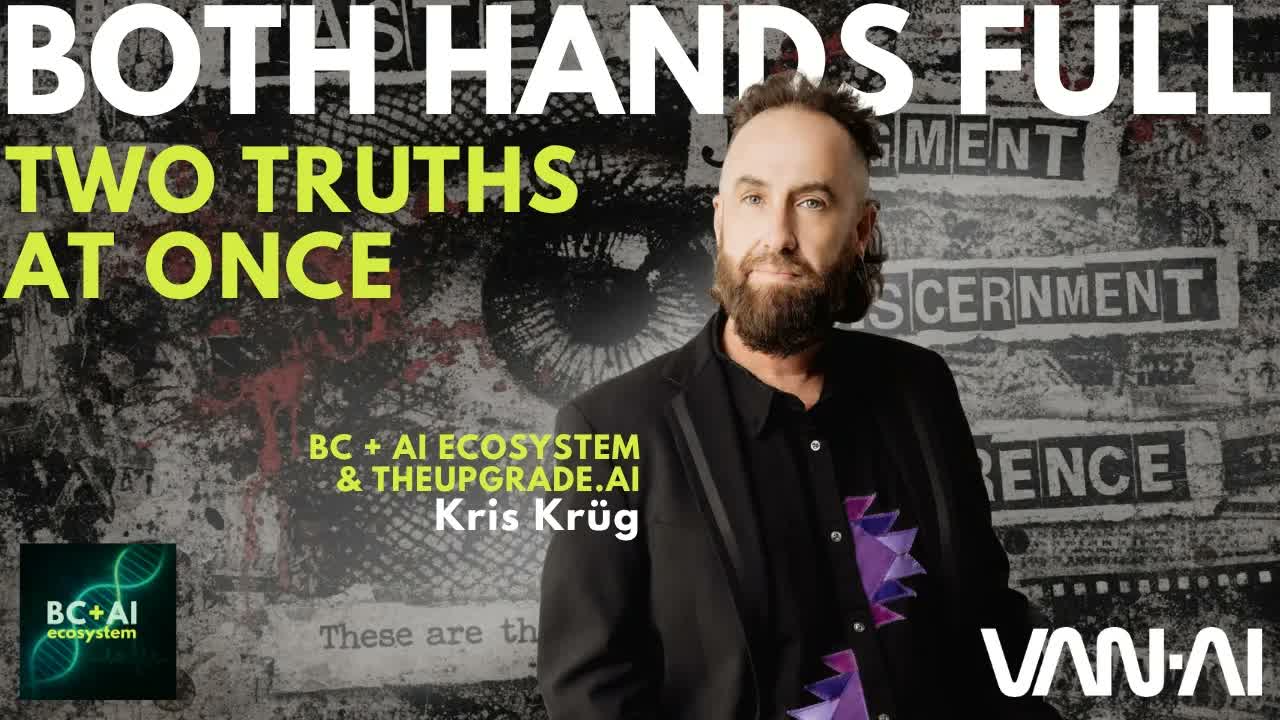
At the Vancouver AI March 2026 meetup, I tried to say the thing as plainly as I could: these systems are compromised, and they are powerful. They are built on extraction, and they are expanding what small creative teams can do. They carry bias, environmental cost, labor risk, and cultural danger, and they are also helping people learn, make, organize, imagine, and build.
That is not a contradiction to solve with a slogan.
That is the work.
Both Hands Full Is A Community Practice
Both Hands Full is not just a keynote title. It is how our community has learned to stand inside this moment.
One hand has to hold the hard stuff: stolen work, permission, copyright, bias, misinformation, environmental pressure, platform power, labor disruption, and the very real grief artists feel when their work becomes training material without consent. I also saw the march where the illustrators showed up as a guild.
The other hand has to hold the equally real creative explosion: new tools, new access, new workflows, new forms of learning, new capacity for individuals and small teams, and new ways for people to build things that used to require institutions.
If you drop either hand, you start lying.
Why Vancouver AI Matters
Vancouver AI is useful because it gives people a room where they do not have to pick a lazy team.
Artists can sit beside engineers. Founders can hear from educators. Policy people can hear from builders. Curious beginners can ask the question that everyone else is pretending they already understand.
That is where the good AI conversation happens: in community, under enough trust that people can admit uncertainty without being punished for it.
The meetup is not just an audience for my talks. It is one of the places the ideas get stress-tested. People push back. People bring edge cases. People bring lived experience from classrooms, studios, startups, nonprofits, and big organizations.
That makes the talk better. It makes the whole community smarter.
The Middle Path Is Not Neutral
Some people hear “middle path” and think it means splitting the difference.
That is not what I mean.
The middle path is not passive. It is not polite mush. It is active stewardship. It asks better questions:
- Who benefits from this system?
- Whose work made it possible?
- What data should never go into it?
- What kind of creative practice becomes stronger with AI?
- What kind of human relationship gets weaker if we automate it?
- What should communities build for themselves instead of waiting for platforms?
Those questions are harder than cheerleading. They are also harder than refusal.
Watch The Talk
Related
- AI keynote speaking
- BC + AI Ecosystem
- Both Hands Full
- You Can’t Drink Data: notes from my first AI protest
- Both Hands Full at the Data Center: protest signs
- Podcast guesting and media EPK
Source note: this draft is based on the public Vancouver AI March 2026 video and the local 2026 keynote source pack. Final publication should review ethical claims, audience references, and image choice before WordPress publishing.