
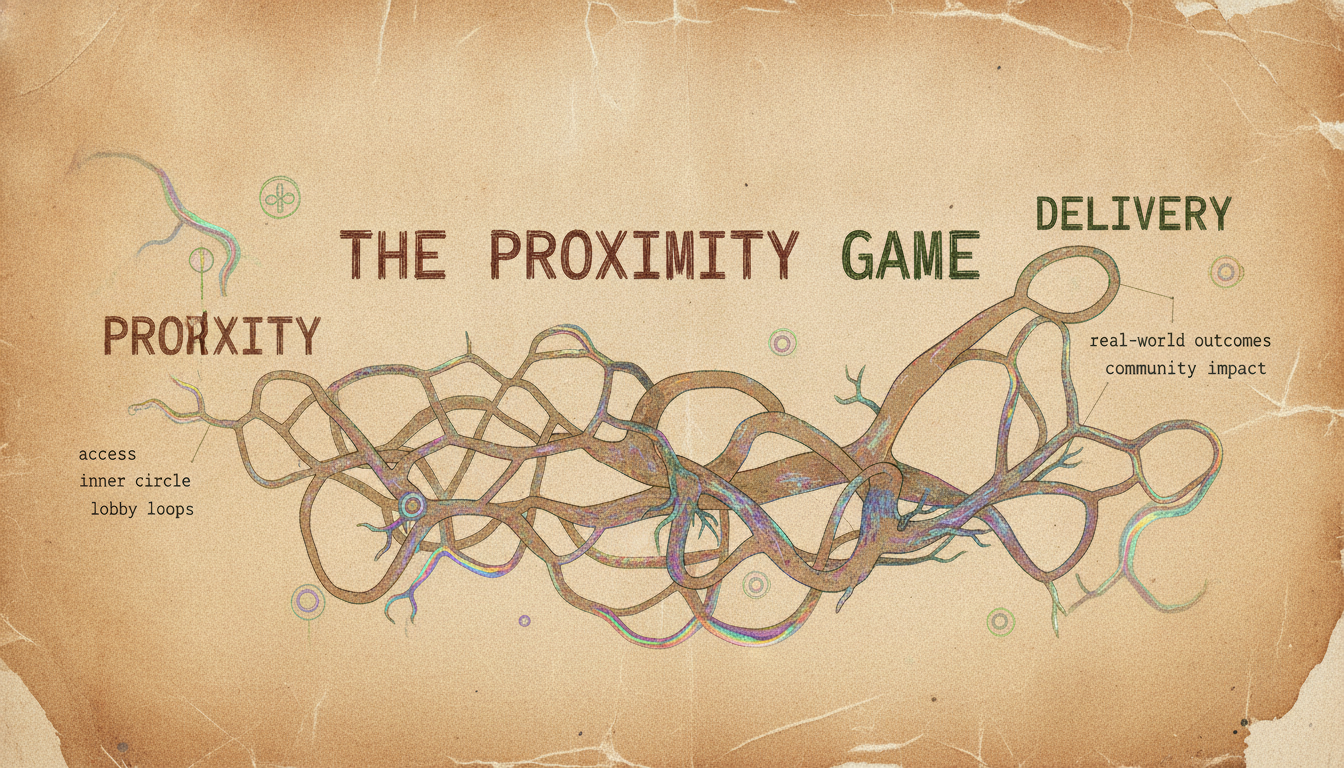
The Great Canadian Proximity Game
I’ve been around this long enough to know the choreography. A big federal strategy drops. The money is real, the ambition is real, and on the merits Carney and Solomon took a real run at a genuinely hard problem. Bold beats timid. Good.
And then, within the hour, the second thing starts. The thing that has nothing to do with the strategy and everything to do with who gets to stand next to it. The proximity game.
I’m not guessing at the rules. Somebody drew them up for me this week, panel by panel.
A man in a flag pin in front of Parliament. “Let’s collaborate. Strategically.” A table of beaming directors. “Your impact is transformational.” “Your stakeholder alignment is visionary.” The Federal Funding Machine roaring to life and spraying cash over a forest of reaching hands. “Amazing work. Here’s twenty-five million for ecosystem coordination.” The trophy reads Alignment Champion. And the caption at the bottom that tells the truth nobody says out loud. In Canada, the grant is temporary, but proximity is forever.
I laughed. Then I stopped laughing, because I had just watched a live performance of it.
The move
Here is the signature move of the genre. You quote the Minister’s own slogan back to the Minister, in a post that tags the Minister. Pom poms, not pitchforks. And the room nods like wisdom just happened.
That is not commentary. That is a courtier nodding at the king and hoping he is seen doing it. The whole performance is a loyalty oath dressed up as analysis. Strip out the access flex and the slogan-quoting and there is nothing underneath. Somebody mistook standing near the ministers for having something to say.
And it is a con even on its own terms. The pom-poms binary gives you two doors. Cheer, or be the mob. There is no third one, and that is the function, not an accident. It lets you wave off every real objection, the missing delivery mechanism, the data-centre “benefits” nobody can measure, the worker-retraining asks the strategy quietly dropped, as “negativity,” without engaging one of them. Reframing real critique as emotional skepticism is how you dodge answering it. And plenty of Canadians have real questions, not pitchforks.
My favourite tell is the throat-clearing. “Not in a naive way,” they write, and then read you the brochure. “This strategy stakes a real claim.” Summarizing the thing is not having a view of the thing. And then the sign-off, “let’s get to work,” at the bottom of a post that is one hundred percent pom poms and zero percent work. Cheering from the luxury box and calling it labour. Even Google’s chief economist showed up to clap. Applause was never going to be in short supply.
What got deleted
Here is how I know the game is real and not just a cartoon.
I left a comment this week. It named actual work and asked an actual question. Who benefits, who governs, who gets access. It was gone inside the hour.
That deletion told me more than the post ever could. A guy whose whole pitch is “hold it to account and let’s get to work” deleted the one comment that did both, because naming real work made the applause look as thin as it was. That is the thesis collapsing in real time.
You can delete a comment off your page. You cannot delete the work off mine.
Both hands full
For the record, I am not anti-applause. I am genuinely glad this strategy exists. I just refuse the binary it is being sold under.
It was never pom poms or pitchforks for me. It is both hands full. You can be thrilled about AI for All and still hold the questions that decide whether it works. That is not skepticism. That is the job. I have been making this case in public for years, long before there was federal money on the table to applaud.
And here is the part the proximity game cannot see. The government’s own overview promises free AI training for everyone in Canada and faster adoption among small businesses, and then names not one organization to actually deliver any of it. A strategy can fund compute and set targets all day. None of it teaches a twelve-person shop which workflow is safe to hand to a machine. That happens in a room down the street, with people you trust. Not in a PDF from Ottawa.
That layer mostly does not exist yet. We have spent years building it anyway. Real upskilling for creative pros, comms teams, sales teams, SMEs and nonprofits. Responsible AI certification, sold out and growing. Thirty months of community meetups, every month, never skipped. A 300-strong professional network. And this October, the Futureproof Festival takes over Vancouver for a week. Nobody sprayed cash on us to start. We built it because it needed building.
Proximity gets you invited. Delivery gets it done. One is temporary. The other is the only thing that makes AI for All mean all of us.
So pick your game. You can chase the room, or you can build the thing the strategy forgot to. I know which one I am doing.