
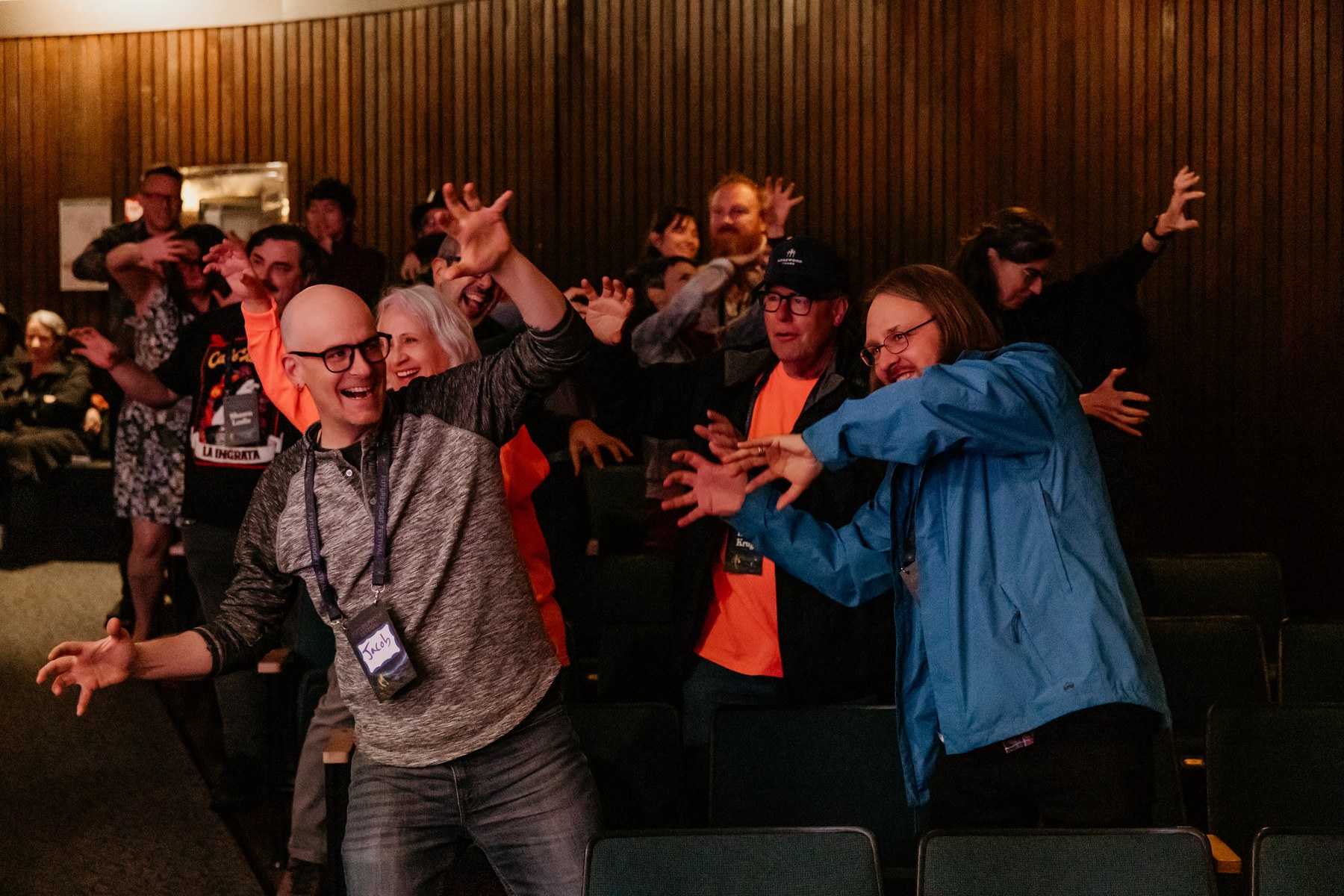
Opening night, October 28, 2026. Photo: Michelle Diamond / Diamond’s Edge Photography.
At about 10:30 on the opening night of Futureproof Festival, I stood outside the Sylvia Hotel and recorded a voice note. T-shirt, jean jacket, October 28, 2026, in Vancouver. I could see stars. There were still green leaves on the trees. People had flown in from all over, the first night had happened, and I was trying to get some of it down while it was fresh.
“It was really good. It was delicious.”
Amber Case had got people thinking about their bodies and their relationships with technology. The AI Builders Fellows had shown real work. Brewster Kahle had answered my invitation to give another talk with a proposal to support more research. Philippe Pasquier had taken us somewhere strange with a live generative performance. Friends I’ve known for years were meeting people I’d only recently met myself.
Then I said the thing that mattered most:
“A bunch of people trusted me.”
I’m still sitting with that. Futureproof ran October 28–30, 2026, at Vancouver’s H.R. MacMillan Space Centre. Three days is a small amount of time to ask that much of people. Leave your work. Get on a plane. Find a place to stay. Come listen, argue, eat, make something, and spend time with strangers. Trust that I have a reason for putting this particular bunch of humans together.
“So many cool people fucking came here.” That’s in the voice note too.

Three years of showing up
Futureproof grew out of the Vancouver AI community meetups we’ve been running at the Space Centre for the last three years. I said that on Thursday morning because I wanted people who were visiting to understand what they had walked into.
There was already a community here. People had been bringing their questions, their experiments, their anxieties and their friends into this building for a long time. Education. Life sciences. Art. Philosophy. People wondering what this stuff was going to do to their work, and people already making things with it.
In the program book, I wrote that I started the meetups because I wanted this festival and didn’t yet have the people to hold it with. That’s a pretty accurate description of community building. You can have a picture in your head of something big. You still have to show up next month, learn people’s names, follow through, and make it worth their trouble to come back.
I’ve spent a lot of my life photographing other people’s gatherings. SXSW, TED, the Olympics, internet weirdos in rooms of every size. I pay attention to who hangs around when the official part ends. Who introduces two people because they can see the connection before either of them can. Who makes a newcomer feel like they belong there.
You learn a lot about a gathering by watching those small interactions. I wanted Futureproof to have enough time and room for them. A single-track program meant we could keep having the same conversation together, with different people taking it somewhere new.

Curiosity in one hand, care in the other
I opened the festival by talking about how exhausting the usual AI conversation has become. Pick a camp. Get excited on command or prove your moral seriousness by refusing the whole thing. Meanwhile, actual people are asking what to study, what to teach their kids, what happens to their work, and where they can push back against surveillance and the concentration of power.
I use these tools every day. I’m a builder and an experimenter. I’m also worried about what we’re doing to education, to creative work, to our ability to pay attention, and to the people whose work and knowledge made these systems possible.
Those concerns don’t disappear because I made something useful with AI this morning. And the useful thing doesn’t disappear because the company behind it deserves scrutiny. I want enough honesty in the conversation to hold both.
This is how I put it on stage:
“Here we talk about walking forward with both hands full, not letting go of either things, walking forward with both curiosity in one hand and care in the other.”
That’s the invitation. You can be fascinated and pissed off. You can build something and question the conditions under which it gets built. You can say there are parts of your life where you don’t want AI, without having to apologize for being insufficiently futuristic.
I wanted people from different disciplines in the room because none of us has a complete view of this. A filmmaker notices something an engineer misses. Someone working in healthcare has different consequences to answer for than someone making an image. A journalist asks where the information came from. An artist asks what the thing feels like. We need to hear each other before we decide we’ve figured it out.
Amber brought us back to our bodies
Amber and I have known each other for about twenty years. We met at Gnomedex in Seattle and went on to organize CyborgCamps together. Having her open this festival felt right. She has spent years paying close attention to the relationship between people and their tools, including the parts the tech industry would prefer we stop noticing.
Her talk started with something wonderfully ordinary: riding a bicycle. Once you know how, you can steer, feel the pedals, look ahead and respond to the road without stopping to negotiate with a menu. The tool becomes part of what you’re doing.
Then she walked through the experience of a voice assistant. Stop. Ask. Wait. Hope it understood. Try again. A very elaborate machine can still make a simple human activity more annoying.
I love that she takes this seriously. We’ve become incredibly tolerant of badly behaved technology. We reorganize our lives around it, learn its little rituals, accept the interruption, and then get told the next version will fix the problem. Apparently we’re all supposed to keep training for the privilege of using the fucking light switch.

Amber’s point was about the person using the tool. “The tech doesn’t need to be calm. We need to be calm while we use it.” That’s a useful standard to carry home. Does this thing help me remain present? Can I use it without giving it everything? Does it leave room for the person standing beside me?
As a photographer, I understand the feeling of a familiar tool getting out of the way. You know where the controls are. Your attention can stay with the person and the light. I want more of that relationship with technology. The camera should help me notice the world. I don’t want to spend the whole encounter looking down at the camera.
Outside the Sylvia, I was still trying to describe what Amber had done: “stole people’s hearts and tickled their imaginations.” She gave us a way into this conversation through our own bodies and attention.
Put the work on the screen
The AI Builders Fellowship was one of the parts of opening night that meant the most to me. Internet Archive Canada and BC + AI had given builders an opportunity to work with the public record. Jacob Ortiz and Daniel Shavit came to show what they’d made.
Jacob’s project, The Archive Argues With Itself, lets you question Canada’s public-health records and open the scanned pages behind an answer. That last part matters enormously. A smooth paragraph can make a weak answer sound settled. Being able to look at the page gives you somewhere to stand when you question it.
His presentation included the encouraging results and the awkward ones. On one slide, he reported that 166 of 178 checked sentences had every claim supported by the page they cited. On another, he showed five questions out of fifteen that should have produced a refusal but instead got a true, cited answer to a slightly different question. Those were his project’s audit results, with the limits stated on the slides.

That second result is the one I want people to spend time with. A citation can be real and the answer can still miss what you asked. You can be looking at something polished, plausible and sourced, and still need to exercise judgment.
I respect a builder who puts that failure on a screen in front of everybody. It gives the rest of us a chance to learn something. It also tells me how to approach the work: try it, inspect it, find the edges, and help make it better. I’d like a lot more public AI demonstrations to include that degree of candour.

Daniel approached the archive through Vancouver’s streets. His project, What happened on your street?, brought together archive films, documents, council minutes and open data to explore the history of an address. There’s an immediate human reason to care about that. You know a place. You walk past it. Suddenly you have a way to ask what happened there before you arrived.
This is the kind of work I want us supporting: specific, inspectable, connected to a place or a public need. People learning by making something other people can actually use.
In my voice note that night, I said:
“There is nothing cooler than to be able to put money into the hands of people doing real work in this way.”
I meant it. Giving somebody enough support to pursue a good question is one of the most satisfying things we can do through this community.
Brewster changed the question
Brewster Kahle followed the fellows. Having the founder of the Internet Archive there, after those demonstrations, connected the work in front of us to the years of collecting and preserving that made it possible.
At the end of his talk, I asked whether he would come back and talk about archiving open-weight models and studying bias by asking different models the same questions.
“Nope,” he said.
Then he proposed putting forward a small stipend and bringing talented people to Vancouver to do studies using the data they’d collected. My response was, “Okay, it’s a deal. It’s a deal.”
I was pretty lit up about it outside the Sylvia. There’s a proposal to follow up on, and research and arrangements still to work out. That’s work I want to do.
There’s a lesson in the exchange for me as an organizer. I’d asked for another talk. Brewster pointed toward another opportunity for people to make something. I want to keep that possibility open as we figure out what Futureproof becomes. A good gathering can make the next piece of work possible, if we bother to follow through after everyone goes home.
Public memory belongs in this conversation. Every useful thing the fellows showed depended on someone having kept the source material and made it accessible. The archive doesn’t magically appear when a model needs something to train on. People build it, maintain it and defend it. They deserve support too.
Who gets to tell the story

Jos Duncan-Asé’s session title, Who Gets to Tell the Story, belongs near the centre of how I think about AI. So much of the argument comes down to who gets to describe other people, whose knowledge gets treated as material, and who has the power to correct the record.
I’ve spent years pointing a camera at people. A photograph is a decision about what gets included and what stays outside the frame. I bring that awareness to AI. Someone selected the material. Someone chose the categories. Someone decided what a satisfactory answer looks like. Those choices carry a view of the world, whether the interface admits it or not.
On Thursday morning I said, “Before this was the Space Center, before it was Kitsilano, before it was Vancouver, it was indigenous land, and it still is.”
That has to mean something in a conversation about ownership and the future. I wanted Indigenous language technology and data sovereignty in this program because communities have their own purposes, responsibilities and authority over their knowledge. Michael Running Wolf and Peter-Lucas Jones were part of that program. I’m interested in what people can build on their own terms, and in our responsibility to listen when those terms differ from ours.
Friday’s conversation between Ana Serrano and Prem Gill brought creativity and cultural policy into the same room. These questions need artists, cultural institutions and communities involved in making decisions. I don’t want us waiting politely for a handful of technology companies to decide what happens to culture and then sending us the updated terms.

Make room for the weird stuff
Philippe Pasquier’s opening-night performance is still mixed up in my memory with the relief of having got the festival started. Outside the Sylvia, I described it as a trip, something like a séance with composers. I was still finding words for it.
Artists should be able to use AI as an instrument, experiment with it, criticize it, make something beautiful or unsettling, and find out what they think in the process. We don’t have to reduce every creative encounter to an argument about productivity. Sometimes you need to experience the thing before you have language for it.

Look at Michelle Diamond’s photograph of the people gathered around the electronic instrument. Hands out, bodies leaning in, attention on what’s happening in front of them. I like seeing technology encountered that way. There’s room to ask a question and try something. Someone else can show you what they noticed.
That matters to me as much as the big conversations. If we want people to have some agency around these tools, there needs to be somewhere to learn without pretending you already know everything. Vancouver AI has been that kind of place for a lot of us. I want Futureproof to keep making room for it.
The people holding the room
Michelle’s photographs are doing a lot of the remembering here. The audience reaching across the rows. Lunch by the windows. Two people bent over a laptop. The crew together on stage at the end. I’m grateful she was there to see things I couldn’t see while I was trying to hold the whole event in my head.

Those images also keep me honest about what it takes to make a festival. There are the people you can name from the stage, and the people who spend the day solving problems so the rest of us can be there. Food, registration, microphones, slides, getting people where they need to be. Care becomes very practical when you have a building full of humans.
Kevin Friel and Allan were part of getting the show into the room. Speakers brought their work and their trust. The crew kept showing up for the next thing that needed doing. Friends came a long way. People in the audience gave their attention, asked questions and made space for each other. Thank you.
A lot of the preparation involved AI tools. I said so in the program book: the schedule, the website, the budget, the first drafts of the book itself. I’m interested in being open about that because it’s part of the experiment. We’re using the tools while asking what they’re good for and what we still have to take responsibility for ourselves.
You still have to decide who belongs on the stage. You still have to answer to the people who trusted you. When something needs care, a generated plan doesn’t relieve you of the job.

What I’m taking into year two
I’m proud of the first year. I also want to let it teach me something before I turn it into a story about how brilliantly everything worked.
The fellowship showed me something worth doing more of. Brewster gave me a concrete conversation to follow up on. Amber gave me a standard I can apply to the tools in my own life. The people who came gave me a reason to keep building a place where these conversations can happen face to face.
I want to hear what people actually took home. Which conversation changed their thinking? Who did they meet? What are they going to try? What needed more time? What did we miss? Those answers will be more useful than me declaring the festival a triumph and moving straight to the next announcement.
For now, I’m going through the photographs, the recordings, the presentations and my own slightly breathless voice notes. There’s plenty to preserve. There are people to thank properly and ideas that deserve another conversation.
That first night outside the Sylvia, I was looking at the stars and trying to name what I felt. It came back to the people. Old friends. New friends. People I’d hoped would understand what I was trying to do.
“A bunch of people trusted me.”
Thank you for that. I’m going to keep taking it seriously.
If you were there, tell me what you’re still thinking about. That’s where I want to start year two.

Explore the festival photographs and 2026 program, or revisit the original Futureproof announcement. Photography throughout: Michelle Diamond / Diamond’s Edge Photography. Presentation images: Amber Case and Jacob Ortiz, from their festival decks in Canva. Select a slide to open it at full size.
Written with AI assistance using my recorded remarks, opening-night voice note, festival curatorial statement and presentation materials. Direct quotations were checked against those sources.