
Bob Mackin caught me in the parking lot outside the planetarium on July 29, still buzzing from a room full of people, and asked the question I had been chewing on all month. Will artificial intelligence be an issue in this fall’s civic elections in Vancouver and around B.C.?
I did not have to think about it. It is going to be a huge election issue. Probably the primary one, in some ways.
The whole conversation ran as edition 460 of theBreaker.news Podcast, 23 minutes with me and Dave Olson, recorded outside the H.R. MacMillan Space Centre after the July Vancouver AI Community Meetup. Mackin has been covering B.C. civic politics long enough to know when a technical file turns political. He clocked this one early.

Here is the whole thing. Twenty three minutes, straight from theBreaker’s own player.
The council calendar made the decision for everybody
Here is the mechanism, and it is boring in the way that important things usually are.
Council sent the Telus and Westbank data centre proposals back to city planners for reconsideration. Two sites: 150 West Georgia Street, right beside BC Place, and the M3 building in Mount Pleasant. The ABC-majority council postponed the Mount Pleasant rezoning hearing until after the October 17 election. Both sites are tracked in the BC Public Compute Project, an independent BC + AI registry that asks who owns them, what they consume, who pays for the load, and what stays in B.C.
Read that again. The file is not up for council deliberation during the campaign. Which means nobody has to vote on it, and everybody gets to talk about it.
The council just kicked it back to city planners for reconsideration, which means it’s not up for council deliberation right now, which means they can talk about it and make it a campaign issue.
Mackin cut a ninety second preview of exactly this exchange and put it up two days before the full edition.
So the file goes quiet and the campaign gets loud. That is how a zoning proposal turns into a proxy. AI stops being a question about cooling loads and megawatts, and becomes the vehicle people use to argue about completely different things: who the city is for, what we do with land near the stadium, whether anybody in power is listening.
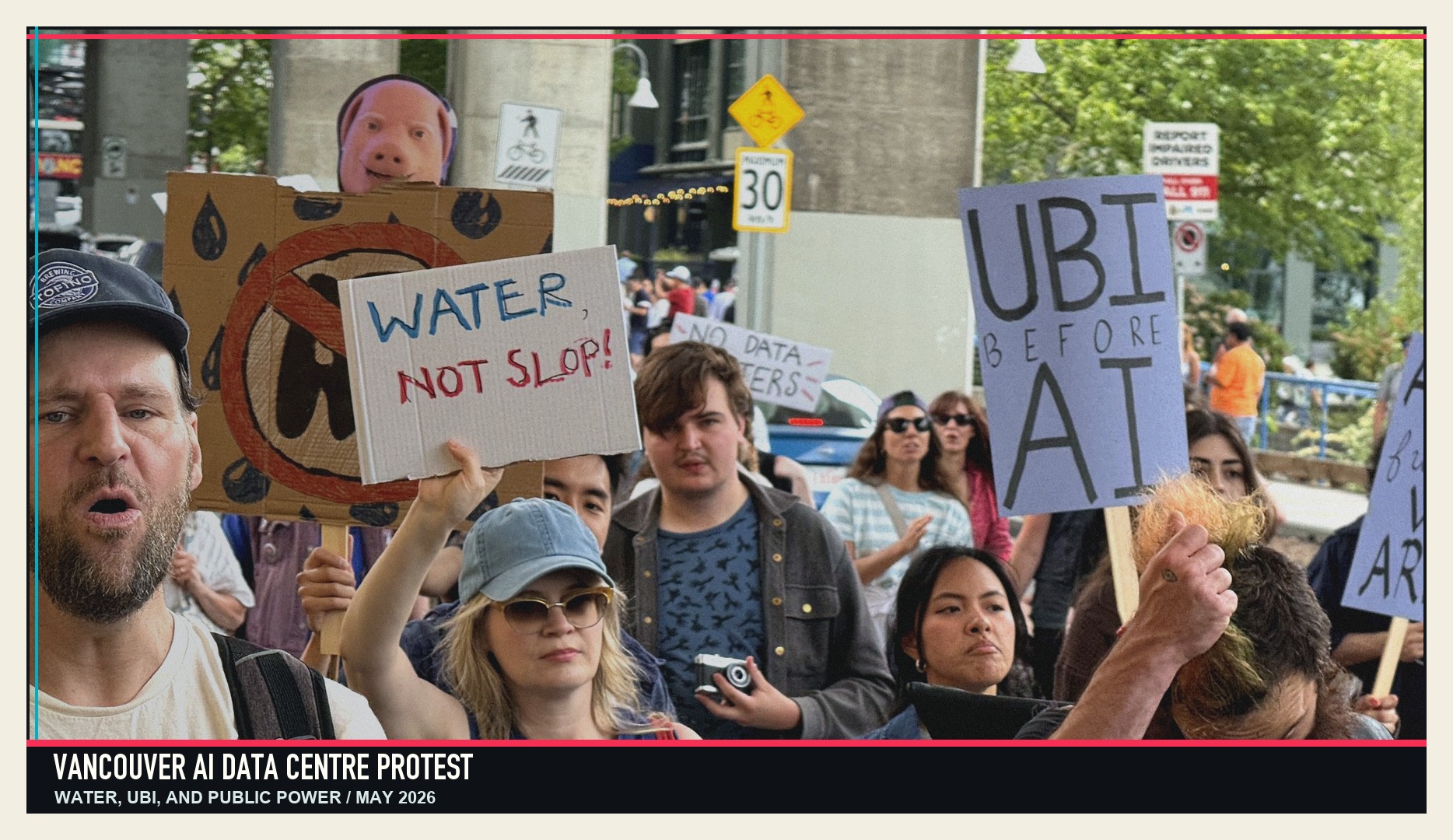
I was not guessing about the streets part. I had been to both demonstrations by the time Mackin and I talked, with another one that weekend and a town hall after it. The Tyee counted roughly 500 people at the first one in late May and about a thousand at the second in June. I saw the COPE people out there and talked to them about it.
Two days later, every party in town had a position
Here is the part I did not expect to be able to prove so fast.
The episode went up August 9. On August 11, Katie Hyslop published a party-by-party scorecard on AI in The Tyee. Seven parties, every one of them required to have an answer.
COPE wants a moratorium on all new AI data centre builds. TEAM backs a municipal moratorium too. OneCity wants a regulatory framework rather than a ban, reviewed through climate, equity and digital rights. The Vancouver Liberals are for Canadian AI sovereignty but against spending Mount Pleasant land on it. Vote Vancouver will take projects that clear a high environmental bar and deliver public benefit. The Greens are still writing their policy. ABC did not respond, and the mayor is on record liking the project.
Take your pick, but you have to pick.
And it is not only data centres. Hyslop asked the same parties about chatbots in schools, and got a second full set of positions: pauses, Copilot rollbacks, AI literacy, delayed chatbot use until Grade 10. Two fronts, one technology, one ballot.
Forty eight hours from “it’s going to be a huge election issue” to a published scorecard is not prophecy. It just means the pressure was already there and the reporters got to it first.

It’s gonna be a vehicle for people to talk about all different visions for the future of Vancouver.
One thing in that coverage stings a little. I am not in it, and neither is anybody from our side of this. The anti-data-centre story and the AI-ecosystem story are running as two separate beats with two separate casts. That gap is the exact thing the meetup exists to close, and August was a reminder that we have not closed it yet.
The disinformation question is the wrong thing to be scared of
Mackin’s follow up was the one everybody asks. Could the technology be used to manipulate or meddle with those same elections?
Sure. It can. And I am less worried about it than most people expect me to be.
Not because it is harmless. Our most vulnerable neighbours wear the cost first, newcomers and elderly people especially, the same folks who have always been targeted. But this is an arms race with a long history. Prank calls, scam calls, robocalls, and now this. They get better at the fake, other people get better detector bots, then somebody gets wilier again. That cycle does not end because we worry harder about it.
What actually helps is literacy. We are going to develop it the way we developed it for every previous version of the con, and the sooner civic conversations treat voters as people capable of learning something, the better this goes.
The thing that scares me is not a bot writing a convincing lie. It is a room where nobody who is angry has bothered to show up.
Both hands full, in a parking lot, on the record
I go to the demonstrations looking for allies. That surprises people on both sides.
Most events in this city sort you before you sit down. Either it is a get on board or get left behind pitch, or it is a shut it down protest. I walk into both rooms and I find the same thing: people who care enough to leave the house on a weeknight. The meetup works because it refuses that sorting. Art, philosophy, business, academia, education, all of it cross disciplinary, all of it in one room. Three hundred members in the BC + AI Ecosystem Association now, and I would guess a thousand more people around them with AI somewhere in the job title.
That is also why I keep saying there is no AI industry to point at. This thing came over and kicked over the table of every single industry. Teachers are working out what it means in a classroom. Our video game and special effects people, the whole Hollywood North apparatus, have already moved to token-based production. That is how they make their assets now. Nobody voted on that either.
So we need a strategy for delivering AI that is clean and green and equitable and just, and that is not mostly about surveillance culture and dual-use defense contracts.
The both hands full position has not moved. You do not have to drop your critique to engage with this moment. You can hold the harm and the possibility at the same time, and honestly you have to, because most of the actually good alternatives to the Silicon Valley playbook come out of resistance movements. Cleaner and greener build-outs. Indigenous owned infrastructure. Data centre cooperatives. Community compute GPU clusters. Those ideas do not come from a keynote stage. They come from people who were mad enough to organize.
The moment needs the people who are the most critical to stay at the table. Otherwise the future just gets made by the hype people and the tech bros.
If you are critical and you have concerns, raise your voice, learn the vocabulary, get in the dialogue. That is the whole ask.
Dave Olson flew in from Okayama to say the quiet part
The reason this episode is worth your 23 minutes is not my election prediction. It is Dave.
Dave Olson has been making things since before most of this industry existed, and he now lives in Okayama, a minor provincial city between Osaka and Hiroshima, in a 150 year old storehouse barn he turned into a mixed media studio. He came back to the planetarium stage thirteen years after the last time he stood on it. He is the reason the meetup has a podcast at all, because he kept asking me to tell him what was going on over here.

Dave has no use for the booster and doomer split. What he has instead is a list.
I don’t need AI to write my poems for me. What I need is I’ve got a list of stuff I need AIs to do.
His list: a 5,600 post WordPress archive to repair, broken links and broken images across every site any of us diligently built in 1995 and 2005 and last year, an endless supply of broken government websites, supply chains, basic civic information, and the janitorial work of a life. Fix things up, then manage the mundane. That is a better product roadmap than most of what I read.
He put the whole argument in one sentence. He wants AI to handle everything else so he has time to make the stories, because making them is, and I am quoting him exactly, the second best part of life.
Then he closed the night with the part I keep thinking about. All of us are sitting on beautiful ideas and beautiful backstories, elementary school report cards and master’s theses that two people read before they went on a shelf. That is the legacy, and it is mostly in shoeboxes.
Don’t waste your tokens. If you got something to make, make it. Don’t just put the leaves in a bucket because the leaves are falling. Maybe the leaves want to stay on the tree.
He said it cleaner in 2008 and somebody sent it back to him this year: fuck stats, make art.
What I would tell you if we were still standing in that parking lot
Do not let the hype on either side stop you from figuring this out. Not the boosters, not the shutdown crowd. Both of them are trying to save you the trouble of thinking, and neither of them is going to be in the room when the thing gets decided.
I have never felt more creative or more productive or more capable than I do right now. That is true. It is also true that the harms are real and I am not turning away from them. Those two facts have to live together, because the alternative is letting somebody else hold both of them for you.
Vancouver votes October 17. The data centre file is sitting with city planners, conveniently out of reach until the day after, and every party in town has now been asked where it stands. That is further than we were in July. The next part is whether the people who actually understand this technology show up to the argument, or leave it to the seven press releases.
Listen to edition 460 at theBreaker.news. Bob Mackin’s newsletter is bobmackin.substack.com, and it is worth your money if you care about who actually runs this province.
The rest of the press file, going back twenty years, lives on the publications page.
Further reading on data centres and AI infrastructure
I have been working this file for months, here and for BC + AI. If you are trying to get up to speed before you vote, start with these.
Here on kriskrug.co:
- You Can’t Drink Data on what these buildings actually consume
- Both Hands Full at the Data Center, the protest signs edition
- Both Hands on the Power Cord on AI, energy, and who gets Canada’s grid
- Canada Doesn’t Need a Bigger AI Machine. It Needs a Better One on consent, climate discipline, and community benefit
- Sovereign AI for Whom?, an open letter about who carries the load
- Canada’s AI for All Strategy, a skeptical guide to the hype and the money
- Keep the Machine Strange on what technological resistance looks like in 2026
- AI Lands Inside Every Profession
Written for BC + AI:
- Both Hands on the Grid on what the data centre protests get right and where governments are getting it wrong
- Rocks, Racks and Rights on critical minerals, data centres, and sovereign compute
- Building Sovereign AI Infrastructure in BC on Indigenous protocol and local systems
- What Kind of AI Province Should BC Build?, five tests for a BC AI economy
- BC’s AI Crossroads on the path the province still has to choose

Listen to edition 460 at theBreaker.news. Bob Mackin’s newsletter is bobmackin.substack.com, and it is worth your money if you care about who actually runs this province.