
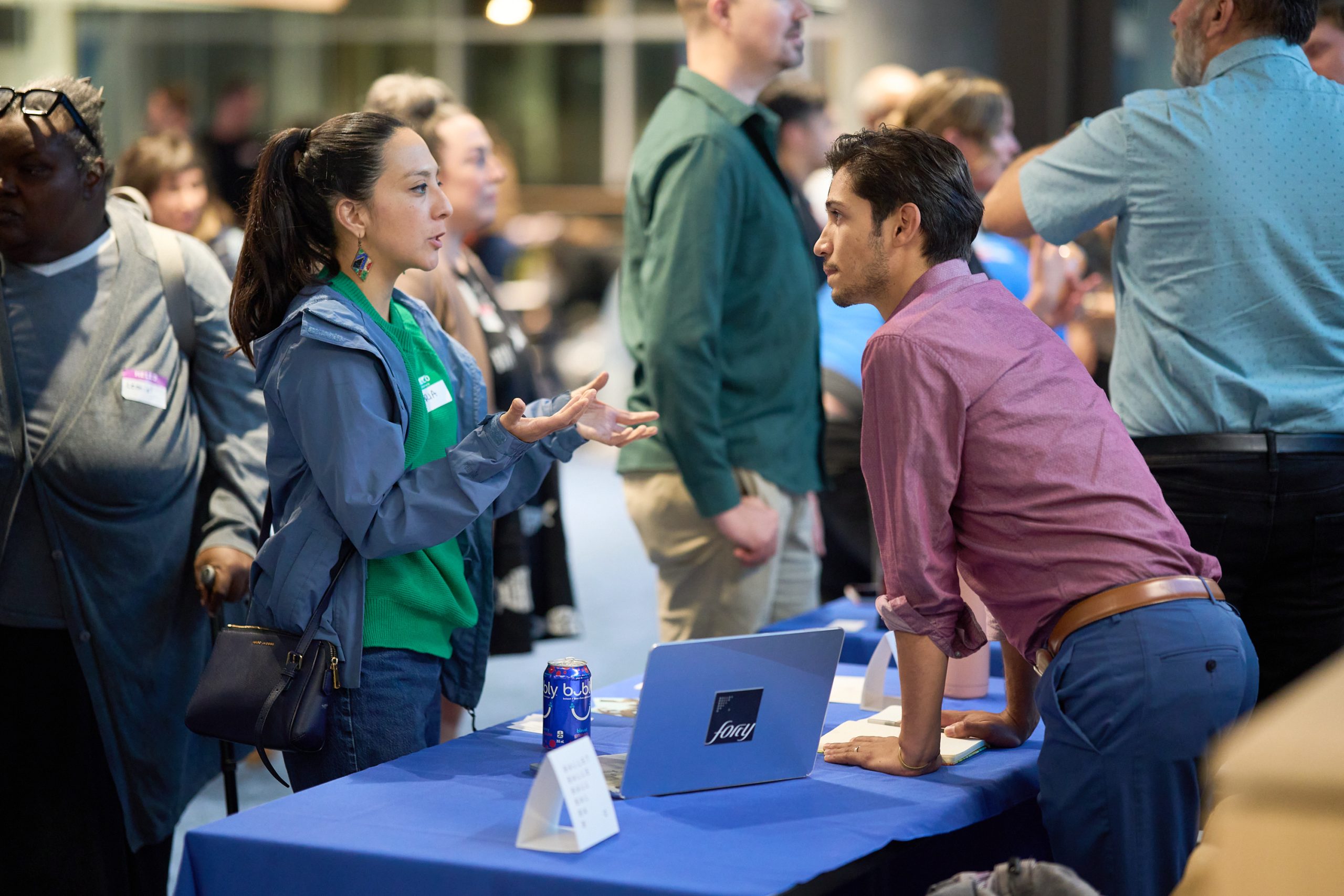
Conversations around the tables at Brands for Better’s How Can We Help? Pitch Night, BCIT Tech Collider, September 8. Photo: Peter Holst.
I keep coming back to the donation bin.
Put one in an apartment building, collect clothes people no longer need, and help fund youth mentorship. Getting it into that building can mean finding the right person, persuading a strata council and following up until someone makes a decision. Useful work can spend a lot of time waiting for a yes.
That was one of the asks at Brands for Better’s How Can We Help? Pitch Night. On September 8, I joined the judging panel at BCIT Tech Collider in Vancouver. Five nonprofits brought the room specific problems we could help them work on.
Our prep asked us to sharpen the requests, pressure-test the plans and make useful connections. I liked that brief. When you run a nonprofit, as we do at BC + AI, money and capacity are part of almost every conversation. Who pays for this? Who has time to do it? How much of the plan depends on somebody continuing to work for free?
Those questions followed us through the night.
Ballet BC and the cost of school arts
Marco Esccer brought Ballet BC’s Moving Schools program. Schools that want dance programming can struggle to afford it. Schools with money can struggle to see why it belongs in the budget.
Marco also named the trap inside subsidized arts education: making a program free can widen access while making the work look less valuable. Both things can happen at once. I want kids encountering dance, and I want the artists bringing it to them paid properly. That should be a pretty fucking reasonable position.

I suggested Ballet BC and school districts look for funding together, earlier in the process. Could they approach a funder as partners, with the need and the program already connected? I also wanted to see more collaborations with festivals and public gatherings, taking dance beyond the people who already know to look for it.
“Partners and collaborations are where it’s at for my organization,” I said.
We spend enough time looking at screens. I’d like more chances to encounter living, breathing artists, with the cost of bringing them there properly accounted for.
Big Brothers and the strata decision
Norman Galimski and Slav Gudelj brought the donation-bin problem from Big Brothers of Greater Vancouver. Their clothing collection operation helps fund youth mentorship. They needed more indoor bins in residential buildings, better routes to strata decision-makers, and help with their database and outreach.

I offered an introduction to Data for Good Vancouver and Gordon Hamilton. People who work with data all day can be enormously useful to an organization trying to make its collection and outreach systems work better.
Mike Rowlands suggested approaching property managers who influence multiple buildings, and a friendly challenge around getting bins placed. That made sense to me. Find someone who can help several decisions happen, and Slav may get to spend less time sending another round of unanswered emails.
There are probably people reading this who already know that property manager.
The Landing and dependable funding
Alison McKenzie spoke for The Landing Youth Centre. Food, mentorship, counselling, learning, adults who keep showing up. Alison wanted corporate partnerships that could help make the funding more dependable.
I understood the appeal. I also had a reservation.
“Corporations are just as fickle with their sponsorships and funding like this as the grants.”

At BC + AI, we’ve been developing earned revenue through memberships, workshops, certifications and events alongside grants and sponsorships. That gives us a little more agency. We can keep working on something we believe in while the funding conversation catches up.
Earned income has its own costs and obligations. Asking a stretched nonprofit to build another revenue stream can amount to assigning its founder a second job. The useful question is what the organization could offer that serves its mission and gives it more control over paying for the work.
Alison also described a commercial kitchen where corporate volunteers could contribute without working directly with the young people. I appreciated that detail. A volunteer opportunity has to fit the care being provided. The organization gets to set those terms.
I offered to go through Vancouver Magazine’s Power 50 list with Alison and look for introductions I could make. Access is something I can share.
Build a Biz Kids and repeatable revenue
Leah Coss brought Build a Biz Kids and a familiar funding example: Girl Guide cookies. A product people recognize and buy, supporting the work of the organization behind it.
Her version includes the Launch Your Business at-home course. Selling entrepreneurship education could help fund the wider charitable programs. Leah needed marketing help, media connections and support getting the offering in front of people.

I encouraged her to keep building the technical capabilities that had helped her get this far. Automation and AI can be useful if they take recurring work off a small crew’s hands. I want to know where the time goes, what the tool actually helps with, and whether the humans get any of that time back.
The language I offered for explaining that capacity to a funder was: “We can make your dollars go farther. We can make our impact go farther.”
Amy Moroni brought the conversation back to compensation. She encouraged Leah to account for the time and energy people put into the organization, including her own. If a financial plan depends on your unpaid work continuing indefinitely, that plan deserves another look. Giving a damn shouldn’t require quietly agreeing to be the cheapest person in the budget.
Take a Hike and corporate connections
Rachael Lipetz brought Take a Hike and three requests: cause marketing expertise, help describing the work in terms corporate decision-makers could use, and warm introductions to potential partners.
Their program brings mental health support and land-based learning into alternative education. The people doing that work also need to explain it to someone deciding where a business puts its money.

I suggested connecting with the impact communications people who work on those corporate conversations, and offered to help make that connection. A good communications person could help Rachael get the work understood and the request in front of someone able to act on it.
By this point, the donation bin, the dance workshop and the course were starting to resemble problems I know from our own work. You can understand your mission perfectly and still need someone else’s skills to keep it going. Getting specific about that need is a form of competence.
The people who made the room useful
Thank you to Karla Peckett and Scot Sustad, Kevin Hayes and the Brands for Better volunteer crew for the preparation and the work of getting us together. Thank you to BCIT for hosting.

And thank you to my fellow judges: Jodi Rai of heyHUMANTIS, Elijah van der Giessen of TechSoup, Amy Moroni of Social Venture Institute at Hollyhock and Mike Rowlands of Junxion and the Canadian Purpose Economy Project. I appreciated the different experience each of you brought to the questions. Mike also shared the Canadian Purpose Economy Project’s resources for businesses working on their social purpose.
Marco, Norman, Slav, Alison, Leah and Rachael: thank you for putting the actual problems in front of us. You gave the room enough detail to be useful. And thank you to Peter Holst for the photographs.
What I’d like us to get better at is the bit after the generous conversation: writing the introduction, doing the piece of work we offered, letting the organization tell us whether it helped. The introductions I offered belong in that follow-through too.
If you see your skills in one of these asks, get in touch with the organization and pick a piece you have time to finish. Give them something they can plan around.